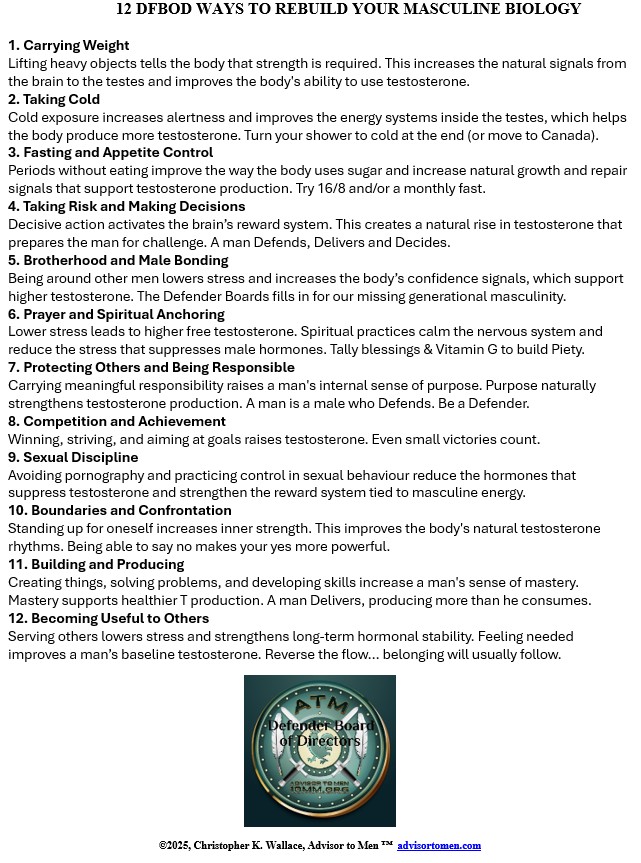
Author: Advisor to Men

Men Without Chests


MEN WITHOUT CHESTS
In 1943, at the height of World War II, C. S. Lewis published The Abolition of Man and issued a prophetic warning. A culture obsessed with being nice, tolerant, and emotionally agreeable, he argued, would not become more humane. Its men would become hollow, manipulable, and ultimately dangerous. He called them “men without chests.”

By this he meant people who still possess intellect and appetite, the head and the belly, but lack the chest, the trained moral instincts making courage, honor, loyalty, and restraint possible.

The chest is not sentimentality. It is disciplined emotion aligned with defensible values. It is the part of a man that allows him to recognize and act in alignment with what is right, even under pressure, without needing permission or consensus.

Lewis’s argument was brutally simple. If you debunk inherited moral law, including the accumulated understanding of right and wrong handed down through civilization, mock tradition, and flatten all values in the name of tolerance, you do not encourage free thinkers.

Instead, you produce people governable by fear and approval, who are easily shaped by bureaucracies, ideologies, and emotionally manipulative personalities, in the absence of an embodied moral structure and the capacity to say no.

These are people who can calculate endlessly, explain everything, and justify anything, but who cannot stand, refuse, or sacrifice. Compassion that is detached from hierarchy and moral training becomes cruelty because values and responsibilities are not interchangeable. Some harms must be tolerated to prevent greater ones, not all suffering is equal, and a culture that rewards weakness while punishing strength produces chaos rather than care.

When nothing is objectively noble, the strongest impulse wins. Safety replaces virtue, comfort replaces truth, and fear becomes the organizing principle of society.

This is exactly the cultural soil that produces Nice Guy Syndrome.

Nice Guy Syndrome
The Nice Guy is more or less polite, accommodating, conflict-avoidant, and morally fluent. He knows the language of empathy and inclusion. He can explain why everyone’s feelings matter. But under pressure, he freezes, appeases, or submits. He has not been trained to contain fear or act in defense of values. Lewis would say he has a head and a belly, but no chest.

Where C.S. Lewis diagnosed the philosophical problem, understanding the predictive brain supplies the missing mechanism. Men do not surrender standards because they have reasoned their way to relativism (no universal right or wrong). Rather, they do so because their nervous systems are governed by dread. Such a man prioritizes safety over meaning, approval over truth, and relief over responsibility. That might be worth reading again.

Let us be clear: this is not first a moral failure. It is a physiological one because we are largely run by our nervous systems, with conscious awareness riding along. George Vaillant noted the integrated nervous system (INS) denies, distorts and represses inner and/or outer reality to lessen anxiety and depression (Wisdom of the Ego, 1995).

Children require a mother, a father, and alloparents (grandparents, aunties, uncles, siblings, neighbours, etc.) to mature properly (Sarah Hrdy, Mother Nature, 1999). While no one emerges from childhood emotionally unscathed, it appears that multiple regulated adults distribute emotional load, model different responses to stress, and prevent over identification with a single nervous system. After all, a child experiences family physically before he experiences it intellectually.

A boy does not grow up under ideas so much as he grows up inside nervous systems. Should he be over-mothered and under-fathered, he is exposed too narrowly and for too long to a single emotional field. Without sufficient paternal containment among a wider circle of adult helpers, the child adapts by orienting toward emotional attunement rather than boundary, action, or risk.

Losing a perfectly-imperfect evolved balance countless millennia in the making means the young male learns to manage emotion rather than confront reality. He becomes sensitive, perceptive, and agreeable, but not grounded or decisive. This is why so many modern men are conflict avoidant yet emotionally fluent. They were trained early to regulate others rather than themselves.

Restoring the Chest
This is also what Robert Bly was pointing to in Iron John (1990) when he said that the boy must leave the mother to become a man. Bly was not attacking women or mothers. He was naming a developmental necessity: male maturity requires generational masculinity.

For most of human history, boys became men in the presence of fathers, grandfathers, uncles, cousins, big brothers, and friends. Masculinity was passed along through proximity, shared labor, and lived example. By watching other as well as older men, young males learned how to bear strain, contain fear, and act under pressure.

That transmission began to break down roughly two centuries ago with the industrial separation of home and work. As men left households for offices, factories, and mines, boys were increasingly raised by mothers, institutions, and abstractions. Masculinity became something explained rather than embodied.

Two hundred years later, Lewis names the result: men educated in moral language but untrained in moral capacity. Without that critical generational transition, the boy remains psychologically oriented toward approval and emotional safety rather than purpose and duty. Unknowingly, at an existential level his nervous system projects and defaults to seeking forms of maternal acceptance across his day-to-day life.

This is why virtue cannot be argued back into men. It must be internalized in the body-mind as experience. Moral language collapses when the nervous system has never been taught to tolerate strain without magnifying it into threat. You cannot reason someone into courage if his body interprets conflict as danger. Neither can you lecture a man into backbone when his physiology equates disapproval with abandonment.

Restoring the chest means training men to regulate fear, tolerate tension, and to act without folding when things go awry.  Until the body is brought back into order, moral appeals will continue to fail, and Lewis’s men without chests will remain easy to govern, easy to manipulate, and unable to say no when it matters most.

It means rebuilding moral instinct through lived practice, not slogans. This is why my framework begins with physiology. A man who cannot calm his body cannot hold a line. From there comes orientation toward higher meaning, accountability with other men, and responsibility through production. Courage is not a personality trait. It is a conditioned capacity, often felt in the chest.

Dark Tetradians
Lewis warned that a civilization that educates clever cowards will eventually be ruled by tyrants or technicians. Not because people are evil (though some are), but because they are untrained. When nothing is worth dying for, everything becomes negotiable, including human dignity.

Paul Bloom identified empathy as biased, parochial, too easily weaponized, and a poor basis for decision-making. (Against Empathy, 2016). Elevating empathy to highest virtue status means the emotionally expressive gain power, boundaries are framed as cruelty, and resistance decried as a lack of compassion.

Perhaps ten percent of human beings are personality disordered. They have always lived among us though tend to show up differently by sex. It is a mistake to say that dark tetrad personalities (Psychopathy, Machiavellianism, Narcissism, Sadism) lack empathy.

What they typically lack is emotional empathy, not cognitive empathy. They are often highly skilled at understanding what others feel, what motivates them, and where they are vulnerable. That understanding is then used instrumentally rather than relationally.

A nice guy (man without chest) is often high in affective empathy and low in boundaries. They feel others’ emotions intensely and mistake that feeling for moral obligation. Dark tetrad personalities, by contrast, understand what others feel, fear, and desire without sharing that emotional burden.

In a culture that elevates empathy while discouraging courage and moral hierarchy, a dangerous asymmetry develops. The empathetic yield when harried, while the manipulative gain leverage.

The dark tetrad personalities use this asymmetry to identify and exploit vulnerability. These types possess sufficient ego defenses to thrive on chaos and more easily rise in prominence… under weakened masculine order which fails to contain their excesses.

With rank-and-file prosocial males disempowered, Lewis’ predictions come true.

I am not rejecting compassion. I am all for restoring its spine. It’s just that compassion without courage collapses into control. The task now is not to make men nicer, but to make them steadier, braver, and capable of defense. That is what it means to rebuild the chest.

For what is a man, if not a defender. When a male refuses to defend it means someone else must step into the breach and defend for him. This is unacceptable.

We need to build Team Human men of character who thrive using power and love in defense of meaning and freedom. Men who can defend, deliver and decide for the good of us all.

Men with chests.

Questions? Comments?

True and Free…
cw

©2026 CHRISTOPHER K WALLACE, Advisor to Men™
all rights reserved.

Join us in building a Defender Destiny by taking this free course.
https://10mm.org/quad-cours*

Find the new ATM Defender App in your favourite app store…


Join the boards by clicking the image ^^

TAILGATING PART 2 CODEBREAKING

CODE BREAKING (TAILGATING part 2)

As I sat in my office, overlooking the very country road where for the first time in my life I pulled over for a tailgater and let them go past, I thought about what had happened over those two days.


I thought again about Osgoode Village, the truck tailgater, my response, the next day sedan tailgater, and how I had pulled over to wish someone well who, only moments before, was a threat.


I thought of where in the body I feel it when such things occur. The racing pulse, shorter breathing, the tight gut and full threat alertness and physiological arousal as the wolf is summoned, just in case. I remembered the ways I might protest and curse at the interloper crowding my back end, the furtive back-and-forth glances at the road and rearview mirror, options running through my mind.


When else had I felt like that? Of course, every time I’d been tailgated, came the answer. And what about earlier than that, I pondered. What’s the earliest I can remember ever feeling this way?


I let that sit for a day or two, moving in and out of my office, hearing the cars whiz by the end of my driveway. I was unhurried, curious, exploring, imagining, seeking only to access an intuitive understanding of why this happens.


About three days later, it came to me:  the earliest time I can remember this kind of arousal was when I was a little boy, say, between age 8 or so and 11, sitting in the living room at my parent’s home watching black & white TV with my eight siblings, and dad would walk in and take his seat.


My dad had his own chair, centrally located in the room, directly opposite the TV. He’d arrive and someone would scramble out of his way, maybe two of us even, so he could take his place and watch with us. It was usually Bonanza, Star Trek, Walt Disney, or cartoons like Bugs Bunny, Elmer Fudd, Donald Duck, and the odd time Superman, Spiderman, and their ilk.


Thinking back to those times I realized that dad’s arrival made me uncomfortable. So much so that in short order, sometimes in five minutes and at other times in ten, I’d make an excuse about having something to do and leave the room. I’d leave Dad and the TV to my brothers and sisters.


Why did I do that? I never even realized I was doing it at the time. The house was run by mom and backed up by dad. With nine kids to look after, ma was tireless and efficient and had little time for anyone stepping out of line. Morality at home was assumed more than it was taught.

And on those occasions where she felt the full weight of her martyrdom, your perceived transgressions fueling the “being taken for granted” caregiver’s dilemma, she summoned her husband as punisher. Mom gave a lot, and sometimes she took a little back.

Over the years of my early life dad had tried various lesser pieces of wood spanking his children and finally settled on a twenty-inch piece of maple hockey stick handle he called “the ruler.” He kept this on top of the kitchen door frame for all to see.

Typically, the progression of his ire was first a look that could kill, then a raised voice that froze you in place, often followed with a slap or a throw across the room, and finally, if he was sufficiently agitated, a spanking with the ruler. I held the family record for number of strikes.

One time a classmate and I were caught tossing a note back and forth in class. It was grade three and our teacher was a nun with the most beautiful face. My friend Jr. sent the first volley with “caca” written on it. I replied with “pipi” and sent it back.

An exchange or two later and, the aerodynamics of folded paper being what they are, my return landed on the desk of another student, the teacher’s pet. To my horror Miss Good-Goody-Two-Shoes promptly read the note and turned it in while pointed me out to the teacher. Since we lived just up the street, I was sent home with a note at lunchtime.


I tried to explain myself to ma, but she spied the envelope I was holding behind my back and demanded to see it. After reading it, all she said was “Wait ‘til your father gets home.”

I knew I was fucked.


That evening, I got the family record: seventy-two full adult swings on my backside while I held on to my bedpost with pants pulled down. After 30 strikes I’d fall to the ground and beg for mercy. “Daddy, no!” I’d say, “I won’t do it again.”  But he’d just reply with “Get up!” and keep hitting me.


My two older brothers listened from the other room and counted the total. It was said I screamed so loudly the neighbours all around us could hear. It wasn’t the first time the old man had yelled at me or hit me, and it wasn’t the last time either.

I’m not writing this to re-live difficult episodes of my early years. Rather, I share these experiences in the hopes others will understand the process I used to address a longstanding shortcoming. Keep in mind this is about tailgating, yes, but much more than that.


It’s enough to say that my nervous system was changed forevermore that day. I was a good kid, no real problems. In fact, I was attending French school as an Anglophone speaker.

Though I understood not a word in grade one, sometime in grade two I had gone to school in the morning ignorant and confused… and come home understanding a new language.

By grade six I was class president.


As I said, the day I got the family record wouldn’t be the last time I was spanked, but it seems that day he beat the emotion out of me. It took many years before I could feel again, at least the way I surmise others might feel in every-day situations.


And so it was that I learned to avoid my father at every turn. My instincts for self preservation honed to a sharp edge, if he showed up, I was out of there as soon as I could. Apparently, he noticed.

Probably when I was eleven or so, my folks tried family therapy at a local mental institution. I remember a session facilitated by two therapists where my father turned his attention to me in and accused me of avoiding him. I was so overwhelmed that I responded angrily and stormed out in tears. They found me later walking down Carling Avenue alone and pulled the car over and let me in.

Not a word was said that I recall. I don’t remember ever going back to therapy either.


Operating System

As I sat in my office remembering all of this, I saw how my physiological arousal while being tailgated dovetailed with the way I felt in the living room of my parent’s home watching TV when dad would come in: people all around, eyes on the TV, on my father, on the TV, on my father, on the TV…


That was it. A perfect match of fact and feelings.

The first time visiting with “Little Chris” years ago required a fair degree of compassion and understanding. Partly that was to make sure I didn’t just scare him off, sending that part of me into hiding again. I talk about this in Sipping Fear Pissing Confidence, my book about addictions.

In my experience, no one survives childhood emotionally unscathed under perfectly imperfect parenting. All of us have a Younger Self wandering the darkened hallways of the psyche, looking, searching, maybe holding a stuffed Teddy Bear and dragging a favourite blanket, looking for belonging. And that part of us always has a story to tell.


So, I asked myself given the circumstances and how I felt, what would I have to believe to make these facts and feelings true. I thought hard about that, re-imagining myself as a boy, barely double digits in age, in that setting with the matching beige pleather couches, every seat taken by someone, the movement of characters on TV, seeing through my eyes as if I were there again…


And it again, the messaging came to me: “I’m in danger. Something bad will happen.”

Looking at the TV, looping, “I’m in danger” and glancing towards dad “Something bad will happen” and at the TV, “I’m in danger” and over my shoulder at dad “Something bad will happen.”


Now, I imagined driving down the road being tailgated and saw that I was unconsciously ruled by these same two declarations. “I’m in danger” looking at the road, and “something bad will happen” while glancing at the rearview, back to the road and “I’m in danger” and to the rearview “Something bad will happen.” These were the irrational beliefs summoning the wolf.

This was a part of my operating system: nervous system coping from decades ago that had been superimposed on tailgaters all that time and had never been updated


It was like using Commodore 64 in a Windows 11 world.

I’d learned to manage that kind of physiological arousal as a child by leaving the room and avoiding my father’s wrath. I couldn’t do that while driving. I was stuck there not feeling safe and expecting something bad would happen. These were the same feelings I had at 8-9-10-11 years old. They were with me still.


Like learning to walk at an early age and doing it automatically ever since, I’d learned the danger of keeping my eyes ahead on a screen while a menace lurked around me outside my control.


It was my nervous system, trained by the body-mind long ago, and on occasions like this, still on autopilot all these years later. It was time to take over the controls and create new concepts my brain could use predictively next time someone decides to follow my vehicle too closely.

Conditioning

I’d experimented that first time with the sedan on my street and it had worked better than expected. What was needed was more opportunities like this to put in place new thoughts, new feelings and new behaviours because the predictive brain is trained by experience. If it learned one way, it could learn another.


I had done this enough times over the years so that I didn’t have to reach out and comfort, reparent, or father my younger self. In my Taming Shame course I teach a few ways of doing this. I did, however, keep him in mind, compassionately, just in case, as I went about watching for the chance to practice giving my brain new concepts to use in the future.


It wasn’t long before a chance came about. On the way to the local supermarket with my daughter one of those little Japanese cars with loud exhaust and a stylish racing wing on the back showed up and was impatiently hurrying me along.


I knew a left turn lane ahead had a right lane go-around for a hundred metres or so.


As soon as I reached that point in the road, I quickly signaled and moved into the slower right lane and let the little sports car pass. While doing so I thought to myself, “Here, allow me,” in highly polite-Canadian fashion.


Off they went, zooming on by and I could see them get stuck behind cars a ways up the road and finally stop at some lights. Meanwhile, daughter and I continued our pleasant conversation before we turned into the grocery store completely unbothered by the tailgater. Such freedom.


The idea is to have new thoughts, new feelings, while engaging in a new behaviour. In my case, in addition to “Here, allow me,” I’d think, “Sure, if you need the road that badly, here it is,” or “You must be in a terrible hurry,” or, “Here you go brother/sister, let me help,” as I pull over and let them pass.


I did a version of this seven or eight times at this initial writing. The emotional activation of when I first notice the tailgater through to the subsequent methods to deal with them has diminished in intensity each time. The rule is if your emotional response doesn’t fit circumstances, an update is in order.


By not rewarding the nervous system with my usual response to tailgaters, the old way of dealing with things will die out completely through behavioural “extinction” simply because it’s no longer being reinforced by the usual O/S behaviours, thoughts and feelings which sustained it.


And the more times I can use my new response to the tailgating situation and not use the old method that plagued me for decades, the more the predictive brain will put in place the new concepts to use in the future.

I am almost looking forward to tailgaters now. Nuts eh?

Sure enough, the day before Christmas Eve (men’s shopping days for sure), I had to travel into town during a snowstorm. On the way back, the roads were full of snow. No way you could see lines demarking lanes and cautious driving was the way to go.

Going through Findlay Creek some dude is six feet from my bumper and honking his horn because I’m driving down the middle of two lanes IN A SNOWSTORM instead of one. So I pull over enough to let him zip by me. I was a little envious of his traction, admittedly, nothing like my Elantra.

At the next lights I rolled up beside him and lowered my window, smiling, gesturing at the road while telling him if he needs to get somewhere I cede the road to him with pleasure. He yelled back thanking me and mentioning that there are two lanes there. I smiled and asked if he noticed THE SNOWSTORM laughing. The light changed. We moved on, him ahead, pulling in a half mile up the road at a used car place. I gave him a short honk politely as I went by. I assume we are friendly now.


That’s how you update your operating system.

©2026 CHRISTOPHER K WALLACE
all rights reserved Advisor to Men™

TAILGATING part 1


TAILGATING (part 1)

Have you ever had an emotional response to a situation that didn’t fit the reality in front of you? Most people assume that means something is “wrong” with them.

The following essay, in two parts, is a true account of where those reactions come from and what it actually takes to change them.


It was two years ago, while driving towards a tiny nearby village here in Ontario, was when the tailgater caught up to me. He was in a pickup, but not your average pickup. No.


You see this truck had been jacked up, a full “Lift Kit” installed, its suspension now high enough to accommodate 45-inch rims and tires. Reminded me a little of the Monster Trucks I took son #1 too when he was just a lad, the kind which always ended with a crash derby.


Driver was a young fella, sunglasses, average size, a little smaller than me though that could have been the truck. I know because I could see him in my rearview mirror, “up there” as he came off River Road and roared up behind me. On the road, just my car and his truck, so why so close?


Then something made him slow, a tractor attempting to cross fields. No sooner had he gotten past that than he ran right up my ass again. He stayed a car length behind me as we drove along at 50 km per hour for another quarter mile into the town of Osgoode.


I could feel the change in my physiology immediately as I went along. When he came up behind me the first time my heart rate went up, clearly, so did my blood pressure, and I surmise my breathing must have changed as well. I track these things so have a modicum of self-awareness.


My focus was now narrowed to the road ahead of me with consistent glances into my rearview mirror to assess the threat. Back and forth, eyes front, eyes back, eyes front, eyes back, all while my body adjusted to a danger imposed on me by this selfish prick driving in a most un-Canadian manner, which is to say, impolitely, even illegally.


My mind wandered onto scenes of mayhem. Of slamming on my brakes, grabbing the railroad spike I keep in the door (to break through windows if we ever find ourselves sinking into a lake or river in winter after sliding off a road), and running back to smash his window, pulling him out of the truck before he can know what’s happening and filling him in on the spot.


Follow this mother fucker! I saw myself telling his battered face.


I was in a Hyundai Elantra, Missus beside me in the front, my two children in the back. And instead, since we were now in town, I decided to pull into the gas station ahead to refuel.


We were out on one of those leisurely Sunday drives and had just checked out the boat launch across River Road. We planned to come back and do a little fishing together as a family.


Today was a scouting trip, a late spring day, sunny, warm, perfect for ice cream. I filled the tank while Missus and kids went into the store. I watched the jacked up pickup truck roll past and go into a driveway, a few doors down from where we were.


As I pumped my gas, I found myself imagining knocking on his door, assessing whether I should go to the front or the side, wondering what kind of dog he’d have, a Pit Bull I reckoned.


In my head I was replaying scenarios where I neutralized the dog and hammered the tailgating punk. I remember shaking my head to clear it but still the images came. Over and over again.


Missus and kids had their ice cream, I passed on the treats, and we got underway. As we drove slowly by his house I looked over and cased the place to match my fantasies.


I saw the disadvantage of the front entrance — up those steps and in full view of anyone on the road or walking by — and assessed the driveway and located the side door as we rolled on by, checking for windows in the house next door, noticing how the rear garage blocked the view of his driveway from houses behind on the next block…


Of course, Missus and the kids had no idea what was on my mind. I’m sure I commented pleasantly enough to fit the moment. “How’s the ice-cream?” I’m sure I said.


Past tailgater’s house we drove and basked in the warmth of each other’s company, slowing to notice the Youth Center where the boy sometimes does Lego club with other kids, and driving past where one of my old energy customers operates a kick ass music studio, and slowly but surely the activated nervous system within me began to subside and return to baseline.


But it was the contrast, you see.

The Wolf

For background, you have a brain, a brain stem, a spinal column that enervates nerves all the way to your extremities for fight or flight, as well as the internal vagus nerve in the body.

Benjamin Libet in the 1980s showed with brain wave studies how neurons near motor areas activate before you are even aware of your decision to move. I remember thinking then that we are run by the nervous system; conscious awareness is along for the ride.

Grant-Gluek study coordinator for many years, George Vaillant, says this integrated nervous system denies, distorts, and represses inner and/or outer reality to lessen anxiety and depression. Also known as the ego, this is the body-mind infrastructure behind the predictive brain.

I’ve long called the more primal “fight, flight, freeze” part of me the “feed, fuck, kill, run, hide” wolf. It was one thing to allow that part of me out of the shadows when I was alone or in need, another for it to show up automatically and take me over like it did while with my family that day.

There’s no getting rid of the wolf; it’s too useful. But like any dog, it needs training.


Truth is, this was not the first episode with tailgating specifically. It had bothered me for a long time; in fact, so long I couldn’t remember when it did not.

I contemplated that a little on the way home. I was sixty-five, and it was likely that tailgating caught my ire for forty or fifty years. Decades of insanity, right there, and always on the edge of full calamity, just waiting to happen.


I thought of the time, the early eighties, when I was in the downtown holding cells and a cop stopped by, saying it was about an incident that occurred during afternoon rush hour the year before. The witness had made himself scarce and so, there would be no charges but since he’d been looking for me, out of curiousity the police officer came by to see what I looked like.

I told him I had no idea what he was referring to. The wisdom of the ego at work…


And that’s what I still had on my mind that fateful late spring day two years ago. I was with my beautiful woman and our precious children, and yet, my whole being was triggered into a personal war zone once again.

Only I am not the same person I was those years ago. I was once the boy my parents made, but slowly and surely I have been able to claim a life as the man I am today from my own experiences.
Oh, the humility gained from all my numerous humiliations, you could say…


I had done much work, attended colleges, universities, learning as much as possible, experiencing what it is to be a good man, giving a shit, practicing breath and self hypnosis while sharing whatever meager talents were bestowed upon me by the heavens while doing my best to make a difference.


It was just that tailgating still got the better of me. It’s the intermittent reinforcement I realized. I don’t get tailgated often enough and so, my response survives unattended and intact. Each episode creates a deep learning groove in answer to some calling from the darkness of my psyche.


I thought of that all the way home, the length of time occupied by this problem of mine, the way in which it failed to subside despite the years. Other than a direct threat to me or to a member of my family or good friends, tailgaters possessed an on-switch, a sure way to activate my wolf.


I knew that despite my thorough analysis and overhaul of my various responses to life this one remained. I had unfinished business with my psyche and, it was time.

________________

I had this in mind the next day, as it just so happens, I found myself once again driving with Missus and our two children. Only this time, we’d taken a rare trip to a local country store together. I say a rare trip only because, while the kids’ and I go there regularly, Missus rarely does.


Only this day I turned off one rural road and onto my street only to find the sedan following us turned with us and began to tailgate me immediately.


For less than a quarter of a mile I contemplated what to do about this, my eyes flitting from the road ahead to the rearview mirror and back again while my physiology went into its predictable response. When I got past the first few houses but well before arriving at the crest of a hill, I decided to signal suddenly and pull over quickly to let the prick pass us. I’d never tried that before.


This he did, and I watched at him going by. Each giving the other some kind of look. He was fifty or so, balding with short hair at the sides, an angular face, stern looking, but a small man and a clearly nervous man. Another one.


As he looked at me and I looked at him, I saw only indifference on his face; I don’t care what he saw on mine. He was hunched over his steering wheel, looking agitated, and it seemed to me, driving like an anxious woman. Drive as much as I have and you too will learn to spot the type.


With no other cars around I pulled back in behind him, and I watched him race down the road. When I crested the hill I could see how he’d caught up with vehicles farther ahead and tailgated them, his brake lights flashing on and off in the distance as he attempted to hurry them along.


But instead of thinking poorly of him, I speculated that he may have had a legit reason for hurrying like he was. Maybe his mother was dying in hospital and he had minutes to get there. Maybe one of his children was sick and he was racing to bring them medicine. Perhaps he was late for work and had been warned that “one more time and your fired,” something that would ruin his family.


What allowed me to think this way was that I had pulled over and ceded the road to him. And as soon as I did, the war-like mentality pulled over too. Pulling over meant caging the wolf.


Universal Love

Instead, it allowed me to use an old trick I picked up over the years to remain sane during rush hours in various cities while running sales teams out of a fifteen-passenger van.


I sent that fucker “universal love.” That’s when you know love exists in the world and is all around at any given time. The trick is to gather up some of that energy and internalize it, breathing it fully so we are filled with love, with universal love.


Then, like those cartoon characters on Saturday morning TV, send off that love energy through the fingertips of my hands towards the intended. I looked at my tailgater’s vehicle and thought to myself, “I send you love mother fucker” and I may have even gestured a little with the fingers of my hands through the front windshield while holding the steering wheel.


As I sent him love, the possibilities, the dying mother, the sick child, the losing his much-needed job, all these potentials manifested as flashed images before me.


Truth is that I have no idea why he was tailgating me, and that’s the promise of it, isn’t it? By sending him love I was using an incompatible behaviour to soothe my agitation because you cannot remain pissed at someone to whom you are also sending love.

See how that works?

Powerful, true and free
cw

©2026 CHRISTOPHER K WALLACE  Advisor to Men™

WOW EFFECT


WOW EFFECT

Nothing brings things to the fore emotionally between couples like being rejected in the bedroom. You can’t hide who you are when you are in your birthday suit. What you see is what you get.

Getting naked with someone takes risk, especially in the beginning, but also trust if you are going to keep doing it.

Without trust, you have nothing.

Males of the western world (and much of the rest of the planet) have lost the generational masculinity so necessary to their maturational development. (read that again)

Males have a large group bias, solve problems using technological advances, and are practical collaborators who stand shoulder to shoulder with other men to build cultures.

Over two world wars, the plague, the nuclear era and the communist threat, and consequential changes in families, Team Human was deprioritized and the result is over-mothered and under-fathered boys who grow up under the “wow effect.”

Let me explain: If a guy robs a bank one day, and a woman robs the same bank identically the next week, and both are caught, you can bet she’s getting a lesser sentence. That’s the “women are wonderful” effect and it’s real and everywhere

Let me add that at their best women are truly wonderful, but so are men when they are at their best too. WONDERFUL

If you have been in therapy a long time and still struggle, good chance you are involved in a form of Socratic questioning circle jerk. I don’t fault the industry I am part of but it’s the nature of the beast. Most therapists, most male therapists, were over-mothered in the same way as you probably were.

Female therapists are maternal by nature. So let me ask you: can you truly say you understand what it’s like to menstruate? No you cannot. And, similarly, she don’t get male weakness. At all…

It’s the blind leading the blind as they say. There are exceptions, bless them, and they don’t disprove the rule.

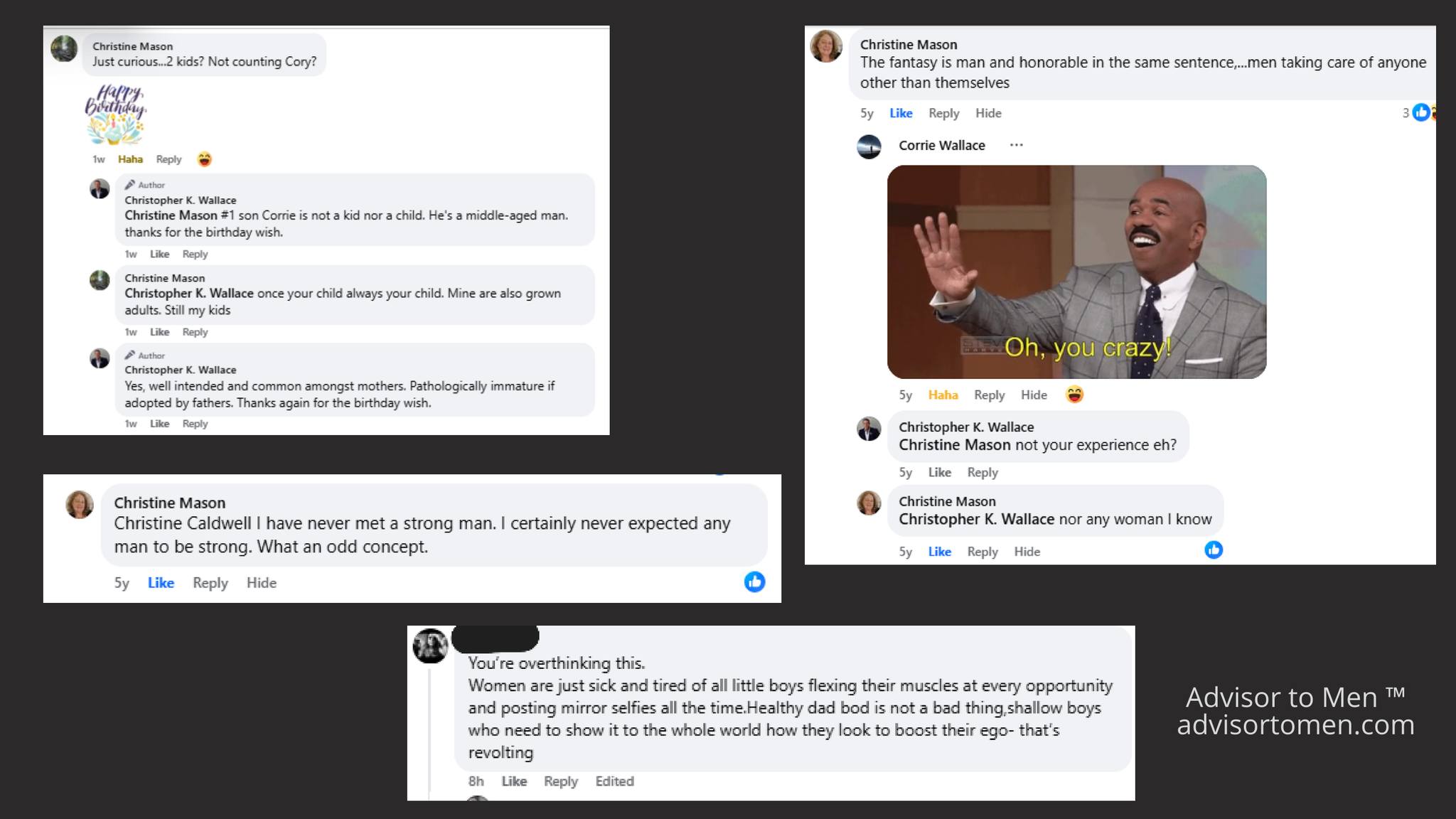
Have a look at my friend Christine’s comments wishing me happy birthday last week. She couldn’t bring herself to write the words herself but called me out for not mentioning all three of my children and when I asked her what she meant, this was her answer.

I found a couple more snips of complaints she’s made over the years about men. You can bet she doesn’t see the connection.

Lastly there is an answer from Justine on a friend’s wall about a dad bods post. People thinks she’s refuting the dad bod post but she’s not. She’s complaining about weak men. Like Christine.

That’s what they all complain about. All over the fucking world women at once create weak men and then complain about weak men once they reach adulthood. I hear it EVERY DAY.

So are women to blame? NO. They are being women.

It’s the generational masculinity that men have allowed to be pulled out from under boys that’s missing.

No one is coming to rescue you from this. Not a therapist, not your one male friend, not your mama or your wife or your GF.

It’s only by supporting generational masculinity as taught in the Defender Board of Directors that you will finally ascend to your rightful position as a powerful defender of life.

Failing this, your expendability means less or no pussy.

Because that’s how Team Human works.

Questions? Comments?

Merry Christmas!

True and free…
cw

ATM DEFENDER APP INTRO

One of the things that struck me as I grew into middle age was that no one ever told me it was up to me to create order. Seems obvious maybe.

I had to run into the order versus chaos dichotomy from sheer ignorance borne from curiousity.

Meaning, it’s a damn good thing I like to read.

I suppose it’s also because I’d learned to be a manager in that purest of sales endeavours, the door-to-door crew business.

I’d hustled jobs and extra money as soon as I hit double digits in age and benefitted from my buddy and neighbour Graydon’s work ethic, but working doors over the years taught me plenty more.

When it comes to setting goals and making steady progress, what I see is that most guys have good intentions, often better than mine, but often fail to systematize their efforts to win.

Or they are blocked somehow.

Though women are usually exceptional organizers, order is key if we are to keep the forces of decay from overwhelming us. That’s very much a male responsibility.

I fling dumbbells around to keep grip strength and have done wall sits while brushing my teeth for decades to protect my knees. I used Day Timer’s system to organize my priorities in college (and still do to some extent).

From this attitude the quadrant system was born.


DAILY QUAD TRACKING
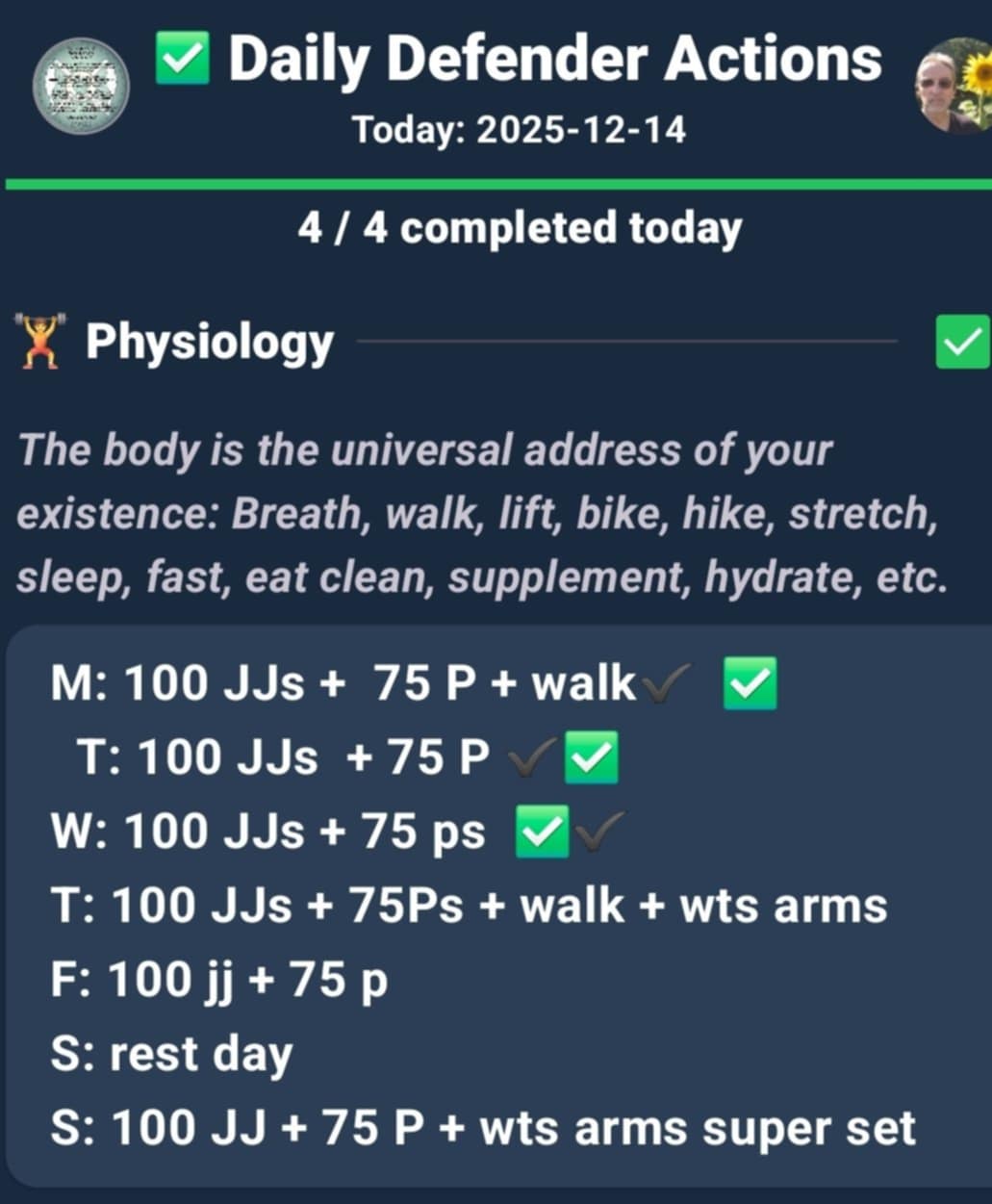
I like to add day of week (M,T,W, etc.) and put something in daily under each quadrant. Here I was with a pulled abdominal muscle but checked off 100 Jumping Jacks and 75 Pushups daily just the same. Tracking did that.

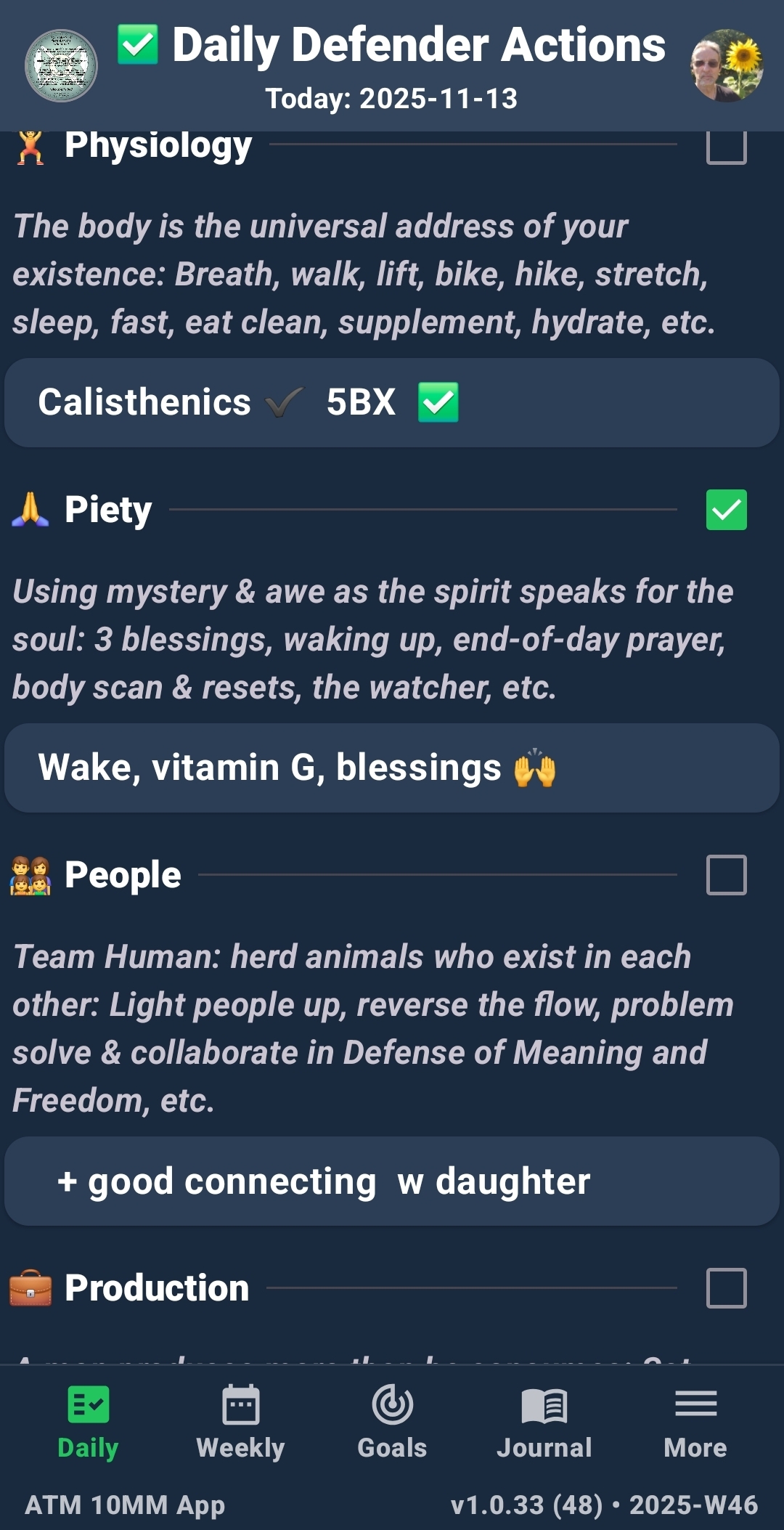
The quadrant system exists to organize daily actions across physiology, piety, people, and production, so that effort can be observed over time. It’s the daily actions, you see.

Like the way I’ve made my bed each morning for decades to “put order into my world.”

Like how I say psalm 118:24 to myself first thing when I pull the window curtain open in my room.

Even as a comfortable agnostic, these set my intentions for the day. It’s the rituals then.

These lessen anxiety, build resilience, form character, and often help with belonging.

For example ma went to church her whole life. Dad didn’t.

I asked him about it in his eighties, and he said he’d wished he’d attended.

Felt he’d missed out on the community.


Some psychologists liken us to herd animals, and tell of how the emotional system is governed by belonging.
The beautiful part of belonging is shared causes, and how as men stand shoulder to shoulder with each other they can accomplish just about anything.

And so, retired engineer and Defender Board member Gary took our stuff and built the Defender App for the benefit of all men. Gary is an amazing guy…

The Defender App supports the quadrant system by providing a stable place to record daily activity and revisit that record later.

Writing actions down creates a reference point that persists beyond mood, fatigue, or temporary self-assessment.

It’s also an app like none other.

WEEKLY CHECK IN 
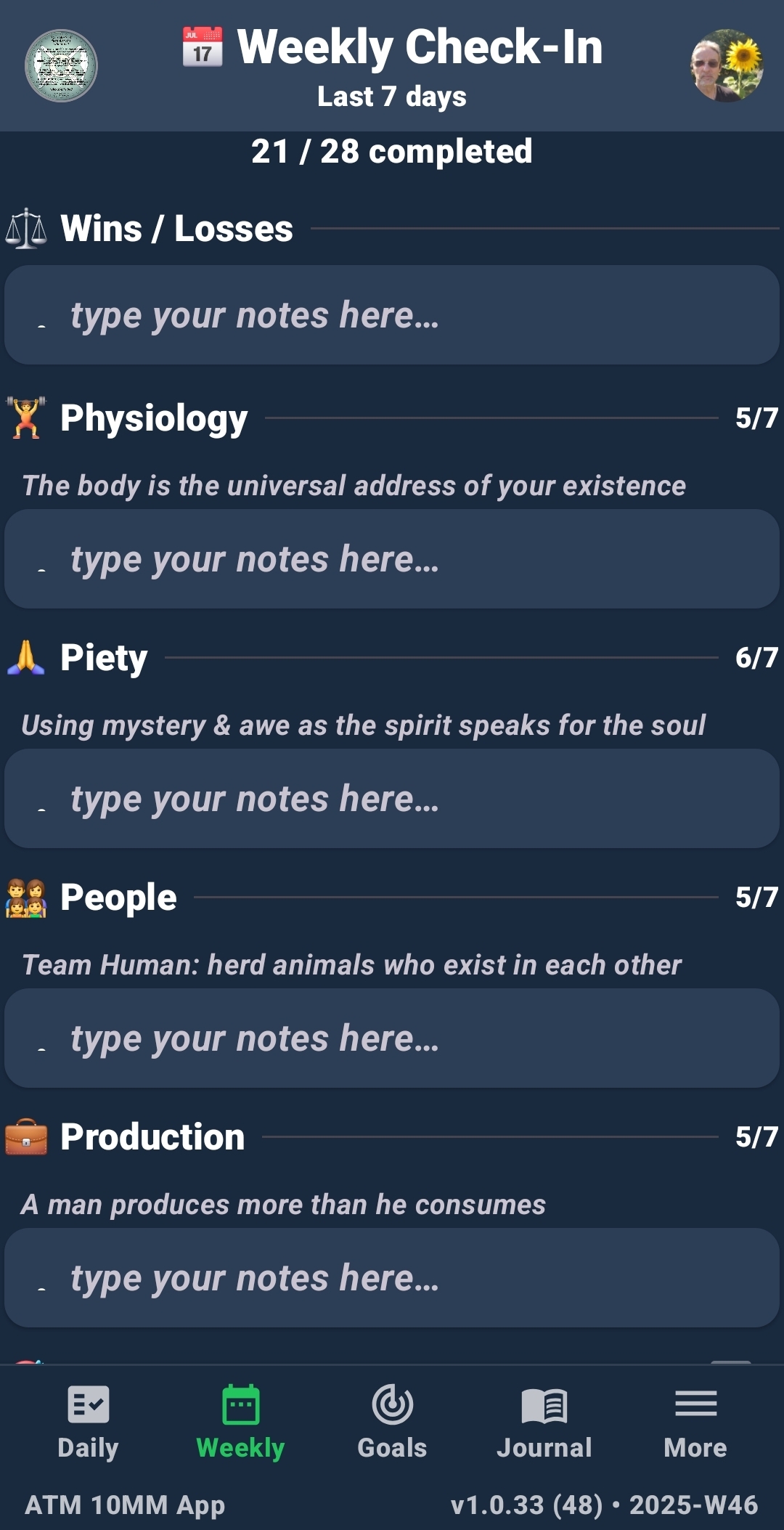
It contains daily quadrant tracking and a weekly quadrant summarizing page.

It has place for a daily “to do” list and leaves room for a “one thing” to get done as this week’s priority.

Taking 15 minutes to review daily activity at the end of the week is really helpful, failing which I would need to assess how committed I am to progress in managing my life.

I like to review my daily activity and summarize them in a weekly “after action review” exercise every Sunday.

GOAL SETTING
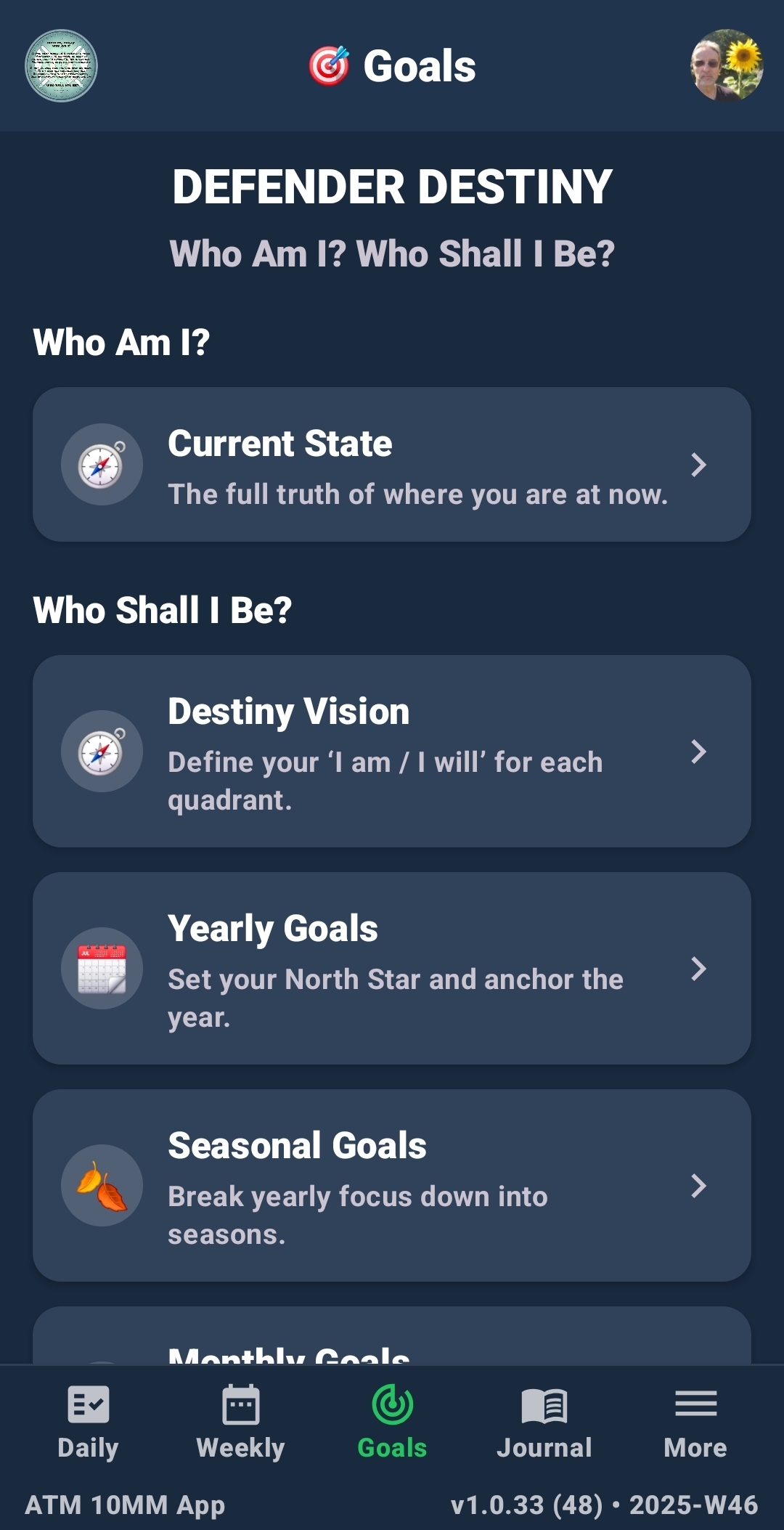
Goal setting starts with a no-BS present time self assessment in each quadrant then it asks that you create goals in each for the next month, season, and year.

Firstly, it invites you to claim your identity by creating a Destiny Vision for each quadrant. Combined these make up a kind of deliberate masculine destiny path to follow.

This is critical for men.


We left room in seasonal and yearly goals to enter various levels of goals in each quadrant.

For example you can input a manageable goal, a slightly more challenging goal, a top end goal and a downright impossible or dream goal.

Having this stare you in the face each day helps you to decide what kind of man you want to be.

Ask: why be average when you can be amazing?

PRIVACY
In developing the app we thought about building an interface so you could also access your data on a desktop or laptop. I’ll tell you why we didn’t. We want your stuff to be fully private.

Besides, all of the goals and journaling entries can be saved to the journal section on the app itself or shared by email as a text file to keep in a file off the phone app itself.

Even though no one has time to look at your stuff, we didn’t even want the ability under any circumstance.

GETTING UNSTUCK 
A big reason for this is not just quadrant tracking and goal setting, but also the journaling functions which contain some of my best proprietary journaling techniques.

I refer to these as the “T Journals” as each can be described with a word beginning with T.

For example:

Option one is the open “free flow” journaling where you can enter whatever is on your mind. This is an important exercise where you can dump thoughts and feelings to find clarity.

Hence, “Talk Journaling”

Gratitude journaling encourages you to write at different intervals about whatever it is you have to be thankful for, a practice with profound effects on mental health in the way it reduces stress and depression, builds resilience, improves sleep, and enhances life satisfaction.

Hence, “Thanks! Journaling

The blessings exercise follows that same idea and invites you to find three things that went well today, why those are important, and how to get more. I even get my kids to do this one.

Hence, “Tally! Journaling”

Caging the wolf will be familiar to those who have read Sipping Fear Pissing Confidence and has to do with refuting the “feed, fuck, kill, run, hide” lower order nervous system at play in addictions and general fear seeking. Instead, build your better character while claiming an identity you can be proud of.
A man must defend his confidence at all costs, I say.

Hence, “Temptation Journaling”

The 10R process is found in The Taming Shame course and has to do with identifying negative feelings but which may not fit the circumstances directly. These often signal an emotional trailhead of sorts. 10R provides a map so you can update your internal operating system.

Hence, “Trigger Journaling”

Lastly, the self care writing exercise is included so a man has a way of dealing with old wounds that might still be affecting his approach to life. This is the exact process I used to get past being beaten as a child, You may or may not make use of this deeper work, but it is there if needed.

Hence, “Trauma Journaling”

All of these can be saved into your personal journal library. The information stays on your phone where no one else can see. You can also send files to yourself.

I find that option particularly helpful when reviewing entries about temptation, being triggered, or about old traumatic events.

So, there you have it.
Daily tracking, weekly progress, goal setting based in facts and not in fiction and that build character and identity, as well as the most comprehensive journaling options possible.

The beauty of the system is if reluctance or inactivity interferes with intention it usually means there is work to do emotionally to resolve whatever is blocking a man’s progress. Combined, the various journaling options is like having an Advisor to Men™ in your pocket. Say what??

THE DEFENDER BOARD OF DIRECTORS
Ideally, you want a squad of men to whom you can turn to for feedback, like what we’ve created in The Defender Boards. The Defender App makes the whole process more efficient, and it’s gamification makes it fun too.


You have no doubt heard that what gets measured gets managed.

Life simplifies immensely with daily tracking because of its measurable progress.

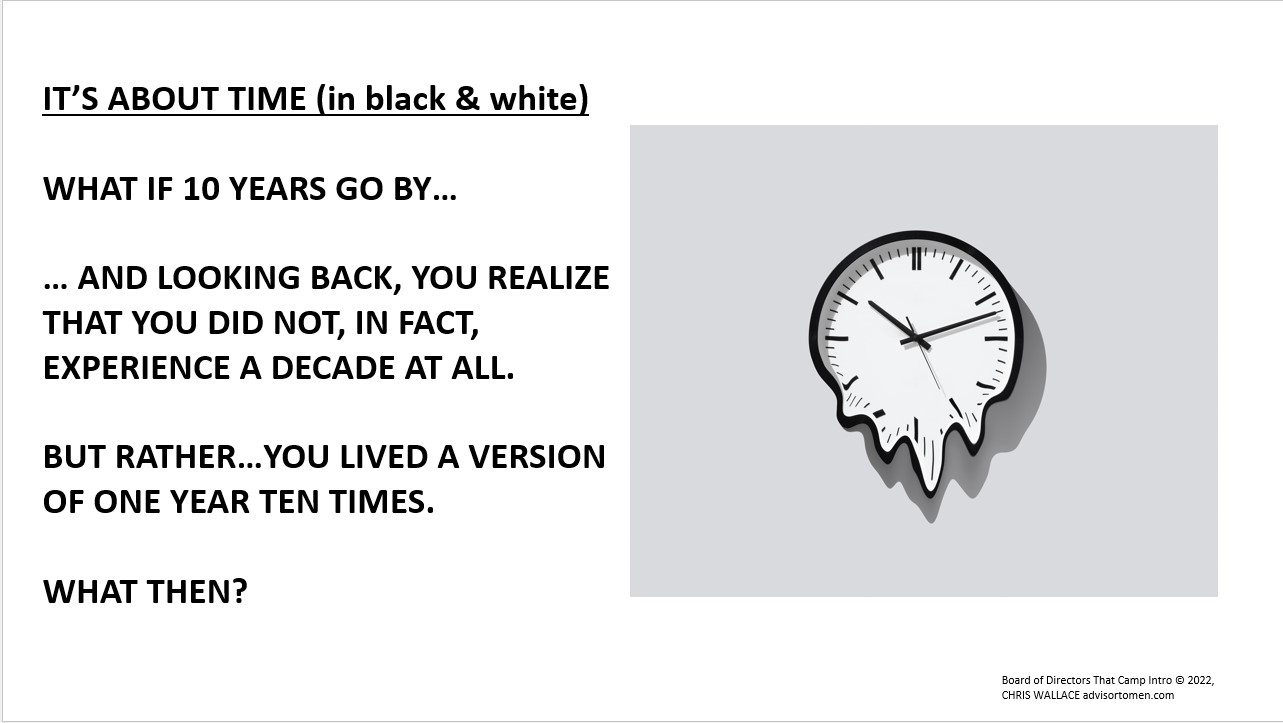
The alternative might mean ten years go by only for a man to realize he did not, in fact, live a decade (or two), rather he lived a version of one year ten times.

Don’t be that man.

Set some goals, track your progress, defend your life.

Be an amazing guy…

Take the quad course, get the app, join the boards

Stay powerful, true and free…
cw

Don’t wait, get started today…

 Join us in building a Defender Destiny by taking this free course.
https://10mm.org/quad-courseVideo version of above: Defender App Intro video Dec,2025
https://youtu.be/4MhnQQWbuoo
🛡️ The Defender Board of Directors meets weekly in squads, daily in chat…
👉 Join here https://10mm.org/membership 
*Note Defender Board members get the Pro version of the app included.
Ask me for my special link to get in the board at less than the usual monthly app rate so you get both for less…

INNER WOMAN: INDIVIDUATION & THE ANIMA

The Four Faces of Her… Within You
Individuation, the Anima, and the Way Forward

Most men I work with are stuck. They are not broken. They are not weak. But they are stuck. Not because they lack willpower. Not because they do not want to grow. But because something inside is unfinished. In Jungian psychology, that unfinished business is often the anima.

My first psychology teacher, a Gestaltist, introduced me to this idea of leftover stuff, with its best practitioner Fritz Perls calling it a “gunnysack of anger” carried over the shoulder wherever you go.

Holy fuck did I carry a load! Maybe you do too… I felt the burden and I realized then and there I had plenty of work to do. I learned to let go of that weight over time.

Through my studies in Behavioural Science, in short order I was introduced to the archetypal psychology of Carl Jung.

Jung’s analytical psych mentions Individuation as the psychological process of integrating the conscious and unconscious parts of the self to become a whole, unique individual. This is integration at its simplest. It involves confronting and balancing inner archetypes, like the anima, to achieve personal growth and self-realization.

The work we do in the Taming Shame course using the Younger Self 10R process is all about understanding the unconscious motivations that drive us. Constructed emotion and the predictive brain alongside my behavioural training mesh well with this approach.

Look, I could go on and on about this stuff but I’ll stop here. THE WORK is about updating your operating system. I call it “using a Commodore 64 operating system in a Windows 11 world.” You may be old enough to get that reference.

Jung describes the anima as the unconscious feminine side of a man’s psyche, representing emotions, intuition, and relational qualities. It influences how he perceives and connects with women and his inner self, evolving through stages from Eve to Sophia as he matures (explained forthwith).

So the anima is the inner image of the feminine that every man carries. She is not a fantasy. She is not a wish. She is the psychic counterpart to your masculine soul.

If she is not integrated, she will distort your relationships. She will lure you into chaos or make you retreat into passivity.

If she is integrated, she becomes your guide to wisdom, purpose, and love.

Individuation means reconciling the parts of your psyche that have been split apart. It is not a goal you check off a list. It is a lifelong process of becoming whole.

One major part of that process is how your inner woman matures. Jung described four stages of anima development: Eve, Helen, Mary, and Sophia.

You will recognize yourself in one or more of these…


Eve is the mother. At this stage, a man seeks care, unconditional acceptance, and emotional security. Many men who were abandoned or smothered by their mothers are stuck here. They do not desire a partner. They desire to be soothed. Often, this leads to addiction, dependency, or an inability to lead.


Helen is the lover. Here, a man is captivated by beauty, youth, and sensual energy. He becomes driven by attraction. He judges women based on looks. He chases validation from women instead of leading them. He fears aging because his anima is still adolescent. This man can be charming but is often insecure.


Mary is the virtuous woman. This phase is marked by a desire for devotion and meaning. The man begins to look for a woman of character. He may idealize goodness. He starts to ask questions like, “What is a good life?” and “What kind of man should I be?” His anima is maturing, and his heart begins
to serve something beyond pleasure.


Sophia is wisdom. She is not beautiful in the youthful sense. She is radiant in the eternal sense. A man at this stage no longer projects fantasy onto women. He sees them as they are. He respects them, but he is no longer ruled by them. His inner feminine now guides him toward truth, meaning, and deep alignment with life.

Most men I see are stuck in Eve or Helen.
They are either looking for a woman to mother them or a woman to turn them on.

And get this: They rarely recognize that what they are seeking is already inside them.

That is the purpose of individuation. Not to find the perfect woman. But to become the integrated man.

You cannot skip these stages. But you can stop getting stuck or bouncing around from one to the other.
Your anima will grow with you if you let her.

It is only with the anima that a man blesses others with his King energy. That’s how it works.

Start by asking yourself honestly: Who am I really drawn to, and why? What do I want from women? What do I fear they might see in me? What kind of woman do I want beside me when I am dying?

Let her grow. And you will grow too. Reverse the flow…

If this stirred something in you, share it. Join the Defender Boards. Learn what it means to walk shoulder to shoulder with men committed to becoming whole.

Stay powerful, true and free…
cw

WHAT DO YOU WANT?

WHAT DO YOU WANT?
(Reverse The Flow book chapter)

Let’s start with the question that cracks open everything else:

What do you want?

It sounds simple. But it isn’t.

Most men never really ask it straight. We go through life doing what is expected, what’s easy, what pays. We take jobs, follow rules, get degrees, sign papers, and pay bills.

When you were less than two years of age, you gave none of this any concern.

You were pure raw being, arriving just the way the heavens intended: perfectly imperfect.

All exploration, curiousity, creativity and intuition and imagination. Then, you learned your first word within your first three months (usually dada) and everyone was overjoyed at this milestone.

You were tickled and smiled at and cooed upon for speaking on command.


Only, as your language understanding increased, your caregiver’s demands rose along with it.

Soon you were being directed at every turn. How to use the potty, how to eat, how to play, how to sleep, what to say and to whom. This is the great after-build, the “souping up” of your intellectual and emotional and behavioural engine.

You learned to tow the line, under what Carl Jung called “the conforming ego.” Why ego? The integrated nervous system is those 86 billion nerves of the brain and another 500 million in the body. These combine to run the system, denying, distorting, repressing inner and/or outer reality to lessen anxiety and depression.


Language thickened the corpus callosum, the bundle of nerves between your two hemispheres.

Language altered a part of the prefrontal cortex (Broca’s area), to get better at processing speech and understanding what others might be thinking while also improving your verbal memory and speech processing.

Possibly to make room, language shifted primary facial recognition to the right hemisphere, whereas humans usually use both. It also made you more analytical, and judgmental.

We learn to judge people and circumstances, but most of all ourselves. We learn to see ourselves through the eyes of others, our caregiver’s nervous system responses echoing in our own.


But deep down, in the quiet of a sleepless night or at the edge of a campfire’s glow, the question returns like an echo: What do you want?

Not what your boss wants.

Not what your parents hoped for.

Not what your partner nags about.

Not what the world says you should want.


What do you want?


The First Roadblock: We’ve Forgotten How to Want

As boys, we wanted things with fire in our bellies—dinosaurs, rocket ships, to be a knight, a builder, a pirate, a protector, a HERO.

But something happened. We got civilized. We got shamed. Guilted. Punished. Corrected.

We got scared. We were told to sit still, stop daydreaming, play safe, aim small. CONFORM!


So, we buried the wanting. Buried it under school, work, sports, porn, weed, debt, devices, and silence. But just because we buried it doesn’t mean it died.

It’s still alive—under the surface—like coals waiting for air.


This is your wake-up.

Let’s fan the flame.


History: Your Long Line of Wanting Men

Back in the day, almost every woman got pregnant —  “even retarded girls,” according to emeritus psychologist Roy Baumeister, PhD.

But probably only half the men fathered children.

Think about it, outside the odd “sneaky fucker,” most men had to be capable enough to protect a family, deliver sustenance, and make good decisions for them all, especially when she’s “in a family way.”  100 years ago, infectious disease caused 50% infant mortality. Survivors were miracles.

You come from this diverse maternity and discerning paternity to stand for Team Human.

Defend, Deliver, Decide.

You come from men who wanted something.

They braved oceans, fought wars, carved farms out of wilderness, built homes with their hands, protected kin, raised their sons with discipline and dreams. These weren’t passive men. They weren’t “going with the flow.” They wanted something—and they moved toward it with grit.


Don’t buy the lie that your history is shameful or worthless. That’s the poison of a confused culture that’s afraid of strong men.

Let me explain this further. Women carry double or more the negative emotion than do men. In a feminized culture, almost all the news is bad. Do not take it personally.

Your lineage isn’t perfect, but it’s powerful in its mystery. Let it fill you with awe. You stand on the shoulders of men who wanted more than survival. They wanted legacy.

So should you.


Talent: What Comes Naturally

Every man is wired for something. Some build, some fix, some speak, some hunt, some lead. You have natural instincts—clues to your talent.

The modern world confuses this by trying to make every man a cog in a machine. School trims the edges. Work dulls the shine. But your real work comes from your talent.


Start paying attention again. Watch for these clues…

What do you do with ease that others struggle to do?

What do others always ask your help with?

What fascinates you?

When have you thought, “I bet I could do that?”

What gives you satisfaction?

What puts you in “the zone?”


You weren’t made generic. You’re meant to contribute in a way only you can.
There has never been another you, there will never be another, you are a one-of-a-kind human.


Values: What You Stand For

A man without values is just a leaf in the wind—blown around by every trend, woman, government, or guilt trip.

Your values are your inner compass. They are the ideas you give a shit about.


Do you value truth? Freedom? Brotherhood? Loyalty? Strength? Order? Adventure?

If you don’t know—decide now. Write them down. No more drifting.


What you want must be anchored to what you value. Otherwise, your wants will become addictions, distractions, or traps.


Experience: The Lessons That Scar and Shape

You’ve been through things.

Loss. Betrayal. Hard days. Easy days. Joy. Frustration. Maybe divorce. Addiction. Failure. Being broke. Being lied to. Being unsure. Being hurt, or maybe even being saved.

Every scar is a teacher.


Don’t waste your pain. Mine it for wisdom. Let it show you what matters. What you don’t want. What must never happen again. That’s how experience guides you toward what you do want.


Remember this wisdom from my teacher when she told me, “Everyone makes the best decisions for themselves at the time. If you could have made a better one, you would have.”

Hindsight is an unreliable window through which to fairly view what has already happened. After all, any coward can judge history.

The better man accepts the past and is determined to learn from it.


If you ignore your past, you repeat it. If you learn from it, you become a dangerous man—in the best way.

Make your suffering pay. Always.


Dreams & Imagination: Practice for the Future

You’re allowed to dream. In fact, if you’re not dreaming, you’re already dying.

Men imagine solutions. We see a broken fence and picture it rebuilt. We see a better way to teach, lead, coach, love. The problem is, we stop trusting our imagination. We call it “childish” or “stupid.” We get embarrassed as we imagine how other’s judge us. There’s that “others” again.


But that picture in your mind of the better life—the one where you walk taller, sleep deeply, lead with strength—that’s not fantasy. That’s your inner man calling you forward.


Einstein said this: “Imagination is more important than knowledge. For knowledge is limited to all we know now and understand, while imagination embraces the entire world, and all there will ever be to know and understand.”

The world needs imaginative men. Imaginative Team Human men.

He also said, “The intuitive mind is a sacred gift, and the rational mind is a faithful servant. We have created a society that honours the servant and forgotten the gift.”

Einstein died a couple of years before I was born but already calling us out. Can you see how? Look at this summary from a man whose life was dedicated to chronicling what we have done:

Sam Francis argues that the modern bureaucratic state, which he terms “Leviathan,” (book title) seeks to consolidate power by undermining traditional societal structures, localism, and cultural heritage. This “managerial elite” class, made up of state bureaucrats and corporate leaders, uses government influence, media, and cultural narratives to maintain control. Francis suggests that this elite system’s aim is not only to govern but to reshape society in ways that undermine historical identities, communities, and personal freedoms.

In hindsight, perhaps we should have kept retail closed on Sundays…


Imagination is the workshop of your masculine destiny.


Curiosity: The Engine of Change

Curiosity is holy. It’s what built fire, forged steel, split atoms, mapped oceans, landed men on the moon. It was present in you in your early years, where is it now?

You’re meant to ask questions.

“Why do I feel stuck?”

“Why do I numb out at night?”

“What would happen if I actually tried?”

“What else is possible for a man like me?”


Ask better questions. Then follow the answers.

Curiosity doesn’t just change your mind. It changes your direction.


Intuition: The Quiet Yes or No

Most men ignore their gut. We’ve been trained to doubt it. But that knot in your stomach when something’s off? Or maybe it’s just an “inkling,” you suppress… Compare that to the electric hum when something’s right? That’s not nonsense. That’s your inner compass.


Here’s a rule to use: If you don’t know much about a subject, let analysis do its thing. If you know a lot about a subject, trust your gut more.


I can take my car into the mechanic suspecting various things. He will listen to my engine for twenty seconds, tell me to shut if off, and diagnose exactly what it needs. He has developed intuition.


Start listening. Your gut may be the only voice left in this world that tells you the truth without trying to sell you something.

Don’t rely on it completely but always include it in the conversation.

When you know, you know. Don’t ignore it.


Exploration: The Risk Worth Taking

The path to what you want is rarely clear at the start.

That’s okay.

Life is not a straight road. It’s a trail you bushwhack one step at a time. You don’t need a full plan. You need to move. Try things. Fail. Learn. Try again.


You don’t explore expecting to find the perfect path. You pick up clues along the way which add up to direction of what is possible.

You explore to become the kind of man who can walk any path.


Creativity: The Gift You Forgot You Had

You don’t have to be an artist to be creative.

Every man creates. Some with words, some with wood, some with muscle, some with strategy.


To be a man is to make something out of something less, bringing order to chaos.

That’s what builders do.

That’s what warriors do.

That’s what fathers do.

That’s what kings do.


You were born to create. Not just to consume. Not just to obey.

To create something better with the life you’ve been given.


So—Back to the Question

What do you want?


Ask it. Don’t rush. Let it sit.

Let the answers come from deep, not shallow. From strength, not fear. From spirit, not shame.

You may not know exactly. That’s fine. Start with clues:


What do I miss?

What do I long for?

What would make me stand up straighter?

What would make my son proud?


Follow those sparks. Write them down.

Speak those ideas aloud. Share them with men who can reflect back truth.


And when the answer comes? Own it.

Not someday.

Now.


Because the world doesn’t need more obedient, nice, hollow men.

It needs you—a man who knows what he wants and walks toward it like it matters.

Because it does.

Look at any successful man and you will find others who helped him after buying into his dreams.

No one makes it alone. Power & Love: problem solving and collaboration.

A man who can use his talents to make a difference around him usually finds his very own place in the sun.


And he may do it more than once.

So… what do you want?

True and free…

©2025 Christopher K. Wallace, Advisor to Men ™

To join the Defender Boards click here


COMING SOON


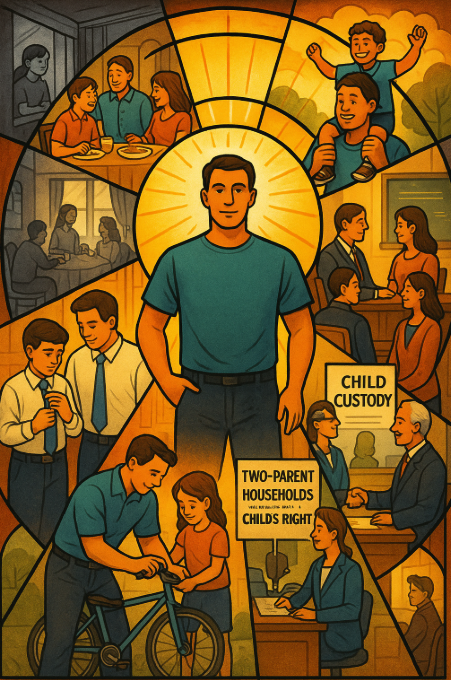
Father Custody Rights

The Marriage Contract Solution: A Father’s Case for Cultural Renewal
(A reflection on Stephen Baskerville’s argument for restoring marriage through father custody)

There’s a conversation we’re not having in the west, one that makes even the strongest men uncomfortable. Professor Stephen Baskerville of Warsaw University in Poland believes he’s found the key to unlocking not just the family crisis, but the west’s broader decline.

His solution is both simple and radical: make marriage legally binding again, with a presumption of father custody in divorce.

The Heart of the Matter:

Baskerville argues that our current “no-fault” divorce system has created what he calls a fraudulent contract. Imagine signing any other agreement where the other party could walk away at will, take half your assets, and remove your children from your life. You’d never sign such a document. Yet that’s exactly what marriage has become.

His proposal isn’t about fathers being superior parents—it’s about keeping families intact. When mothers know they can’t simply leave with the children, they’re far less likely to initiate divorce. When fathers know their parental rights are secure, they’re more likely to invest deeply in marriage and family life. Because that’s how it works.

The Ripple Effects:

What strikes me most about Baskerville’s argument is how he traces seemingly unrelated social problems back to this single source. Consider these connections:

Young men today lack motivation because they see no secure future in family life. Why work, save, and improve yourself when any family you build can be dismantled at will? Father custody would restore that fundamental incentive structure.

The welfare system becomes largely unnecessary when families stay together. Single motherhood, with all its associated poverty and social problems, becomes the exception rather than the rule.

Crime and social decay in our cities trace back overwhelmingly to fatherless homes. Restore the father’s role, and you restore order to communities.

The Deeper Philosophy:

There’s something profound here about authority and responsibility. Our current system has created what Baskerville calls “emasculation”—not in a crude sense, but in the deeper meaning of removing men’s authority as leaders of their children and families.

When a man cannot be certain his investment in family will be protected, when his role as father exists only at the discretion of others, we’ve fundamentally undermined the natural order that built Western civilization. Given human evolutionary history shows and still shows human children are best raised by a mother and a father and a series of helpers (alloparents) — see Sarah Blaffer Hrdy, Emeritus Professor of Anthropology at University of California Davis and her book, Mother Nature — subverting father’s role is nothing less than unnatural.

This isn’t about domination—it’s about responsibility. A man who knows his family depends on him will rise to meet that responsibility. Again, because that’s how it works.

The Political Reality:

Baskerville suggests that even strong leaders like Trump avoid this issue because it requires confronting forces that have made careers out of the current system. The family court industrial complex, the welfare bureaucracy, the entire apparatus built around broken families—they all have vested interests in maintaining the status quo.

But here’s what I find especially compelling: this solution requires no new government programs, no massive spending, no complex bureaucracy. It simply requires restoring one principle: that marriage means something legally binding.

The Strategic Insight: Feminism’s Achilles’ Heel:

Baskerville makes a crucial observation that goes deeper than policy reform. Drawing on the work of scholar Daniel Amneus and activist Phyllis Schlafly, he argues that feminism’s entire power structure rests on one foundation: mother custody after divorce.

“The linchpin in the feminist program is mother custody following divorce,” he writes. “Pull that pin…and the feminist structure collapses.

This isn’t just about family law—it’s about understanding the source of feminist power itself.

According to Amneus, feminism’s central impulse is “the demand for unlimited sexual freedom and female-dominated reproduction.” As he put it: “A woman’s right to have a baby without having the father around is what feminism is all about.”

The historical progression reveals the strategy: after securing the vote, feminists’ first major achievement was the welfare state, followed by no-fault divorce. Both innovations served the same goal—transferring authority over children from married fathers to single mothers.

The National Association of Women Lawyers (USA) proudly called no-fault divorce “the greatest project NAWL has ever undertaken.” Are you kidding me?

This creates what Baskerville, and others call a climate of fear that extends far beyond individual families. When women can divorce at will, take the children and assets, and consign men to “state-enforced servitude,” it doesn’t just affect divorced men—it makes all men fearful of marriage itself.

Government officials learned from this matriarchal model how to create other bureaucratic tyrannies, understanding that “ordinary men heading families pose the principal impediment to their power.”

The Marriage Strike as Leverage:

Here’s where the whole argument becomes particularly interesting. We see that conventional political methods—lobbying, protesting, organizing—won’t work for men seeking to restore family stability. But men already possess a powerful form of leverage: they’re increasingly refusing to marry, date, or start families. No one is born aspiring to become an Incel.

Rather than seeing this “marriage strike” as merely a symptom of social decay, Baskerville views it as potential ammunition. Men are already voting with their feet. The question is whether this spontaneous boycott can be directed toward specific legal reforms.

Think about the logic: if women derive power from their ability to control access to children and sexual relationships, then men’s withdrawal from those relationships removes that source of power. It is economic pressure applied to the most fundamental human institutions.

The Path Forward:

The beauty of the father custody solution its clarity. Instead of getting lost in a dozen different battles, we are better to focus on this single, achievable goal: Make marriage contracts enforceable with father custody as the default. Watch as the incentives align to strengthen rather than destroy families.
1-2…

The claim is that this one change would accomplish more than any collection of smaller reforms. Why? Because it strikes at what he sees as the root of the problem rather than its symptoms.

Would there be challenges? Certainly. Would some bad fathers gain custody they shouldn’t have? Possibly. But Baskerville argues—and I find myself agreeing—that these costs pale beside the wholesale destruction of family life we’ve accepted as normal.

Look, she is the burdened female creator of life. He is the expendable male powerful defender of life. Together, with plenty overlap, they are Team Human.

As creator, one side has more chaos, while the other defends with order.  The culture has become so feminized and chaotic that it now requires drastic masculine order to restore balance. Enforceable marital contracts with default father custody honours children with two parents while also respecting our evolutionary history. It’s what brought us this far.

A Personal Reflection:

Reading Baskerville’s argument, I’m struck by how it connects to something deeper than policy—it touches on what it means to be a man in modern North America, Australia, Europe, and likely the West in general. We’ve created a society where a man’s most important role, as father and protector of his family, exists only at the pleasure of others. This is fucked up.

I remember arguing with my first wife about her egregious behaviour as she planned yet another overnight trip out of town to see her gal pal. I protested and she whirled about to face me on the front steps of our home. “If you don’t like it we’ll divorce and I will make sure you never see your son again!,” she said… with such vehemence I believed her. She knew I’d never leave him.

And every time I nudged her closer to marital counselling she’d provoke a fight and refuse to go. The custody issue meant she held all the cards and could pursue her dysfunction at will.

No fool, in his late teens the boy asked me why I hadn’t divorced her already. He saw, he knew. I finally left when he was 20 or so.

Perhaps that’s why this conversation makes us uncomfortable. It forces us to confront not just failed policies, but failed assumptions about human nature, family, and the proper ordering and sustainability of society.

The question isn’t whether Baskerville is completely right about every detail. The question is whether we have the courage to admit that our current approach has failed spectacularly, and whether we’re willing to try something that might actually work.

Males are taught to be men by generations of men around them — most important of which is the father. An externality of the capitalist system — that began in the Victorian era as men left home to go to work — is that this critical contact has been lost. Now, most men grow up confused, left longing for maternal acceptance learned from being over-mothered. It’s all they know.

Though the danger of nuclear war looms large on any given day, it is not global warming or communism or authoritarianism that is the biggest threat. The biggest problem is weak men. The world desperately needs powerful rank and file prosocial defender males running families… lest we continue to be led by Dark Tetradians and their hybristophillic followers.

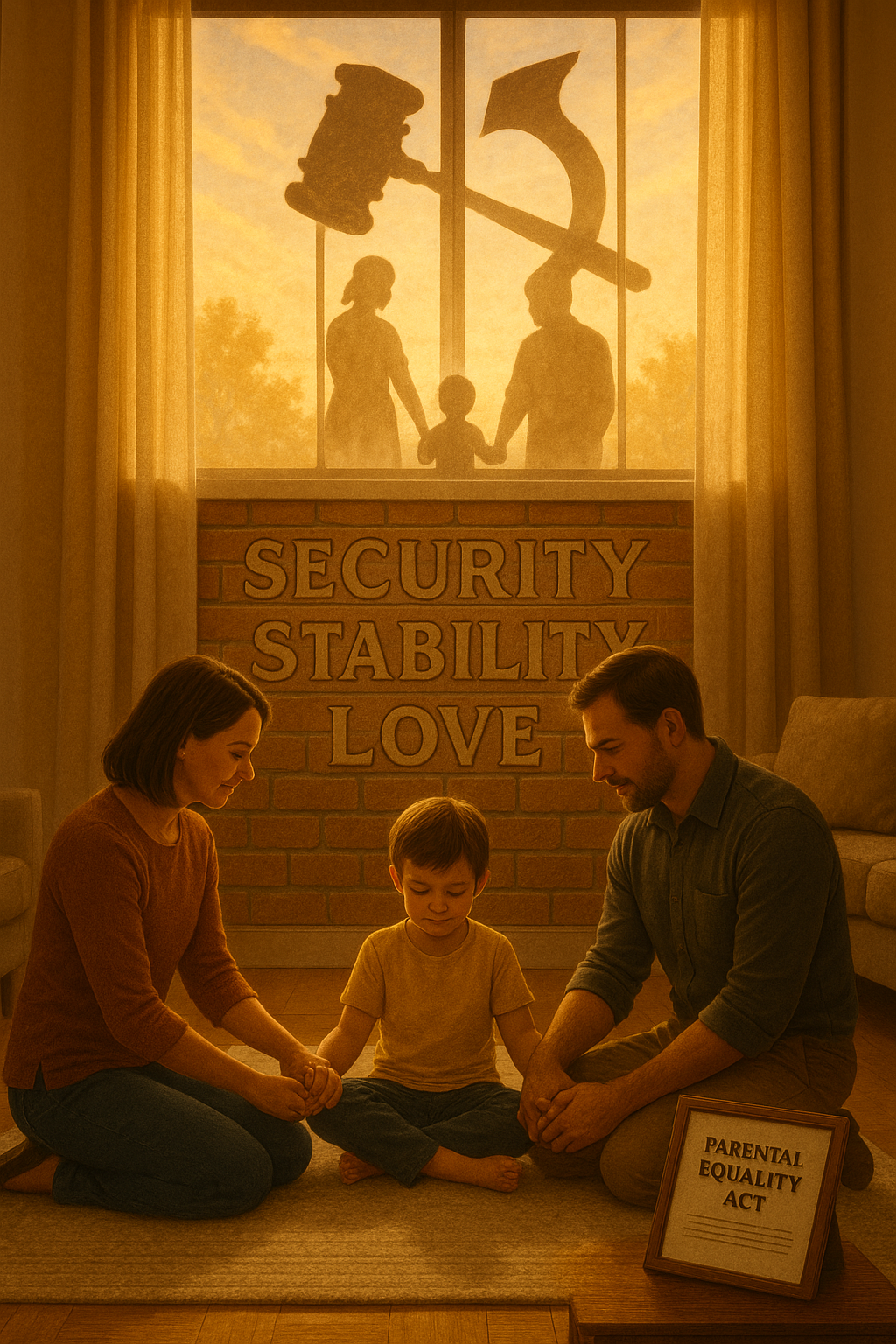
We ought to build our cultures with the underlying premise that children have the right to both a mother and a father. We need Team Human in balance. Honour the marriage contract and you restore the foundation upon which healthy society rests.

Let yourself imagine how that might be…

Questions? Comments?

True and free…
cw

©2025 ATM NEWS
Christopher K Wallace
|Advisor to Men ™

Join us in the Defender Boards today:

Defender Board of Directors link

_________________________________________________

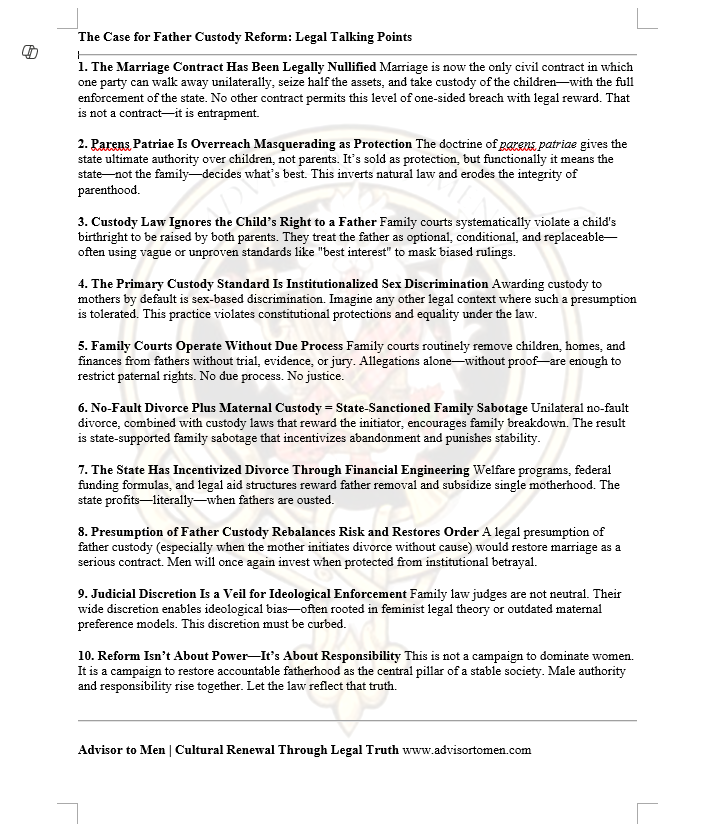
The Case for Father Custody Reform: Legal Talking Points

  1. The Marriage Contract Has Been Legally Nullified Marriage is now the only civil contract in which one party can walk away unilaterally, seize half the assets, and take custody of the children—with the full enforcement of the state. No other contract permits this level of one-sided breach with legal reward. That is not a contract—it is entrapment.
  2. Parens Patriae Is Overreach Masquerading as Protection The doctrine of parens patriae gives the state ultimate authority over children, not parents. It’s sold as protection, but functionally it means the state—not the family—decides what’s best. This inverts natural law and erodes the integrity of parenthood.
  3. Custody Law Ignores the Child’s Right to a Father Family courts systematically violate a child’s birthright to be raised by both parents. They treat the father as optional, conditional, and replaceable—often using vague or unproven standards like “best interest” to mask biased rulings.
  4. The Primary Custody Standard Is Institutionalized Sex Discrimination Awarding custody to mothers by default is sex-based discrimination. Imagine any other legal context where such a presumption is tolerated. This practice violates constitutional protections and equality under the law.
  5. Family Courts Operate Without Due Process Family courts routinely remove children, homes, and finances from fathers without trial, evidence, or jury. Allegations alone—without proof—are enough to restrict paternal rights. No due process. No justice.
  6. No-Fault Divorce Plus Maternal Custody = State-Sanctioned Family Sabotage Unilateral no-fault divorce, combined with custody laws that reward the initiator, encourages family breakdown. The result is state-supported family sabotage that incentivizes abandonment and punishes stability.
  7. The State Has Incentivized Divorce Through Financial Engineering Welfare programs, federal funding formulas, and legal aid structures reward father removal and subsidize single motherhood. The state profits—literally—when fathers are ousted.
  8. Presumption of Father Custody Rebalances Risk and Restores Order A legal presumption of father custody (especially when the mother initiates divorce without cause) would restore marriage as a serious contract. Men will once again invest when protected from institutional betrayal.
  9. Judicial Discretion Is a Veil for Ideological Enforcement Family law judges are not neutral. Their wide discretion enables ideological bias—often rooted in feminist legal theory or outdated maternal preference models. This discretion must be curbed.
  10. Reform Isn’t About Power—It’s About Responsibility This is not a campaign to dominate women. It is a campaign to restore accountable fatherhood as the central pillar of a stable society. Male authority and responsibility rise together. Let the law reflect that truth.

Advisor to Men™ | Cultural Renewal Through Legal Truth www.advisortomen.com