men

TAILGATING part 1


TAILGATING (part 1)

Have you ever had an emotional response to a situation that didn’t fit the reality in front of you? Most people assume that means something is “wrong” with them.

The following essay, in two parts, is a true account of where those reactions come from and what it actually takes to change them.


It was two years ago, while driving towards a tiny nearby village here in Ontario, was when the tailgater caught up to me. He was in a pickup, but not your average pickup. No.


You see this truck had been jacked up, a full “Lift Kit” installed, its suspension now high enough to accommodate 45-inch rims and tires. Reminded me a little of the Monster Trucks I took son #1 too when he was just a lad, the kind which always ended with a crash derby.


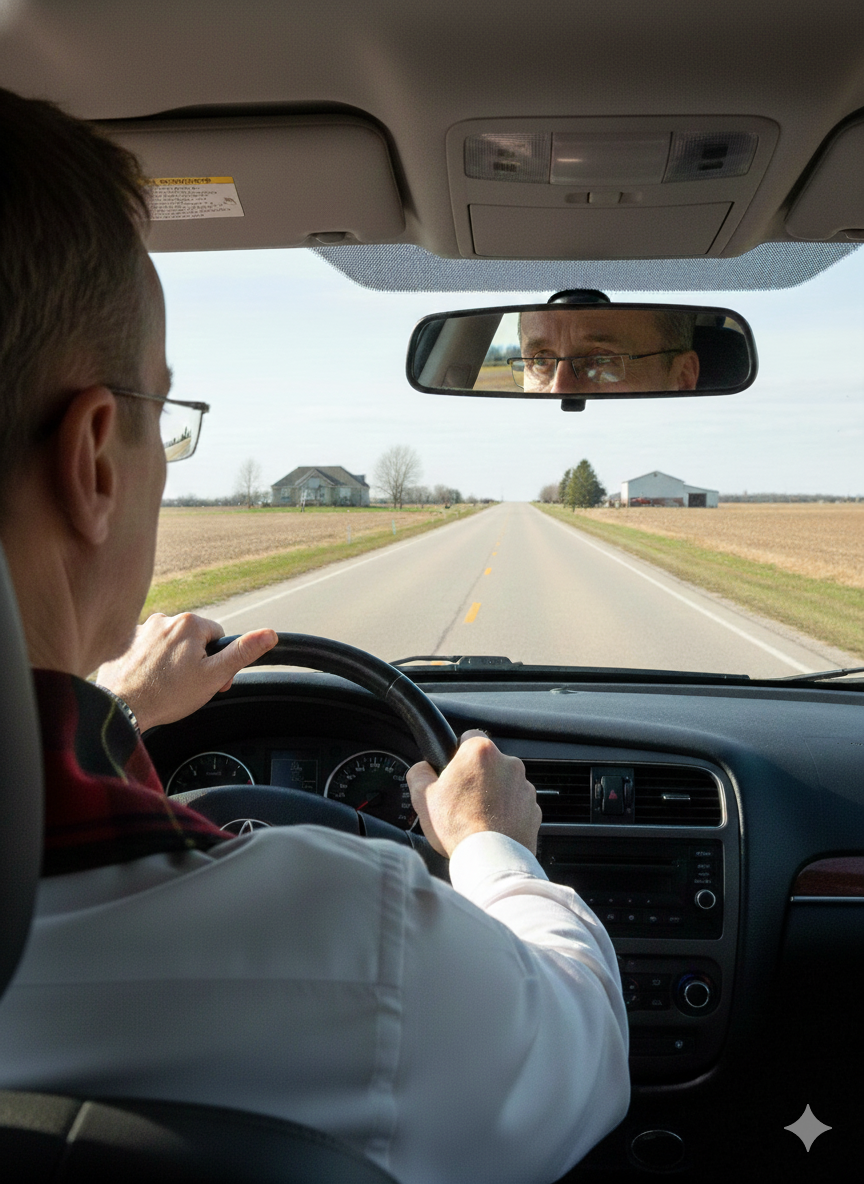
Driver was a young fella, sunglasses, average size, a little smaller than me though that could have been the truck. I know because I could see him in my rearview mirror, “up there” as he came off River Road and roared up behind me. On the road, just my car and his truck, so why so close?


Then something made him slow, a tractor attempting to cross fields. No sooner had he gotten past that than he ran right up my ass again. He stayed a car length behind me as we drove along at 50 km per hour for another quarter mile into the town of Osgoode.


I could feel the change in my physiology immediately as I went along. When he came up behind me the first time my heart rate went up, clearly, so did my blood pressure, and I surmise my breathing must have changed as well. I track these things so have a modicum of self-awareness.


My focus was now narrowed to the road ahead of me with consistent glances into my rearview mirror to assess the threat. Back and forth, eyes front, eyes back, eyes front, eyes back, all while my body adjusted to a danger imposed on me by this selfish prick driving in a most un-Canadian manner, which is to say, impolitely, even illegally.


My mind wandered onto scenes of mayhem. Of slamming on my brakes, grabbing the railroad spike I keep in the door (to break through windows if we ever find ourselves sinking into a lake or river in winter after sliding off a road), and running back to smash his window, pulling him out of the truck before he can know what’s happening and filling him in on the spot.


Follow this mother fucker! I saw myself telling his battered face.


I was in a Hyundai Elantra, Missus beside me in the front, my two children in the back. And instead, since we were now in town, I decided to pull into the gas station ahead to refuel.


We were out on one of those leisurely Sunday drives and had just checked out the boat launch across River Road. We planned to come back and do a little fishing together as a family.


Today was a scouting trip, a late spring day, sunny, warm, perfect for ice cream. I filled the tank while Missus and kids went into the store. I watched the jacked up pickup truck roll past and go into a driveway, a few doors down from where we were.


As I pumped my gas, I found myself imagining knocking on his door, assessing whether I should go to the front or the side, wondering what kind of dog he’d have, a Pit Bull I reckoned.


In my head I was replaying scenarios where I neutralized the dog and hammered the tailgating punk. I remember shaking my head to clear it but still the images came. Over and over again.


Missus and kids had their ice cream, I passed on the treats, and we got underway. As we drove slowly by his house I looked over and cased the place to match my fantasies.


I saw the disadvantage of the front entrance — up those steps and in full view of anyone on the road or walking by — and assessed the driveway and located the side door as we rolled on by, checking for windows in the house next door, noticing how the rear garage blocked the view of his driveway from houses behind on the next block…


Of course, Missus and the kids had no idea what was on my mind. I’m sure I commented pleasantly enough to fit the moment. “How’s the ice-cream?” I’m sure I said.


Past tailgater’s house we drove and basked in the warmth of each other’s company, slowing to notice the Youth Center where the boy sometimes does Lego club with other kids, and driving past where one of my old energy customers operates a kick ass music studio, and slowly but surely the activated nervous system within me began to subside and return to baseline.


But it was the contrast, you see.

The Wolf

For background, you have a brain, a brain stem, a spinal column that enervates nerves all the way to your extremities for fight or flight, as well as the internal vagus nerve in the body.

Benjamin Libet in the 1980s showed with brain wave studies how neurons near motor areas activate before you are even aware of your decision to move. I remember thinking then that we are run by the nervous system; conscious awareness is along for the ride.

Grant-Gluek study coordinator for many years, George Vaillant, says this integrated nervous system denies, distorts, and represses inner and/or outer reality to lessen anxiety and depression. Also known as the ego, this is the body-mind infrastructure behind the predictive brain.

I’ve long called the more primal “fight, flight, freeze” part of me the “feed, fuck, kill, run, hide” wolf. It was one thing to allow that part of me out of the shadows when I was alone or in need, another for it to show up automatically and take me over like it did while with my family that day.

There’s no getting rid of the wolf; it’s too useful. But like any dog, it needs training.


Truth is, this was not the first episode with tailgating specifically. It had bothered me for a long time; in fact, so long I couldn’t remember when it did not.

I contemplated that a little on the way home. I was sixty-five, and it was likely that tailgating caught my ire for forty or fifty years. Decades of insanity, right there, and always on the edge of full calamity, just waiting to happen.


I thought of the time, the early eighties, when I was in the downtown holding cells and a cop stopped by, saying it was about an incident that occurred during afternoon rush hour the year before. The witness had made himself scarce and so, there would be no charges but since he’d been looking for me, out of curiousity the police officer came by to see what I looked like.

I told him I had no idea what he was referring to. The wisdom of the ego at work…


And that’s what I still had on my mind that fateful late spring day two years ago. I was with my beautiful woman and our precious children, and yet, my whole being was triggered into a personal war zone once again.

Only I am not the same person I was those years ago. I was once the boy my parents made, but slowly and surely I have been able to claim a life as the man I am today from my own experiences.
Oh, the humility gained from all my numerous humiliations, you could say…


I had done much work, attended colleges, universities, learning as much as possible, experiencing what it is to be a good man, giving a shit, practicing breath and self hypnosis while sharing whatever meager talents were bestowed upon me by the heavens while doing my best to make a difference.


It was just that tailgating still got the better of me. It’s the intermittent reinforcement I realized. I don’t get tailgated often enough and so, my response survives unattended and intact. Each episode creates a deep learning groove in answer to some calling from the darkness of my psyche.


I thought of that all the way home, the length of time occupied by this problem of mine, the way in which it failed to subside despite the years. Other than a direct threat to me or to a member of my family or good friends, tailgaters possessed an on-switch, a sure way to activate my wolf.


I knew that despite my thorough analysis and overhaul of my various responses to life this one remained. I had unfinished business with my psyche and, it was time.

________________

I had this in mind the next day, as it just so happens, I found myself once again driving with Missus and our two children. Only this time, we’d taken a rare trip to a local country store together. I say a rare trip only because, while the kids’ and I go there regularly, Missus rarely does.


Only this day I turned off one rural road and onto my street only to find the sedan following us turned with us and began to tailgate me immediately.


For less than a quarter of a mile I contemplated what to do about this, my eyes flitting from the road ahead to the rearview mirror and back again while my physiology went into its predictable response. When I got past the first few houses but well before arriving at the crest of a hill, I decided to signal suddenly and pull over quickly to let the prick pass us. I’d never tried that before.


This he did, and I watched at him going by. Each giving the other some kind of look. He was fifty or so, balding with short hair at the sides, an angular face, stern looking, but a small man and a clearly nervous man. Another one.


As he looked at me and I looked at him, I saw only indifference on his face; I don’t care what he saw on mine. He was hunched over his steering wheel, looking agitated, and it seemed to me, driving like an anxious woman. Drive as much as I have and you too will learn to spot the type.


With no other cars around I pulled back in behind him, and I watched him race down the road. When I crested the hill I could see how he’d caught up with vehicles farther ahead and tailgated them, his brake lights flashing on and off in the distance as he attempted to hurry them along.


But instead of thinking poorly of him, I speculated that he may have had a legit reason for hurrying like he was. Maybe his mother was dying in hospital and he had minutes to get there. Maybe one of his children was sick and he was racing to bring them medicine. Perhaps he was late for work and had been warned that “one more time and your fired,” something that would ruin his family.


What allowed me to think this way was that I had pulled over and ceded the road to him. And as soon as I did, the war-like mentality pulled over too. Pulling over meant caging the wolf.


Universal Love

Instead, it allowed me to use an old trick I picked up over the years to remain sane during rush hours in various cities while running sales teams out of a fifteen-passenger van.


I sent that fucker “universal love.” That’s when you know love exists in the world and is all around at any given time. The trick is to gather up some of that energy and internalize it, breathing it fully so we are filled with love, with universal love.


Then, like those cartoon characters on Saturday morning TV, send off that love energy through the fingertips of my hands towards the intended. I looked at my tailgater’s vehicle and thought to myself, “I send you love mother fucker” and I may have even gestured a little with the fingers of my hands through the front windshield while holding the steering wheel.


As I sent him love, the possibilities, the dying mother, the sick child, the losing his much-needed job, all these potentials manifested as flashed images before me.


Truth is that I have no idea why he was tailgating me, and that’s the promise of it, isn’t it? By sending him love I was using an incompatible behaviour to soothe my agitation because you cannot remain pissed at someone to whom you are also sending love.

See how that works?

Powerful, true and free
cw

©2026 CHRISTOPHER K WALLACE  Advisor to Men™

ALPHA-BETA

ALPHA/BETA
One way to approach this subject is to look up Frans de Waal’s video on Chimpanzees to better understand the term alpha.

Labeling someone an alpha or beta is demeaning to people. For one thing, no such thing exists in humans. Why not? Because human life is too complex for such a simple term.

If we were limited to a highly predictable existence where we ate leaves all day and slept in a nest of grasses at night, interspersed with banging a few females, maybe. But, we don’t.

I like to say that if you are broken down at night in the middle of buttfuck nowhere your money or muscles don’t matter. The only alpha around is the tow truck driver who shows up to rescue your stranded ass.

Men defer to expertise. That’s one reason we build cultures. And, everyone has something to offer. None of us is expert at everything. “None of us knows the all of anything,” is the quote by Robert Louis Stevenson my father had written in marker on his bookcase at home.

Sure, we exist on a continuum of maternal care at one end and predatory aggression at the other, and we tend to form hierarchies. But those tend to always be job or context specific.

When the general gets to a river with his army, he calls in the raft guys to get across—if they are successful, they win the day and are celebrated (like the tow truck operator in the middle of the night). When the general gets to a castle wall, the siege machine operators will carry the day. And why is there a general? It’s because he knows enough shit to lead an army. It’s all context. In fact, context is everything.

If you work at a high-tech company and you’re the smartest engineer out of 200 and can work hard and be social, expect to rise to the top. Everyone under you is beta? Come on.

No man is all things in all situations.

The other issue is labeling in general doesn’t allow as easily the transition from weakness to power. It says you are “this way” or “that way” when in fact, all of us have the capacity to be weak at times, just as we all have the capacity to be more powerful.

I’ve had occasion to think hard about labels because of my own life and expertise around addictions. I’ve known too many hard-core gangsters who became decent men, myself included. And, I have known people written off as hopeless alcoholics or junkies who defeated their compulsion. Too many to call them names.

I much prefer to use weakness and powerful because any weak man can act and be more powerful in an instant if he’s called to do so by his spirit. That’s why we love the come-from-behind story of the underdog vanquishing obstacles to succeed at something. From weakness and insignificance to power and significance is within reach for each and everyone one of us.

Self concept is how you see yourself contrasted against how you believe others see you. One is the character you build and the identity you form, the other is the remnant personality and habits derived from your environmental feedback loop.

The younger you are the more you experience your environment physically (read family, school, etc.). Those experiences are recorded into the very neurons of your body. That’s where feelings and your subconscious exist. You have the same neurons for life.

The male brain doesn’t fully develop until age thirty. That’s why addictions are often picked up before that age. It’s also the age where a significant amount of people give up an addiction on their own. (the rest need extra help and keep men like me busy).

So why would we saddle a male with a term like beta? I’ll tell you why: Competition derived from predatory aggression and our tendencies to hierarchies.

There are two main ways males tend to compete.

In one way, we go head to head, mano a mano, or often against a group of men. Each lays down their best performance and may the best man win. This is how we discover who among us has expertise we can use for the group’s benefit. Afterwards, in that context, we remember who our top man or men are, so that if that situation arises again, we know who to call.

Men tend to have relationships with a wide variety of groups of other men. They can form loose bonds and move in and out of these groups with a fair amount of ease. Women, on the other hand, tend to have just one or two (and usually no more than five) girlfriends she guards jealously. These she uses for emotional regulation. Men generally have no such need.

This is another reason why men build cultures; and why women tend to stress-test them.

But it’s the second way men compete which is often problematic: It’s the put down.

Men test each other from an early age. You can see it in kids as young as grade two or three, where boys push each other to find out if you are a girl or a boy. Researchers who study this figure it’s because it is boys who grow up and defend their tribes and nations.

It is said the calling out and such is an early form of making sure the other males will be able to stand next to you and fight the enemy later in life. The literature suggests an innate trait.

Little boys create imaginary enemies early in life. Little girls do not do this. Give a piece of cloth to five-year-old kids and a boy will make a cape and become a superhero; a little girl spreads it on the ground and has a picnic with her dolls and stuffed toys.

If you hook up fMRI to males and present them with two situations, one where he competes head to head fairly, and one where he competes by putting others down, the same reward centers of the brain light up, and doesn’t discern between the two.

This may be why bullying will never completely go away.

Examining these two approaches used by men, one is prosocial, while the other is not. Anything beyond mild ball busting is, in most cases, very much antisocial, but derived from that insecurity found in children who test each other’s interdependence.

We don’t apologize for being men. That’s my stance. Yet, that doesn’t mean we don’t try to become better men. Or, in fact, grow into becoming the best men we can be.

So, men’s way of challenging each other exists on a competition continuum. It might go from head to head group or individual competing to mild ball busting to calling each other out directly to outright bullying to punching each other in the face.

I’d ask anyone reading this if calling others “beta men” is just a way to affirm their own status, a way to aggrandize themselves at someone else’s expense. What’s behind that?

Given what we know about how people take in information from their environments below age thirty, who does it help to call someone beta?

That part of self-concept which derives from how you believe others see you can both propel you forward but also become a burden. For many, their family of origin programming and childhoods are a cross they bear.

Trust me when I say I have lived too faulted a life to judge anyone else’s with much conviction.

I was once diagnosed an antisocial after I shot someone and spent 30 days in a locked psychiatric ward being assessed by the courts. You can bet that label followed me thereafter.

I’ve also been weak in my lifetime enough times to know people can and do change. I’m living proof a man can claim his power for good if he wants. Yet, it is only by bringing things into awareness that we advance the possibility of change.

Which brings me to my last point: something I call PHD. The paradox of human development says adults make your decisions when you were a child experiencing your environment physically (remember, your brain does not fully develop until near age 30).

You needed protection, shelter, sustenance, and nurturing, and so, created a conforming ego to survive. You did this with the heart and mind of a child, internalizing sensations, images, behaviours, feelings, and meanings, which obscured your true self.

We all have this judgmental side to us as a result. When we judge ourselves, others, or circumstances harshly, we are operating from the basis of what Freud called the superego. Carl Jung called it the conforming ego.

It’s Grandma’s law: “eat your vegetables before dessert.” It’s: “don’t talk back to adults.” It’s all the rules you were told to follow… for your own good. It’s the demand you tow the line.

It’s that part of you which was taught to you by parents and teachers and other adults around you as a child echoing in the back of your mind, often showing up as the “inner critic.”

These thoughts are usually expressed under the tyranny of words like “should, would, could, what if, if only and must,” serving to remind you that you are not good enough, keeping you fearful and uncertain. Not only do we beat ourselves up under this conforming ego, but we project it out to the people around us and our circumstances. We make demands of others.

We have studied this: it’s not your best side. I go further: your quest in life is to dampen this conforming ego and develop your own identity, one which manifests your gifts. The conforming ego is stultifying, existing only to keep you safe. It keeps you playing small.

Watching Frans De Waal’s talk about alpha chimps—who do spend all day eating leaves and sleeping in nest of grasses at night and banging chimp wenches—you will discover the basis of what Jung called the King archetype in humans. Chimp DNA is less than 3% different than that of humans (male and female humans have less than a 2% difference).

De Waal’s alpha chimp not only get to bang the wenches, but also get to look after ALL the members of the troupe, right down to the weakest. Roosters do the same thing.

And, if an alpha chimp doesn’t work to benefit the whole troupe, a few lesser males will get together and take him out. Humans do the same thing. A version of this leaked out from Vietnam vets in the 1970s about “fragging” a bully unit commander. In the heat of battle, it was “sorry, somehow, Sarge took one to the back of the head.” Happens with gangsters all the time as well.

That’s another compelling reason why using the term alpha for humans is misplaced.

Archetypes are instinctual energies found in all of mankind. Everywhere you go, people are afraid of the dark. Everywhere you go, people are afraid of heights. And, the same metaphors are repeated in cultural histories the world over despite being continents and millennia apart.

Carl Jung said these archetypes were proof of the existence of a “collective unconscious.” One such energy is the King archetype. It exists in every man.

According to Jungian analysts Moore and Gillette, the archetype of the King is responsible for order, fertility, and blessings.  What is a realm without order?

Now, we are not referring to wanton order imposed by a tyrant. No. We are speaking of order in the sense the needs of the many outweigh those of the few. We are talking Golden Rule.

Fertility is all about the mental, physical, social, and spiritual health of the ruler whose acts are in service of the greater good. It’s the benevolent King. When the King is healthy and rules with passion for his people, the crops grow, the granaries and pantries of the kingdom are full, and the loyalty of the people is assured. And, the women willingly produce offspring.

Blessings are the Kingly equivalent of encouragement. In a monarchy, the King might “Knight” a subject as a way of recognizing their contribution to society. He may even create an “order” bearing their name. The King can hand out “merits” and other rewards to the citizens of the realm.

Suffice it to say, a man aware of his King energy will see the good in people, often before they see it in themselves, and makes sure to let others know they are appreciated.

Look, I’m not perfect at this but you can bet we all live more powerful lives when we embrace our King energy and live up to our “true self.” Judging others always comes from a place of fear. Better to just notice how others are and then rise to your best self.

The advantage of the higher self is that it sees the silver lining, the gift in anything. This energy can spot the gold in others and serves to bring out people’s best.

Your duty to the universe is to find your true self once more.

It is to examine the beliefs, meanings, sensations, images, feelings, and behaviours inherited from your PHD upbringing, discarding what you have outgrown while adopting a truer identity with which to manifest your gifts.

Not because you can, not because you want to, but because it is what you owe.

Stay powerful, never give up
cw

©CKWallace, June, 2020, all rights reserved
Advisor to Men, Mentor at Large
advisortomen.com

CLICK HERE FOR A FREE DISCOVERY CALL

GETTING OVER A FATHER

GETTING OVER A FATHER (in 6 steps)

You can do this exercise even if you don’t know your father. If you do or did, that is know him and felt loved and can say you had a great relationship, I thank him on everyone’s behalf (as do you). We need good men. Though, even if he wasn’t part of your life you can still take from this essay a kernel or two of wisdom. I’ll give you my example, you can take it from there.

Not all but many men have problem relationships with their fathers. The post-second world war period as the west re-industrialized under new technologies meant many men worked away from contact with their children for most of the day and week. Lots of men continue to make not much more than an evening appearance at home and spend scant time with family and children on weekends. Feminism probably didn’t help men’s contact with their children, especially as divorce laws were liberalized to favour mothers.

These six steps I used to deal with my father issues were important for me to gain perspective, to put things in black and white. I knew in the end where my anger came from, my nice guy compensation, and several other compromises I unknowingly accepted in developing my personality. I also learned to understand and accept several of my father-derived traits for which I had no prior appreciation, including a multi-generational understanding of influences. This helped me take better charge of my life.

First step: Acknowledge your father’s weaknesses and strengths while identifying which you have adopted as your own.

Undoubtedly, he left his mark in some way so take an inventory. First, put aside resentment if you have any and try to see things as objectively as you can. Even if you don’t know your father, your ma can give you hints: If you have a trait that is clearly from her, but others that are not, assume those other part of you came from dad. Simple elimination.

Write a list of characteristics and assign them accordingly.

Step two: Assert your reasons for change and gain leverage

Why do you want to do things differently than your father? Recognize, we exist in each other. Epigenetic influences on ancestral DNA are handed down for several generations through the methyl groups and are part of your soul. But you can still make decisions for yourself so it’s best to decide out of anger or out of love how you will proceed with your life. The better you understand the forces operating on how you got to where you are, the easier it is to steer yourself to a better existence. I was damned if I was going to parent as my dad did.

You are bound to have some of your father’s tendencies so it’s worth spending a bit of time deciding which to keep and which to update.

We exist in each other. I tell my kids when they are getting strapped into their car seats, “Watch your fingers, watch your toes, canteen open, canteen close,” the same ditty my father learned in the navy and he used to say to us when piling nine kids into a ’67 Pontiac Parisienne. When I repeat those words, my father in me is speaking.

There are stories of twins separated at birth who find each other decades later and they are dressing the same and have similar interests. While not as drastic as that perhaps between father and son, ancestry might be a third of soul. We can’t get away from that stuff so make peace with it.

My father, Howard Carew Wallace and grandson, Howard Thomas William Wallace (my boy)

Step three: Surmise where dad’s influences may have come from. He had parents and grandparents and lived in a different era.

This is where your natural curiousity comes into play. Even if you don’t know your father you can conclude quite a bit from the area of the country and the generation in which he grew up. These things are easily researched. What would a man who has these traits (name the ones you have that are not from mom) growing up in this area at this time be like? That’s what you’re dealing with.

How little or how much you know about your father’s background shouldn’t prevent you from doing this exercise. What’s important is you develop a narrative about his life that allows you to reconcile his existence in so far as it concerns yours.

In my case, I learned my dad was never accepted by his father. My father’s first memory was of his dad smacking his mom around in the kitchen when my dad was just four. He could hear them and remained frozen at the top of the stairs wanting to intervene but afraid, he told me a few years ago clenching his fist. He was just four years old at the time he witnessed it all, mid-eighties when he told me.


My dad and his big sisters

Regrettably, the argument was over my father’s paternity, dad found out later. Dad’s three big sisters were fine and accepted but somehow my grandfather got it into his head grandma had borne him an illegitimate son. It ended up defining my father’s life and he was still mad about it when he told me about it eight decades later so you can imagine.

My grandfather was institutionalized for many years and didn’t appear in our lives until the 1960s when he showed up with grandma, introduced to us nine kids as “Uncle Gimpy.” It was only later we found out he was our lost grandfather and were given permission to call him Grandpa Gimpy. During some visits, I witnessed my father and grandfather arguing in the living room, shouting at each other, presumably over the paternity issue.

My dad spent some time in an institution himself in the 1970s, suffering from what they called manic-depressive back then, bi-polar now. It forced his early retirement from the navy as he tolerance to stress became less and less. He swung back and forth emotionally in what I call a crazy 8 pattern, from anger and rage to loneliness and brooding self-pity and back to anger again. Once the “horses are galloping” as he put it to me once, it could take him days and days to settle down.

Dad was holding his father’s hand when he died at age 98 in the Rideau Veteran’s Home here in town around 1990. Right to the end, my father hoped for a sign, something which would acknowledge him, or perhaps even a death-bed reconciliation. He got nothing.

I saw his pain retrospectively, with him discussing what his influences were while looking at his life. Though, he eventually got dementia and spent his last two years in a locked ward for his own safety, for two years before he went in, I purposely moved nearby from another city and visited him at the family home each week during the day. We spoke less as father and son and more as men.

He told me many stories of his early years and lifetime. He lived in his living room with floor to ceiling bookcases and read thousands of books. As a kid, we were afraid to ask him something because you might get a half hour lecture about a culture or place in the world. When you are a learner, you must teach.

When he died in November, a month shy of five years since he lost ma, his partner of sixty-two years, a few of his nine children were present, including me. It was at the Perley Rideau Veterans’s home built on the grounds of the old Rideau Vets home where his father died. We held his hands in turn, no reconciliation necessary.

Given the uneven attachments and unpredictable violence of my early years, I gained a good understanding of why my father was weakened so in his lifetime despite it all: his pain was large and lifelong.

Ma was not much better off. Born into a family of nine in Newfoundland, she was given to her grandmother as a child because her mother “couldn’t bear another.” Though cared for, she never got over this separation from her family. At some point in her early teens, she was allowed to stay overnight at her mothers and announced defiantly in the morning she wasn’t leaving. You can imagine the deal she had to make with herself just to stay and be near where she believed she would be loved.

And my grandfather Gimpy, my father’s father. As a boy he heard his two older sisters, the ones tasked mostly with looking after him, crying to each other in the night sick with scarlet fever. In the morning he found them both dead. It was the late 1890s, the milkman had infected the whole neighbourhood.


Then, his mother bleeds to death over three days while delivering twins at age forty, despite the neighbourhood women taking shifts to staunch the blood from her ruptured uterus. Then a wicked stepmother enters the picture.

In 1914, he goes off to war and is shot by a sniper and thought dead. He miraculously recovers leaving an ugly pink scar more than a foot long on his leg and giving him his nickname, Gimpy. He takes up flying, done with the infantry, comes back from a bombing run at war’s end and crash lands in the fog, staying hospitalized with brain damage in Britain until 1921.


While there, he loses his father back in Halifax. My great grandfather is killed racing his horse and buggy through a short cut by a train at a hidden crossing racing home after seeing another of his sons, long before they had those lights and barriers common today.


Thomas Patrick Wallace with his three sons, Howard Vincent, soon to be named Gimpy is on the right.

Looking up my ancestral records, sleuthing through the genealogical tree, I find my great-great grandfather, John Wallace dies of “exhaustion due to excessive drink” on a Saturday night in Oshawa Village. He worked at the carriage maker which later become part of General Motors and leaves a conscientious woman, Mary Hart, in charge of his five kids of whom Thomas Patrick was one.


John Wallace, b. 1824 Ireland (we don’t know for sure) d. 24 May, 1875.
His schedule C gave the reason for death as “exhaustion from excessive drinking.”

John Wallace was the only son of Thomas Wallace, my founding immigrant, who fought in the Gibraltar campaign of the Napoleonic War before sailing to Canada to fight for Her Majesty in the War of 1812. Arriving in 1814 at war’s end, he settles in Oshawa Village.

Thomas Wallace gravestone, Oshawa, Ontario

I can trace five generations of Wallaces before me through these men and see the pain they have transferred to each generation.

Step four: accept, forgive, surrender

Call it compassion, sympathy, cognitive empathy while realizing we are people makers. It is only by understanding that each person lives the best they can under the circumstances and makes the best decisions for themselves at the time. Of course, they do, self-interest is always paramount. If they knew better or could act differently, they would.

Seeing a previous generation through the lens of today’s values and morality is called presentism. It drives historians nuts. Let this knowledge signal greater tolerance and compassion for those who came before you.

Not only were the cultural values different way back in your father’s time and his father’s time, so was the environment. Times of war or of social justice upheaval or economic hardship far removed from our experience precludes our ever being able to completely reconcile their journey. “You had to be there” you have heard people say. Well, we could not, so judge less on that basis.

We didn’t live through the advent of electricity, women’s emancipation or even the vote being extended to all citizens for that matter. We know nothing of two world wars. Most can’t remember the sixties. Two hundred years ago life expectancy was less than fifty and most were living hand to mouth on the family farm or in tiny communities. Religion was stronger and laws often looser.

Step five: seize control and take the stand all men must make.

Ask: am I going to allow my history to determine my future? Or, shall I create a life of my own?

What will be my legacy to others? How will I improve upon my ancestral line so that my legacy flows into the distance intact and strengthened?

Make the declaration. THE PAIN STOPS HERE!

Use this powerful stance to decide your future, ensuring you are an improvement on the previous generation. I remember visiting my mom and dad from out of town once when I had then missus and my first son in tow. Dad noticed how I interacted with my boy and remarked to all around, “Christopher is determined to not act like me.”

He was right. I’d be damned. I haven’t been perfect, but I haven’t been him either, not by a long shot. Though I recognize him in me when shit hits the fan. That’s been an important part of my personal legacy.

No one becomes a parent with anything but the best intentions. No one has kids and intends to fuck them up on purpose. Good intentions are tossed aside when stress hits and we revert to our family of origin programming. Be aware of this and make plans for how you will counter this if necessary when it happens, because it will.

Step six: Reclaim your power and gain your freedom.

Oliver Wendell Holmes Sr. wrote at one point: “One’s mind, once stretched by a new idea, never shrinks back to its original dimensions.” Think of that for a moment.

Whatever circumstances came before you, you can live differently but only under certain conditions. This is because we live emotionally and interpret things later. Most of what we do happens subconsciously. It’s only by bringing something into awareness that we can bring about the possibility of change or control. It is only with insight where free will begins, not before.

If the soul is comprised of the epigenetic influences on ancestral DNA, contrasted with the collective unconscious of all mankind’s history and then added to by your databank of emotional experiences since birth, the spirit is its voice. You are a unique combination of these influences and to deny any is to deny them all. It is to deny your spirit.

The more aware you are of your history, and the more you accept and surrender expectations and the futility of should have, could have, would have and what if,  the more you can take charge your present and future. Life is lived forwardly, not regressively, though the past has lessons to teach.

Now that I know all this, I get to decide. Some of my father lives on in me as a shadow aspect of my personality. Knowing my shadow allows me to live in the light.  It is a light of my choosing. Power equals agency.

I consciously blame him for this violence in me I had to learn to tame on my own. I blame him for my disregard for money and for my nice guy tendencies earlier in my life. I also blame him for my love of books, for my memory, for my athleticism, for my sense of justice and for the simple love of teaching. He taught me to write when I was fifty. I blame him for that too.

Using our power in service of ourselves and others is how we find meaning and freedom.

Ask yourself: How will I live?  Powerfully or in weakness? How will I be an improvement on the generations which preceded me. As Horace Mann once suggested, “Be afraid to die until you have won a victory for mankind.”

Stay powerful, never give up: You will sleep better at night

cw

©January, 2020, all rights reserved
Christopher K Wallace
Advisor to men, mentor at large

book a free call here