health

TAILGATING PART 2 CODEBREAKING

CODE BREAKING (TAILGATING part 2)

As I sat in my office, overlooking the very country road where for the first time in my life I pulled over for a tailgater and let them go past, I thought about what had happened over those two days.


I thought again about Osgoode Village, the truck tailgater, my response, the next day sedan tailgater, and how I had pulled over to wish someone well who, only moments before, was a threat.


I thought of where in the body I feel it when such things occur. The racing pulse, shorter breathing, the tight gut and full threat alertness and physiological arousal as the wolf is summoned, just in case. I remembered the ways I might protest and curse at the interloper crowding my back end, the furtive back-and-forth glances at the road and rearview mirror, options running through my mind.


When else had I felt like that? Of course, every time I’d been tailgated, came the answer. And what about earlier than that, I pondered. What’s the earliest I can remember ever feeling this way?


I let that sit for a day or two, moving in and out of my office, hearing the cars whiz by the end of my driveway. I was unhurried, curious, exploring, imagining, seeking only to access an intuitive understanding of why this happens.


About three days later, it came to me:  the earliest time I can remember this kind of arousal was when I was a little boy, say, between age 8 or so and 11, sitting in the living room at my parent’s home watching black & white TV with my eight siblings, and dad would walk in and take his seat.


My dad had his own chair, centrally located in the room, directly opposite the TV. He’d arrive and someone would scramble out of his way, maybe two of us even, so he could take his place and watch with us. It was usually Bonanza, Star Trek, Walt Disney, or cartoons like Bugs Bunny, Elmer Fudd, Donald Duck, and the odd time Superman, Spiderman, and their ilk.


Thinking back to those times I realized that dad’s arrival made me uncomfortable. So much so that in short order, sometimes in five minutes and at other times in ten, I’d make an excuse about having something to do and leave the room. I’d leave Dad and the TV to my brothers and sisters.


Why did I do that? I never even realized I was doing it at the time. The house was run by mom and backed up by dad. With nine kids to look after, ma was tireless and efficient and had little time for anyone stepping out of line. Morality at home was assumed more than it was taught.

And on those occasions where she felt the full weight of her martyrdom, your perceived transgressions fueling the “being taken for granted” caregiver’s dilemma, she summoned her husband as punisher. Mom gave a lot, and sometimes she took a little back.

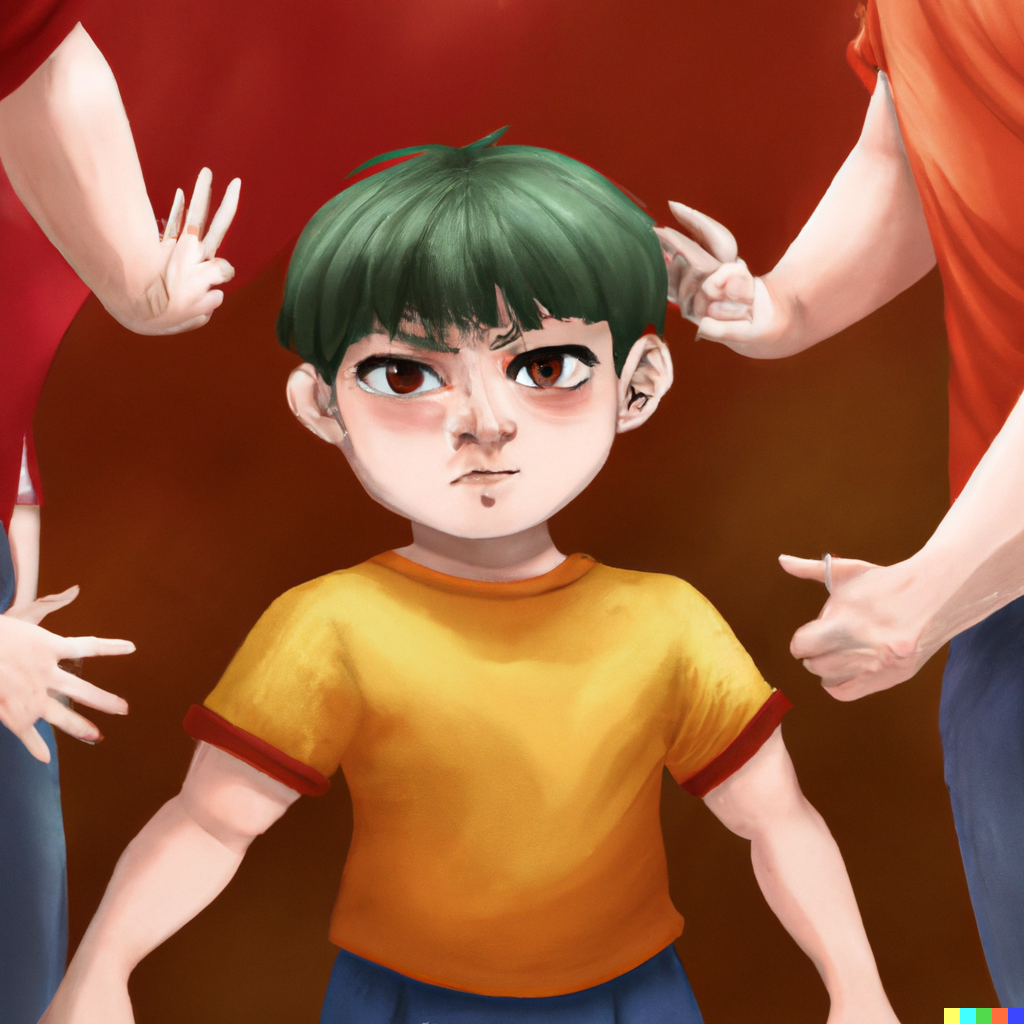
Over the years of my early life dad had tried various lesser pieces of wood spanking his children and finally settled on a twenty-inch piece of maple hockey stick handle he called “the ruler.” He kept this on top of the kitchen door frame for all to see.

Typically, the progression of his ire was first a look that could kill, then a raised voice that froze you in place, often followed with a slap or a throw across the room, and finally, if he was sufficiently agitated, a spanking with the ruler. I held the family record for number of strikes.

One time a classmate and I were caught tossing a note back and forth in class. It was grade three and our teacher was a nun with the most beautiful face. My friend Jr. sent the first volley with “caca” written on it. I replied with “pipi” and sent it back.

An exchange or two later and, the aerodynamics of folded paper being what they are, my return landed on the desk of another student, the teacher’s pet. To my horror Miss Good-Goody-Two-Shoes promptly read the note and turned it in while pointed me out to the teacher. Since we lived just up the street, I was sent home with a note at lunchtime.


I tried to explain myself to ma, but she spied the envelope I was holding behind my back and demanded to see it. After reading it, all she said was “Wait ‘til your father gets home.”

I knew I was fucked.


That evening, I got the family record: seventy-two full adult swings on my backside while I held on to my bedpost with pants pulled down. After 30 strikes I’d fall to the ground and beg for mercy. “Daddy, no!” I’d say, “I won’t do it again.”  But he’d just reply with “Get up!” and keep hitting me.


My two older brothers listened from the other room and counted the total. It was said I screamed so loudly the neighbours all around us could hear. It wasn’t the first time the old man had yelled at me or hit me, and it wasn’t the last time either.

I’m not writing this to re-live difficult episodes of my early years. Rather, I share these experiences in the hopes others will understand the process I used to address a longstanding shortcoming. Keep in mind this is about tailgating, yes, but much more than that.


It’s enough to say that my nervous system was changed forevermore that day. I was a good kid, no real problems. In fact, I was attending French school as an Anglophone speaker.

Though I understood not a word in grade one, sometime in grade two I had gone to school in the morning ignorant and confused… and come home understanding a new language.

By grade six I was class president.


As I said, the day I got the family record wouldn’t be the last time I was spanked, but it seems that day he beat the emotion out of me. It took many years before I could feel again, at least the way I surmise others might feel in every-day situations.


And so it was that I learned to avoid my father at every turn. My instincts for self preservation honed to a sharp edge, if he showed up, I was out of there as soon as I could. Apparently, he noticed.

Probably when I was eleven or so, my folks tried family therapy at a local mental institution. I remember a session facilitated by two therapists where my father turned his attention to me in and accused me of avoiding him. I was so overwhelmed that I responded angrily and stormed out in tears. They found me later walking down Carling Avenue alone and pulled the car over and let me in.

Not a word was said that I recall. I don’t remember ever going back to therapy either.


Operating System

As I sat in my office remembering all of this, I saw how my physiological arousal while being tailgated dovetailed with the way I felt in the living room of my parent’s home watching TV when dad would come in: people all around, eyes on the TV, on my father, on the TV, on my father, on the TV…


That was it. A perfect match of fact and feelings.

The first time visiting with “Little Chris” years ago required a fair degree of compassion and understanding. Partly that was to make sure I didn’t just scare him off, sending that part of me into hiding again. I talk about this in Sipping Fear Pissing Confidence, my book about addictions.

In my experience, no one survives childhood emotionally unscathed under perfectly imperfect parenting. All of us have a Younger Self wandering the darkened hallways of the psyche, looking, searching, maybe holding a stuffed Teddy Bear and dragging a favourite blanket, looking for belonging. And that part of us always has a story to tell.


So, I asked myself given the circumstances and how I felt, what would I have to believe to make these facts and feelings true. I thought hard about that, re-imagining myself as a boy, barely double digits in age, in that setting with the matching beige pleather couches, every seat taken by someone, the movement of characters on TV, seeing through my eyes as if I were there again…


And it again, the messaging came to me: “I’m in danger. Something bad will happen.”

Looking at the TV, looping, “I’m in danger” and glancing towards dad “Something bad will happen” and at the TV, “I’m in danger” and over my shoulder at dad “Something bad will happen.”


Now, I imagined driving down the road being tailgated and saw that I was unconsciously ruled by these same two declarations. “I’m in danger” looking at the road, and “something bad will happen” while glancing at the rearview, back to the road and “I’m in danger” and to the rearview “Something bad will happen.” These were the irrational beliefs summoning the wolf.

This was a part of my operating system: nervous system coping from decades ago that had been superimposed on tailgaters all that time and had never been updated


It was like using Commodore 64 in a Windows 11 world.

I’d learned to manage that kind of physiological arousal as a child by leaving the room and avoiding my father’s wrath. I couldn’t do that while driving. I was stuck there not feeling safe and expecting something bad would happen. These were the same feelings I had at 8-9-10-11 years old. They were with me still.


Like learning to walk at an early age and doing it automatically ever since, I’d learned the danger of keeping my eyes ahead on a screen while a menace lurked around me outside my control.


It was my nervous system, trained by the body-mind long ago, and on occasions like this, still on autopilot all these years later. It was time to take over the controls and create new concepts my brain could use predictively next time someone decides to follow my vehicle too closely.

Conditioning

I’d experimented that first time with the sedan on my street and it had worked better than expected. What was needed was more opportunities like this to put in place new thoughts, new feelings and new behaviours because the predictive brain is trained by experience. If it learned one way, it could learn another.


I had done this enough times over the years so that I didn’t have to reach out and comfort, reparent, or father my younger self. In my Taming Shame course I teach a few ways of doing this. I did, however, keep him in mind, compassionately, just in case, as I went about watching for the chance to practice giving my brain new concepts to use in the future.


It wasn’t long before a chance came about. On the way to the local supermarket with my daughter one of those little Japanese cars with loud exhaust and a stylish racing wing on the back showed up and was impatiently hurrying me along.


I knew a left turn lane ahead had a right lane go-around for a hundred metres or so.


As soon as I reached that point in the road, I quickly signaled and moved into the slower right lane and let the little sports car pass. While doing so I thought to myself, “Here, allow me,” in highly polite-Canadian fashion.


Off they went, zooming on by and I could see them get stuck behind cars a ways up the road and finally stop at some lights. Meanwhile, daughter and I continued our pleasant conversation before we turned into the grocery store completely unbothered by the tailgater. Such freedom.


The idea is to have new thoughts, new feelings, while engaging in a new behaviour. In my case, in addition to “Here, allow me,” I’d think, “Sure, if you need the road that badly, here it is,” or “You must be in a terrible hurry,” or, “Here you go brother/sister, let me help,” as I pull over and let them pass.


I did a version of this seven or eight times at this initial writing. The emotional activation of when I first notice the tailgater through to the subsequent methods to deal with them has diminished in intensity each time. The rule is if your emotional response doesn’t fit circumstances, an update is in order.


By not rewarding the nervous system with my usual response to tailgaters, the old way of dealing with things will die out completely through behavioural “extinction” simply because it’s no longer being reinforced by the usual O/S behaviours, thoughts and feelings which sustained it.


And the more times I can use my new response to the tailgating situation and not use the old method that plagued me for decades, the more the predictive brain will put in place the new concepts to use in the future.

I am almost looking forward to tailgaters now. Nuts eh?

Sure enough, the day before Christmas Eve (men’s shopping days for sure), I had to travel into town during a snowstorm. On the way back, the roads were full of snow. No way you could see lines demarking lanes and cautious driving was the way to go.

Going through Findlay Creek some dude is six feet from my bumper and honking his horn because I’m driving down the middle of two lanes IN A SNOWSTORM instead of one. So I pull over enough to let him zip by me. I was a little envious of his traction, admittedly, nothing like my Elantra.

At the next lights I rolled up beside him and lowered my window, smiling, gesturing at the road while telling him if he needs to get somewhere I cede the road to him with pleasure. He yelled back thanking me and mentioning that there are two lanes there. I smiled and asked if he noticed THE SNOWSTORM laughing. The light changed. We moved on, him ahead, pulling in a half mile up the road at a used car place. I gave him a short honk politely as I went by. I assume we are friendly now.


That’s how you update your operating system.

©2026 CHRISTOPHER K WALLACE
all rights reserved Advisor to Men™
ATM DEFENDER APP INTRO

One of the things that struck me as I grew into middle age was that no one ever told me it was up to me to create order. Seems obvious maybe.

I had to run into the order versus chaos dichotomy from sheer ignorance borne from curiousity.

Meaning, it’s a damn good thing I like to read.

I suppose it’s also because I’d learned to be a manager in that purest of sales endeavours, the door-to-door crew business.

I’d hustled jobs and extra money as soon as I hit double digits in age and benefitted from my buddy and neighbour Graydon’s work ethic, but working doors over the years taught me plenty more.

When it comes to setting goals and making steady progress, what I see is that most guys have good intentions, often better than mine, but often fail to systematize their efforts to win.

Or they are blocked somehow.

Though women are usually exceptional organizers, order is key if we are to keep the forces of decay from overwhelming us. That’s very much a male responsibility.

I fling dumbbells around to keep grip strength and have done wall sits while brushing my teeth for decades to protect my knees. I used Day Timer’s system to organize my priorities in college (and still do to some extent).

From this attitude the quadrant system was born.


DAILY QUAD TRACKING
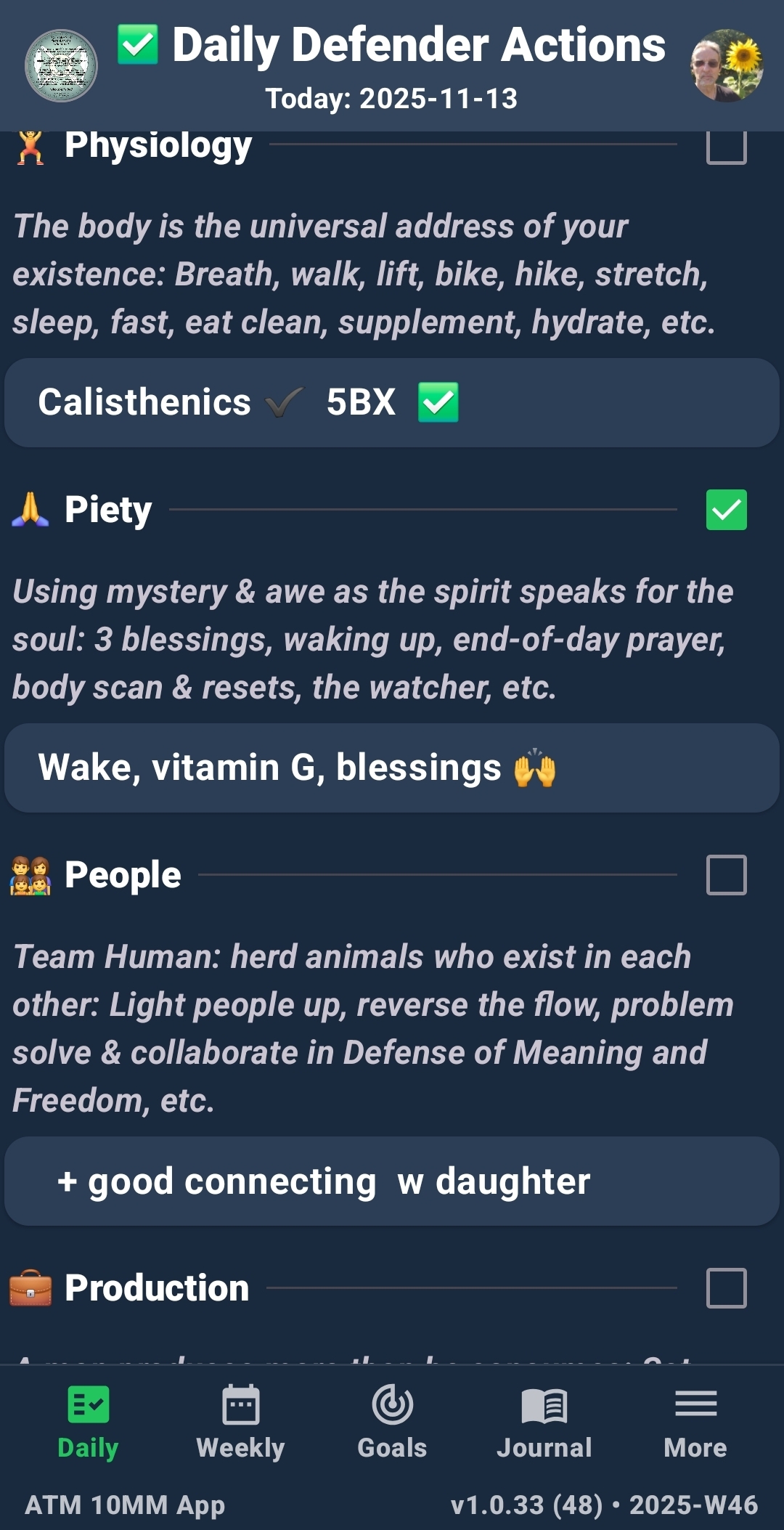
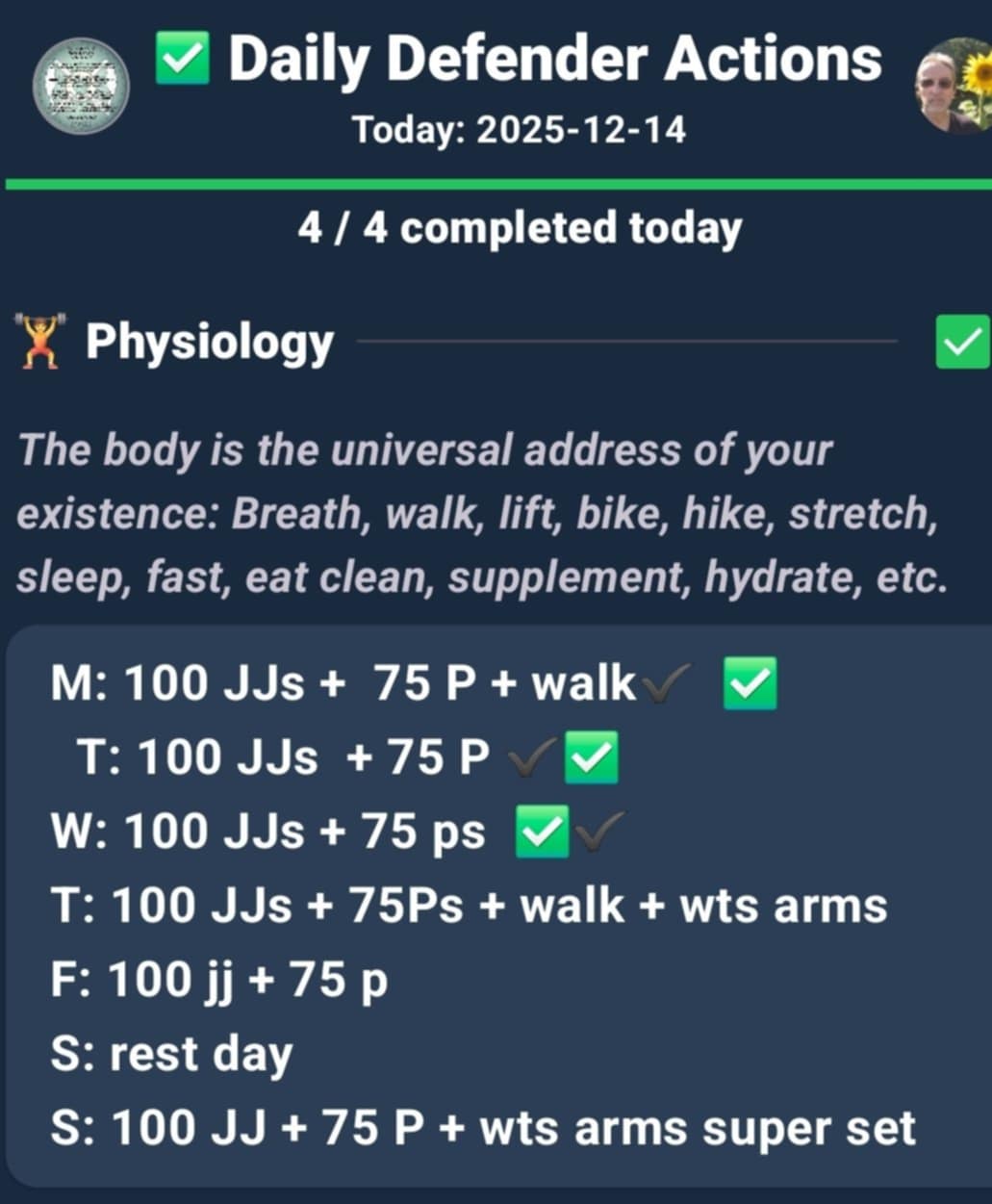
I like to add day of week (M,T,W, etc.) and put something in daily under each quadrant. Here I was with a pulled abdominal muscle but checked off 100 Jumping Jacks and 75 Pushups daily just the same. Tracking did that.

The quadrant system exists to organize daily actions across physiology, piety, people, and production, so that effort can be observed over time. It’s the daily actions, you see.

Like the way I’ve made my bed each morning for decades to “put order into my world.”

Like how I say psalm 118:24 to myself first thing when I pull the window curtain open in my room.

Even as a comfortable agnostic, these set my intentions for the day. It’s the rituals then.

These lessen anxiety, build resilience, form character, and often help with belonging.

For example ma went to church her whole life. Dad didn’t.

I asked him about it in his eighties, and he said he’d wished he’d attended.

Felt he’d missed out on the community.


Some psychologists liken us to herd animals, and tell of how the emotional system is governed by belonging.
The beautiful part of belonging is shared causes, and how as men stand shoulder to shoulder with each other they can accomplish just about anything.

And so, retired engineer and Defender Board member Gary took our stuff and built the Defender App for the benefit of all men. Gary is an amazing guy…

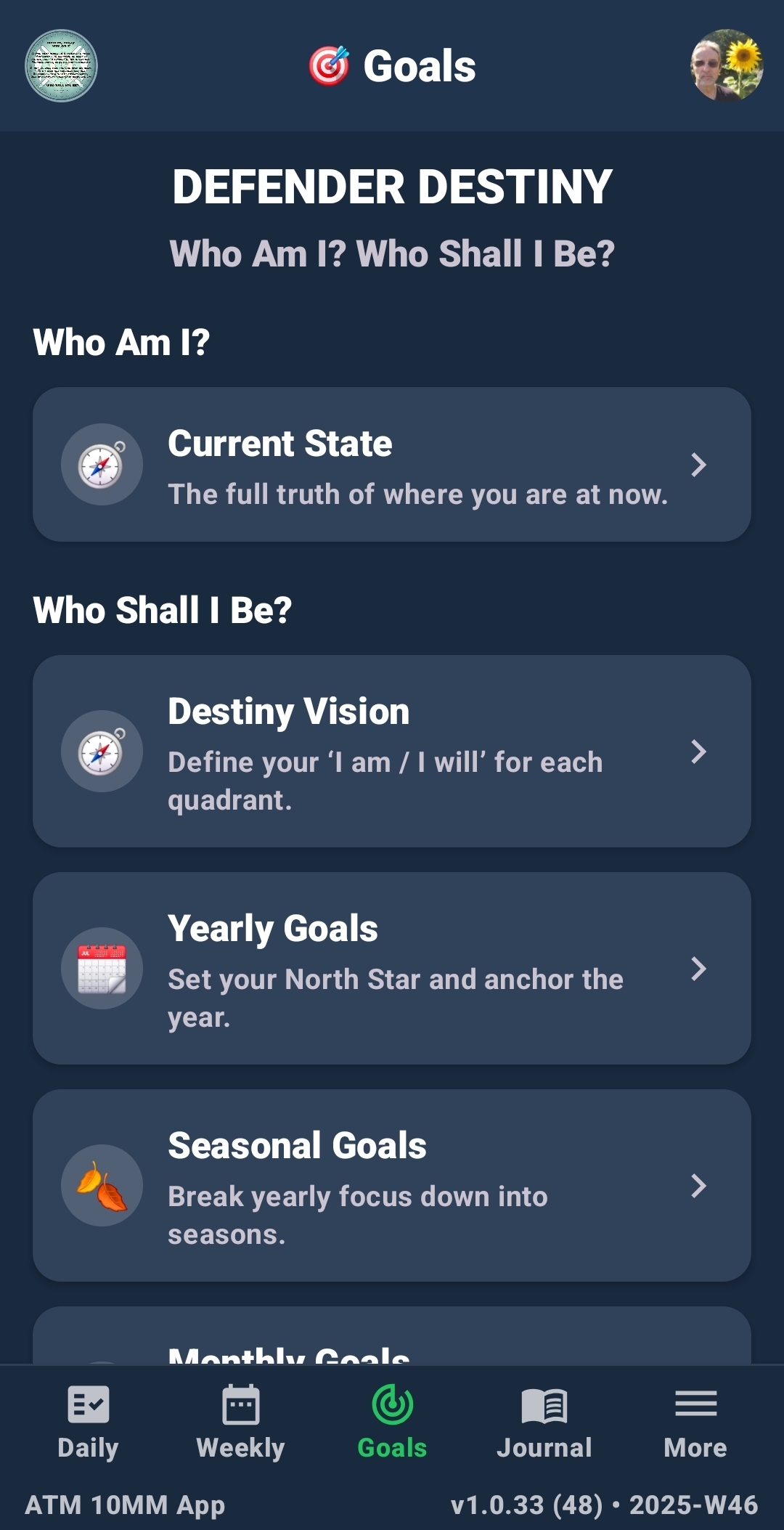
The Defender App supports the quadrant system by providing a stable place to record daily activity and revisit that record later.

Writing actions down creates a reference point that persists beyond mood, fatigue, or temporary self-assessment.

It’s also an app like none other.

WEEKLY CHECK IN 
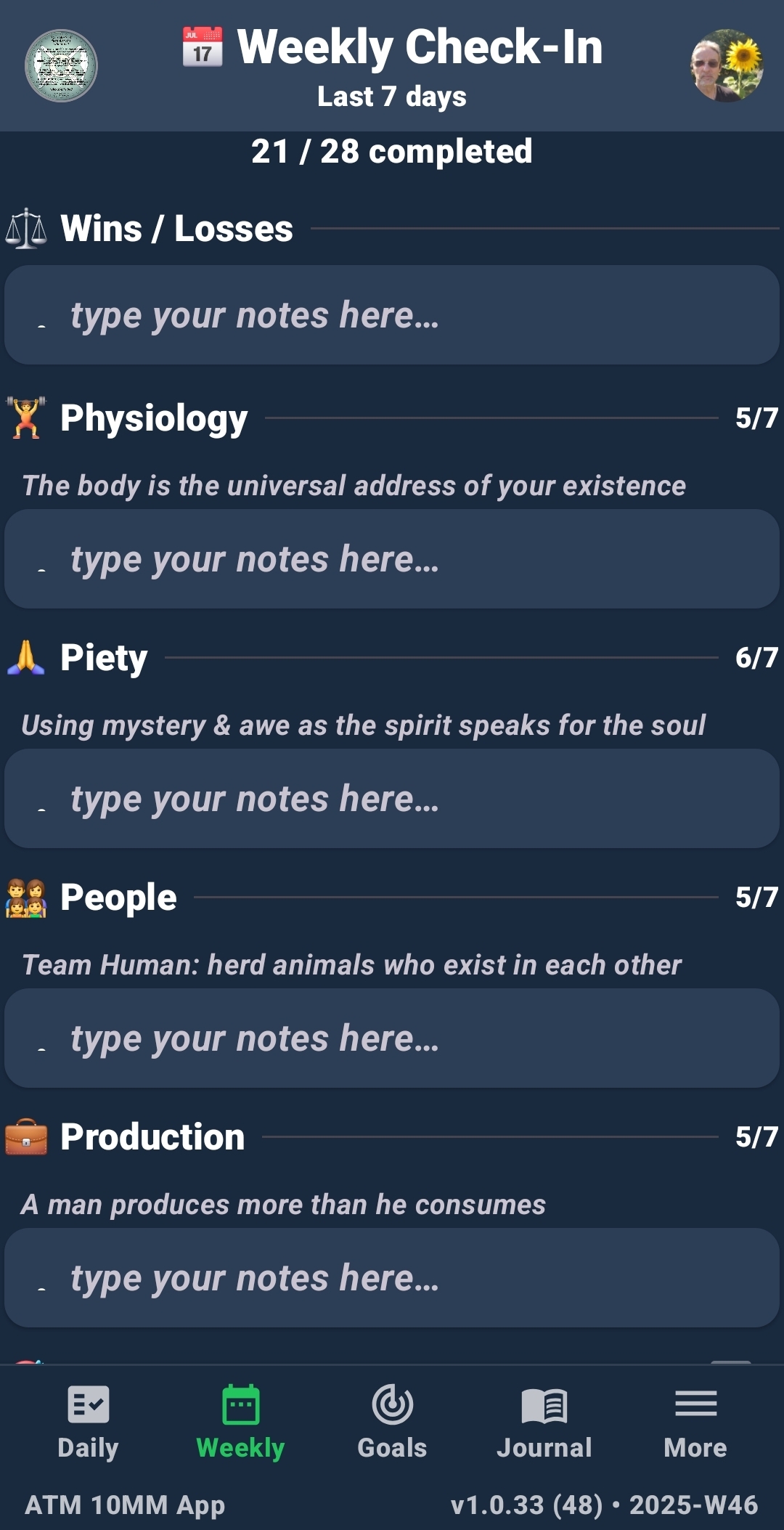
It contains daily quadrant tracking and a weekly quadrant summarizing page.

It has place for a daily “to do” list and leaves room for a “one thing” to get done as this week’s priority.

Taking 15 minutes to review daily activity at the end of the week is really helpful, failing which I would need to assess how committed I am to progress in managing my life.

I like to review my daily activity and summarize them in a weekly “after action review” exercise every Sunday.

GOAL SETTING
Goal setting starts with a no-BS present time self assessment in each quadrant then it asks that you create goals in each for the next month, season, and year.

Firstly, it invites you to claim your identity by creating a Destiny Vision for each quadrant. Combined these make up a kind of deliberate masculine destiny path to follow.

This is critical for men.


We left room in seasonal and yearly goals to enter various levels of goals in each quadrant.

For example you can input a manageable goal, a slightly more challenging goal, a top end goal and a downright impossible or dream goal.

Having this stare you in the face each day helps you to decide what kind of man you want to be.

Ask: why be average when you can be amazing?

PRIVACY
In developing the app we thought about building an interface so you could also access your data on a desktop or laptop. I’ll tell you why we didn’t. We want your stuff to be fully private.

Besides, all of the goals and journaling entries can be saved to the journal section on the app itself or shared by email as a text file to keep in a file off the phone app itself.

Even though no one has time to look at your stuff, we didn’t even want the ability under any circumstance.

GETTING UNSTUCK 
A big reason for this is not just quadrant tracking and goal setting, but also the journaling functions which contain some of my best proprietary journaling techniques.

I refer to these as the “T Journals” as each can be described with a word beginning with T.

For example:

Option one is the open “free flow” journaling where you can enter whatever is on your mind. This is an important exercise where you can dump thoughts and feelings to find clarity.

Hence, “Talk Journaling”

Gratitude journaling encourages you to write at different intervals about whatever it is you have to be thankful for, a practice with profound effects on mental health in the way it reduces stress and depression, builds resilience, improves sleep, and enhances life satisfaction.

Hence, “Thanks! Journaling

The blessings exercise follows that same idea and invites you to find three things that went well today, why those are important, and how to get more. I even get my kids to do this one.

Hence, “Tally! Journaling”

Caging the wolf will be familiar to those who have read Sipping Fear Pissing Confidence and has to do with refuting the “feed, fuck, kill, run, hide” lower order nervous system at play in addictions and general fear seeking. Instead, build your better character while claiming an identity you can be proud of.
A man must defend his confidence at all costs, I say.

Hence, “Temptation Journaling”

The 10R process is found in The Taming Shame course and has to do with identifying negative feelings but which may not fit the circumstances directly. These often signal an emotional trailhead of sorts. 10R provides a map so you can update your internal operating system.

Hence, “Trigger Journaling”

Lastly, the self care writing exercise is included so a man has a way of dealing with old wounds that might still be affecting his approach to life. This is the exact process I used to get past being beaten as a child, You may or may not make use of this deeper work, but it is there if needed.

Hence, “Trauma Journaling”

All of these can be saved into your personal journal library. The information stays on your phone where no one else can see. You can also send files to yourself.

I find that option particularly helpful when reviewing entries about temptation, being triggered, or about old traumatic events.

So, there you have it.
Daily tracking, weekly progress, goal setting based in facts and not in fiction and that build character and identity, as well as the most comprehensive journaling options possible.

The beauty of the system is if reluctance or inactivity interferes with intention it usually means there is work to do emotionally to resolve whatever is blocking a man’s progress. Combined, the various journaling options is like having an Advisor to Men™ in your pocket. Say what??

THE DEFENDER BOARD OF DIRECTORS
Ideally, you want a squad of men to whom you can turn to for feedback, like what we’ve created in The Defender Boards. The Defender App makes the whole process more efficient, and it’s gamification makes it fun too.


You have no doubt heard that what gets measured gets managed.

Life simplifies immensely with daily tracking because of its measurable progress.

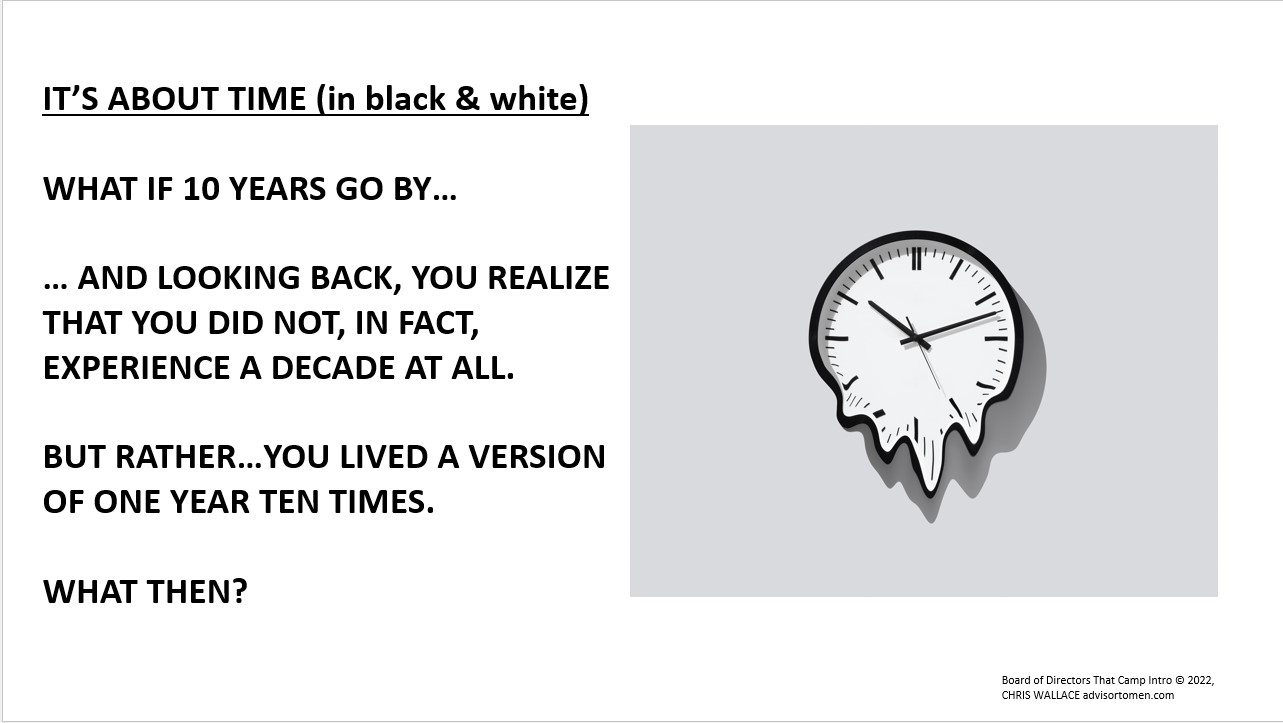
The alternative might mean ten years go by only for a man to realize he did not, in fact, live a decade (or two), rather he lived a version of one year ten times.

Don’t be that man.

Set some goals, track your progress, defend your life.

Be an amazing guy…

Take the quad course, get the app, join the boards

Stay powerful, true and free…
cw

Don’t wait, get started today…

 Join us in building a Defender Destiny by taking this free course.
https://10mm.org/quad-courseVideo version of above: Defender App Intro video Dec,2025
https://youtu.be/4MhnQQWbuoo
🛡️ The Defender Board of Directors meets weekly in squads, daily in chat…
👉 Join here https://10mm.org/membership 
*Note Defender Board members get the Pro version of the app included.
Ask me for my special link to get in the board at less than the usual monthly app rate so you get both for less…

PERCEPTION & PERSPECTIVE

PERCEPTION AND PERSPECTIVE

It so happens that I often speak with men who are perplexed at how to handle their partner’s foul moods.

“When she’s in a pissy mood, it throws me off my game,” they will say. It follows that they feel significant disregard from her in the home when she’s such a frame of mind.

Think for a moment about the word disregard.

You already know it means to NOT pay attention to something or someone, to ignore. Get a sense of how her emotional state affects you.

If you find her mood bothersome, unsettling, distracting, etc., and that it preoccupies your thoughts and feelings, ask yourself why that is.

When else have you felt this way?

When is the first time those feelings made their way into your awareness?

At what other time did you find your body and being negatively affected by someone else?

You might even body trace your present feelings to the very first time you remember feeling these sensations.

Now, think of how these are HER negative feelings…  and ask yourself how those feelings are somehow influencing and even directing your own feelings today.

Why is that? How is that?

How can it be that you, a separate person from her, are suddenly taking on her foul mood. I know, I know, it’s as if we are following the contagion of a yawn.

Her negative mood says jump and in response, your nervous system says, “How high?”

(See the Taming Shame course for a full dissection and strategies around this topic).

The biggest mistake a man makes in those situations is taking things personally.

He does it automatically. It’s subconscious, his nervous system putting out a hypothesis which has worked in the past… for him to evaluate and possibly adopt in the present.

The thing is, to take on her negativity, he must relegate who he is presently to a former version of himself.

In all likelihood, to a time of his life when his very existence depended on the kindness and goodwill of a powerful figure. That’s usually mom (though not always).

In those long ago moments, he may have had fear struck into the center of his heart. Let me explain.

I have two older brothers born 11 months or so apart. This makes them Irish Twins (as siblings born within 12 months of each other are known).

This is something common in Irish Catholic families. My very devoted Ma had ten pregnancies in 12 years (bless her Irish Newfie heart).

A daughter soon followed the birth of my brothers, but she died in the days after she was born. It was the 1950s, and ma blamed painting the basement stairs with lead paint during her pregnancy for losing the child.

I was born next: 9 pounds 10 ounces of maternal redemption.

As a youngster, I longed to be part of an older boy’s trio. In a family of eleven, you needed allies.

The gap between my age and my two older brothers caused by the birth and loss of deceased sister Marie Claire (the name Ma had picked for her) made it difficult for them to take me seriously.

I was very much the lesser brother, never fully accepted but tolerated, especially if I was useful. My brother once told me that all they had to do to get me to act on something was dare me. A double dare meant it was as good as done.

Strive as I might to belong, equality wasn’t possible. The age hierarchy was too great an influence.

Though, when it came time for punishments, an exception was made. After all, I couldn’t very well disown them after striving to be like them and so, I was often lumped in with them when things went wrong.

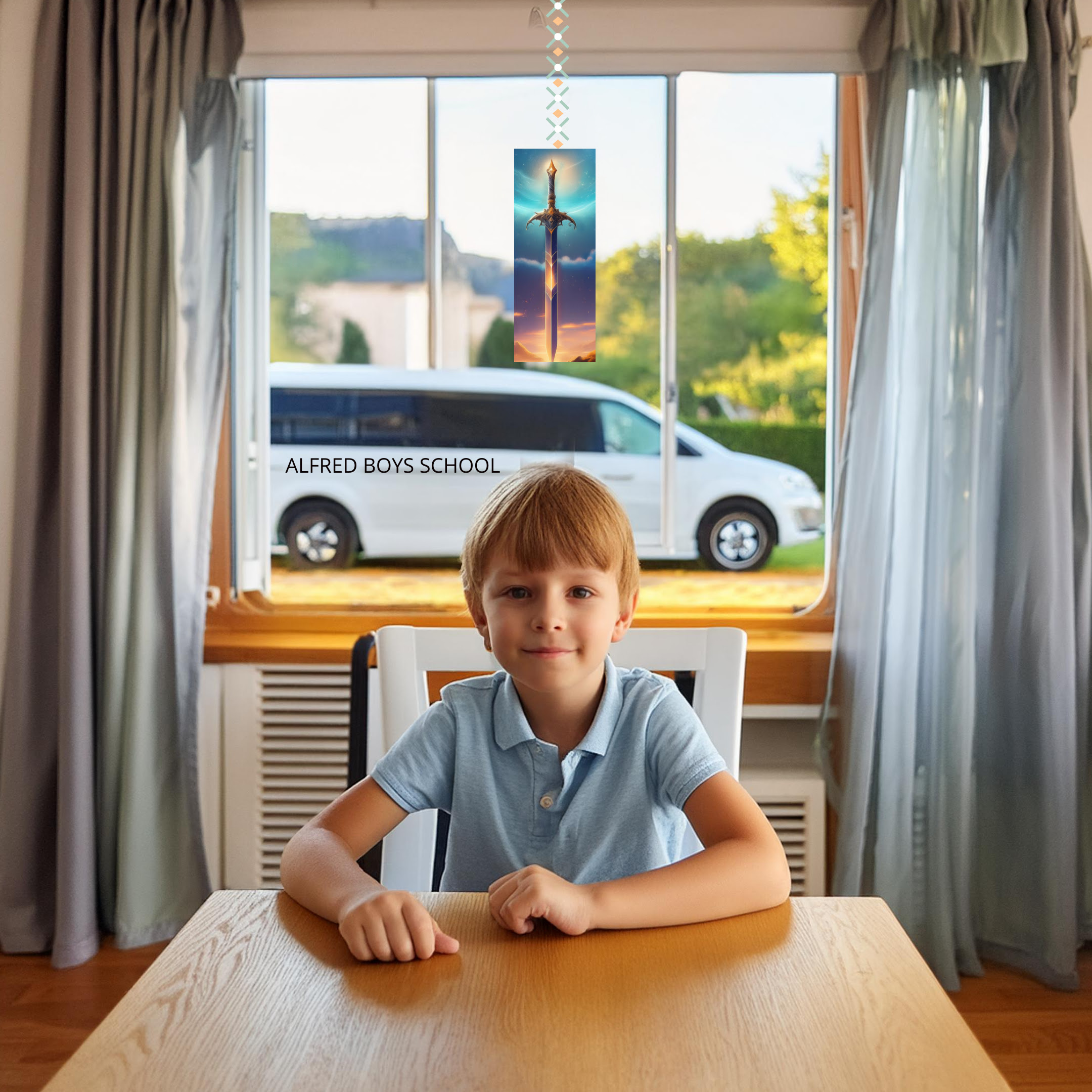
I remember ma would get pissed at my older brothers, Duncan and Stephen, especially the eldest, Duncan, and threaten to send us all off to a boy’s reformatory in Alfred, Ontario.

We knew it existed because Mr. Bougie down the street reportedly worked there.

I was six or seven… and she’d say she was going to call Mr. Bougie and send us off… and I believed her. When I first got wind of it I even remember asking her if she was serious and in her frustration she insisted that she was.

Oh the horror!  I expected the boy’s prison van to pull up at any moment and take me away. What did I know?

It was one of the many Sword of Damocles scenarios of my childhood.

Talk about abandonment fear.

That weakness lingered in the back of my emotional self as an adult. A similar thing happens in an infinite number of ways to countless men.

Parents install abandonment fear in children, mostly with good intentions and sometimes in frustration, for the sake of survival and socialization.

A three-year old will walk onto a busy road unawares until we drive home the idea that a car might run them over.

They ask what would happen. We tell them it would hurt and may kill them. More importantly, that we may never see them again and this would make us sad.

We may repeat that theme for years to effect change in the kid’s roadside protocol so they look both ways before attempting to cross a street.

It is leverage that works.

So next time you find yourself a little out of sorts when she’s out of sorts, stop and track its true source.

Almost always it’s not what’s before you. Rather it’s a prediction from long ago coming back in case it’s useful once more in the present.

The trick is to use perception and perspective.

You must have the perception to know you are triggered by your partner beyond what the circumstances call for and realize the predictive nervous system is doing its thing.

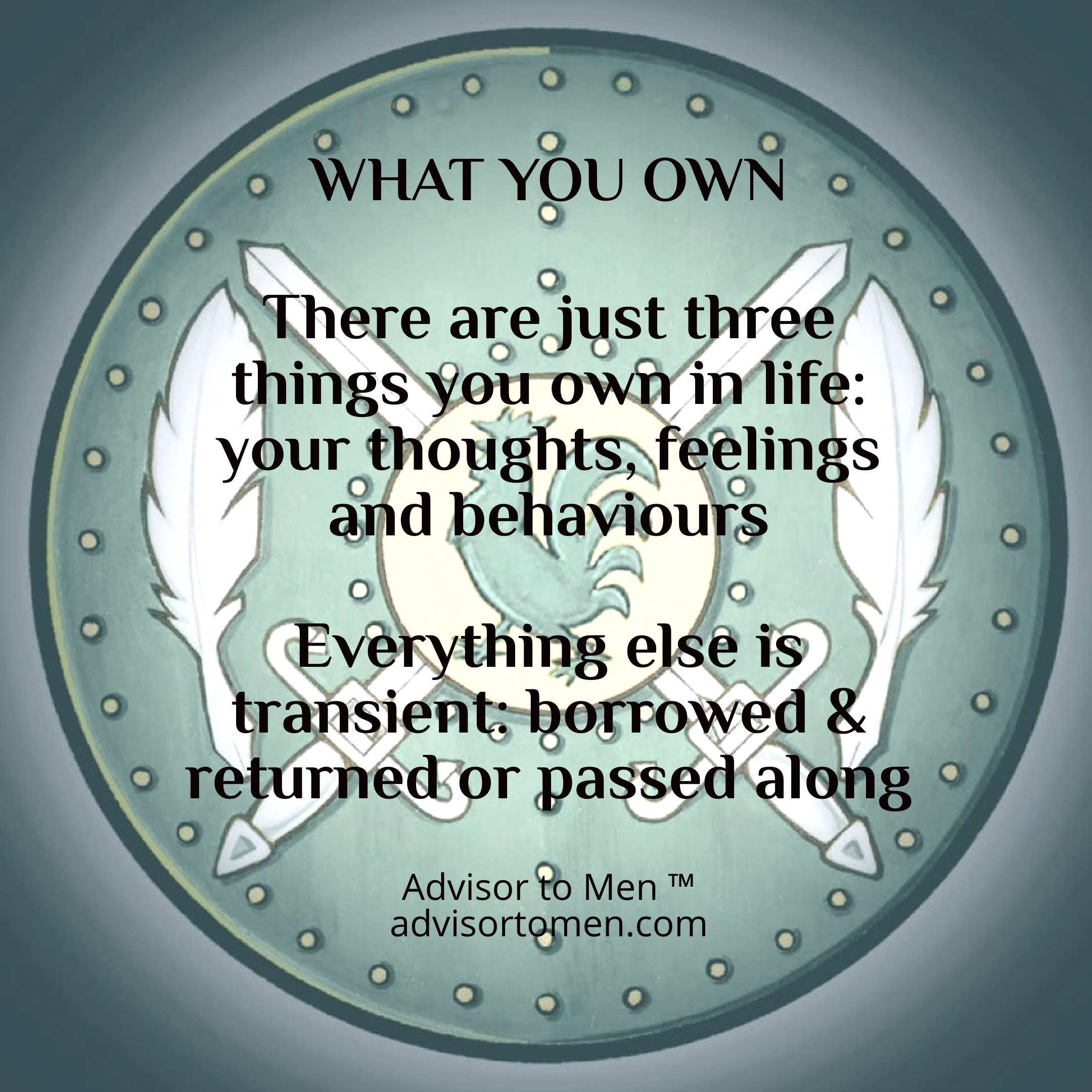
Keep in mind, all you own in life as an adult are your thoughts, feelings and behaviours.

How is it you, as a grown man, are controlled as if you are an emotional puppet?

By doing so you may gain perspective.

I have long ago abandoned free will, so I am saying that with awareness you can exercise a little more “free won’t.”

You can put her remarks or foul mood or detachment into its proper context. Soon, you and I both may see it’s not about me or about you.

In fact, it’s more that her gifts sometimes turn on her.

Her fantastic powers of wider scope with heightened sensitivity to sickness and danger are often too much for her to bear and she suffers accordingly.

It means she sometimes finds herself in protection mode instead of connection mode.

The Quebec French up my way have a saying for that: “Nous avons tous les défauts de nos qualités.” We all have the faults of our qualities.

I guess we could say this is what is meant by “there is a price to pay for everything” and “nothing for nothing”.

The last thing I need to do is make things worse by failing to realize that she is temporarily offline.

So, if possible, I rescue her from her insanity with reassurance. What I won’t do is make it worse by becoming needy in the face of her discontent.

That’s like adding fuel to her fire.

LOL (I know you know it).

Instead, we can best tend to order in the kingdom and remain unflustered by her foul mood…

… and instead encourage her.

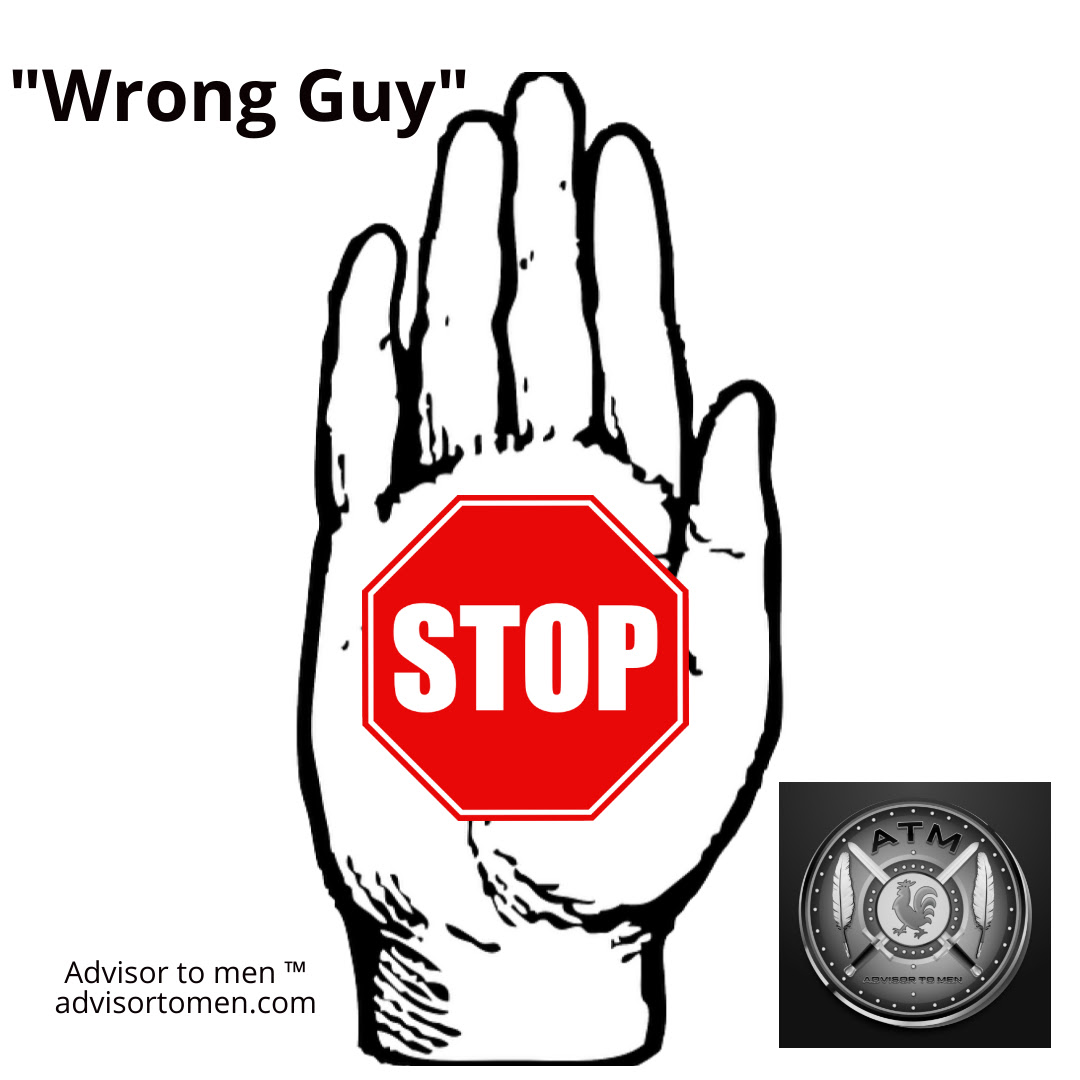
If necessary, I may hold up my hand and impose a limit. I’m nobody’s punching bag. Remember respect is earned or taken. The “wrong guy” signal, said with a calm smile, deflects her angst elsewhere.

But it is compassion that best serves you both. Compassion for myself and what might trigger me. Compassion for her as her gifts turn on her to create her discomfort.

Compassion is like that. It spreads. Seems to me the feminized culture complains we need more compassionate men. Kill two birds with one stone by starting with you.

Surely, we can do that for a partner. We can do that for ourselves. For us. For Team Human…

Only men can ensure love prevails in a home.

She can’t do it without you.

Men lead, women command…

Next time, use perception and perspective to rise up and remain a powerful man.

A powerful defender of life.

Could you do that?

Questions? Comments?

true and free…
cw

* want to talk about how you can manage this stuff on your own? Talk with me and let’s see what we can do together…

Book at https://go.oncehub.com/ChristopherWallace

SLEEP HORROR


SLEEP HORROR
Sleep in this morning? Needed it maybe? Not worried? Maybe you will “catch up” later? Good.

Perhaps you are on modern society’s treadmill, a pawn of the bankers and their capitalist soldiers using interest to create scarcity and competition. Like a junkie’s tolerance, their heroin is ever-increasing growth at any cost, never enough, more and more. That’s life, right? Can you keep this up?

Indeed, chances are for you there will be a  “personal reckoning” of some kind. You suspect this already. Sleep was your God-given right. It was your blessing from the universe: your dreams a therapist’s couch and an art school within the confines of your head.

That you are not alone in this struggle offers little comfort. “We die together,” might be our valiant stance. How honourable. For what cause was this again?

Best get on it. Why? Think you can scoff at your body like that and get away with it? Modernity is relatively new; Mother Nature is old. “Don’t be obtuse,” said the warden to the prisoner…

“Routinely sleeping less than six or seven hours a night demolishes your immune system, more than doubling your risk of cancer. Insufficient sleep is a key lifestyle factor determining whether or not you will develop Alzheimer’s disease. Inadequate sleep—even moderate reductions for just one week—disrupts blood sugar levels so profoundly that you would be classified as pre-diabetic. Short sleeping increases the likelihood of your coronary arteries becoming blocked and brittle, setting you on a path toward cardiovascular disease, stroke, and congestive heart failure. Fitting Charlotte Brontë’s prophetic wisdom that “a ruffled mind makes a restless pillow,” sleep disruption further contributes to all major psychiatric conditions, including depression, anxiety, and suicidality. (Walker, Matthew. Why We Sleep: Unlocking the Power of Sleep and Dreams (p. 3). Scribner)

Fuck me. Walker takes all the fun out of insomnia. Speaking of which, I suffered this way from about single digits until my 30s. Unluckily, once out my parent’s home at 15 years of age, I gained access to intoxicants to knock me out each night, from hashish to booze to heroin. I say knock me out because although I was unconscious, apparently sleep still evaded me. What did I know?

In my thirties, I temporarily gave up all that shit. Oh my, and insomnia returned. It was like meeting an old bully you thought was left behind years ago and then after transferring into a new school, you find them there, well-established and hanging with those you intend to make your friends.

I learned self-hypnosis and defeated insomnia. Defeated it. Although, I eventually allowed substance use to creep back into my life, I was a more of an intermittent user. Functional, until those last few years that is. Both these things were gifts. I solved that addiction riddle too. Defeated it.

It’s the dreams you see, you can’t escape them. And, for better or worse, we need them. I can sleep in a gas station parking lot with cars going by now. I almost slept through the birth of my second son sitting in a chair ten feet from the missus. “Wally, you’re going to miss it!” was her cry. I awoke to find her and her sister and the nurse giving me the look women give men for being men. Oh, I know that look so well.

“They went painlessly in their sleep,” should be everyone’s hope. To go out that way is to gift wrap the inevitable. Link up years of sleep deficits with how sleep tunes the brain up each night and your chances of facing significant mental decline increase exponentially. It could be the difference between dying horribly and dying healthfully in your sleep, your DNA clock simply having wound down to zero.

Rob yourself of sleep and you may face dark dementia days ahead. With dementia, your brain slowly breaks down, and the horror is you are aware of its every step into madness. The horror, yes. You see and feel yourself slowly getting stupider and there is nothing you can do about it. Stupider, yes.

Your frustration falls on sympathetic but capably deaf ears, speaking of which the voices of those you love become garbled. Garbled, yes. And this might make you mad, so angry you fight back, swinging wildly in self-defence and at other times in righteousness. Whereas most of your life you were occasionally wrong and corrected yourself with humility and an apology, now you are always wrong.

You might take a walk down the hallway of your locked ward, this institution where you now live. You see others and take a seat among them to rest. You put your hand on your cane to steady yourself as you sit. Someone gets up to leave and wants your cane. You refuse to give it up, a struggle ensues. You get the worst of it. You are 89 and both your eyes are blackened. The horror… it was their cane after all.

You just don’t understand…. Anything.

Your speech goes from full sentences down to phrases. You nod a lot at those who visit… if you have visitors at all. For a while, at times you read better than you hear so some take to writing notes for you, you know, so information can enter what’s left of your mind using a different pathway. Soon the letters on the pages might as well be Egyptian hieroglyphics.

Eventually, your confidence is so shot you are afraid to even venture a word and instead, stare silently doing your best to convey your mood with your eyes and facial expressions. A smile, a shrug, the odd eye-contact is what you are left with. You may feel like the family dog now, and so you sleep. You can still eat if it’s put in front of you, a lifetime of putting food to mouth not gone yet.

Until you are left staring straight ahead, in the stink from pissing and shitting yourself, great blistering red rashes burning your balls and ass. You scream in pain and lash out at your well-intentioned tormentors, your only salve the drugs you are given to knock you into unconsciousness once more. That’s when you shit yourself again and your torturous cycle of shame and humiliation begins anew.

The pain of your care awakens in you glimpses of injustice. These are triggered deep inside you as if you are being molested while mentally in a coma yet physically capable but weakening more by the day. It’s like you are immobile while being operated on without anesthetic, and your screams go unheard. Powerless, you are outnumbered, and alone.

You realize this is an awful way to go: and you never thought in a million years it would come to this. How can this be?  You are awake and it’s as if brain worms are slowly consuming your reason, but you can’t stop them. They are locked inside your head, slithering among your neurons, multiplying in your Glial spaces, swimming in your cerebrospinal fluid, laying eggs, building a hungry army of young consuming your brain whilst you are alive and listening. Oh, the horror.

Get your sleep. How will you make it a priority? How?

Stay powerful, never give up
cw

©CKWallace 2019 all rights reserved
Advisortomen.com

Get help with your insomnia by booking a free call here


Lieutenant Commander H.C.Wallace (ret)
1929-2019
You’re life counted dad,
cw