Author: Advisor to Men

MORNING ROUTINE


I never gave much thought to mornings the first half of my life, the demands of life dictated my start to the day. If I had to get to work, I tended to leave just enough time to make it, or even be a few minutes late. If I had to be somewhere to do something for my business, then that’s what determined how and even why I got up. For many years, I got up because others depended on me, where others could not do their work until I showed up. That’s a pretty good motivator: 20 people waiting for you.

Over time, I’ve thought to impose some order on this part of how I live. This is more true now that I am no longer and afternoon and evening worker as I was for most of my adult life, and often have to get up in the mornings to go out to appointments.

My children often wake me in the morning. Or, missus will have an alarm go off an hour earlier than it was supposed to. This is almost always a leftover from last week sometime when she needed up, but then, forgot to reset her alarm.

We marry what we can tolerate. I remind myself of this at 5 am and go back to sleep.

Whichever way I wake up at other times, its usually not by alarm. In fact, I rarely use one. From decades of calculating my sleep needs, necessary tactics I used to combat insomnia in my early life, I manage sleep with a priority that works for me.

The first thing I do upon waking is grab my woman’s ass. I think touching her lets her know I’m happy to wake up beside her. Touch is the best way to show she’s appreciated. If she’s already out of bed, I stretch, grateful I got to be one of the lucky ones alive after the dark of night. This is the first thought in my head, and over the years I’ve trained myself to say this silently to myself: “I get to get up today.”

Then, I take the pillows and place them on top of our other ones. I straighten the comforter and sheet and voila! the bed is mostly made before I’m even out of it, needing only slight adjustments afterwards as I roll out and stand up.


I have a carpet under my bed which extend around its periphery. This is where I keep my slippers. But first, I flood light into my eyes suddenly when I whip open the curtain next to my side of the bed. While looking outside at whatever scene is there, I recite the same prayer I’ve said for over 30 years:

“This is the day the Lord has made, let us rejoice and be glad in it.”

It’s from Psalms, 118:24. My rabbi friend says to source something this way is to offer redemption to the world, something his Talmudic teachers taught him. Lately, when I say this silent prayer, I think of this wider frame and accord myself a little redemption, quietly stealing a little personal forgiveness before moving through my day.  Who doesn’t want redemption? Now it’s psalm 118:24 and I redeem myself.

I hang the curtain so it remains open, do the same to the matching window a few feet to the left, dress in morning clothes (housecoat if jumping in the shower, leisurely stuff if I’m working at home) and head downstairs. I stretch high when I do this because I usually wake up a little sore.

I currently head to the kitchen window and drink two big glasses of cold filtered well-water while looking out at my bird feeder. Banter with the missus and kids ensues, especially now that I have imposed order on their morning. No toys at the table, eggs, toast with peanut butter, fruit and goat milk before they get their gummy vitamins as reward.


As I gaze out the windows above the sink, I like to take a moment to notice nature, to let my eyes take in the expanse of scrub brush and trails out back of my house. And the various chickadees, juncos, jays, cardinals, woodpeckers and other feathered visitors who dive in from the cedars to feed on oiled sunflower seeds. I often think of my mother when I do this. Fleetingly, it sets my spirit a little.

Currently, six red squirrels live above in the cedars beside my utility shed out back. My first summer here I never saw them, though we heard them scold us loudly the odd time, first thinking it was tree frog. We have lots of those, and in spring and summer their chorus will fill the evening with such song you must remain silent, unable to compete. This also sets my spirit as I remember what it’s like here in summer.

The bird-feeders I put up last year drew the squirrels out of their trees. I read recently reds can occupy a tree and set stores in its every nook and cranny, then pass the storehouse of food on to the next generation, often for up to 30 years. They don’t hibernate in winter like the Northern Gray squirrels, a solitary black individual I’ve seen only once or twice scampering in from the edge of the woods. Just this week I saw the black version of the Norther Gray, said to happen in Canada’s cold, hurriedly checking below the feeders unmolested. Sure enough, out of nowhere, a red came dashing at him and the chase was on, the black squirrel making it for the safety of the woods a hundred feet away. Those reds don’t like sharing and keep interlopers at bay.


When I was a boy, my two older brothers were Irish Twins and did everything together. In fact, they are the same age right now for another few days, the 3 and 13th of March being their birthdays. Ma had ten pregnancies in twelve years but lost the one before me. This meant a longer gap separated me from the two of them. I felt it deeply when they went to high school and left me still in primary. I felt cast adrift, abandoned.

Ma gave me a set of binoculars as encouragement. This was a rare treat in our family, to be so honoured with such an adult piece of equipment, and a  guidebook to boot. It was all so… professional. I’ve been fascinated by birds ever since. I’m not dogmatic about it, I don’t have a list of birds I have to see. Not anymore. I tried that and it lessened my enjoyment. If I saw an Evening Grosbeak way back and then forgot about it, finding one again is like finding it for the first time. A list would be a way of reminding me how stupid I was to have forgotten. So, no list,  I just like them. The white throated sparrow song is probably my favourite evening song in summer. Often at dusk one will perch at the very top of a nearby tree and let loose its song. It sets my spirit.

My original binoculars are long gone, but ma gave me her pair a few years before she died at age 86. Now her Bausch and Lomb’s are in the cupboard over the fridge, for me to use anytime. I used them an evening a few days ago when a bright red cardinal and his buff coloured mate were seen picking up leftover seeds off the snow beneath the feeders, right where the chickadees and woodpeckers would have scattered them earlier today.

It’s rare to see a mated pair in the backyard this time of year, and usually only one of the pair makes it to the feeder at a time. I like the way the female and male cooperate for survival, something I think provides lessons for humans. The male is bright red and attracts all the attention. If a Sparrow Hawk attacks, chances are he’ll get it first. The female is buff coloured with red accents, beautiful in her own way, easily camouflaged against the forest. And when she is sitting on the nest, it is he who is out hunting and returning with food, spelling her later in the day so she can come to the feeder alone and take her fill. It’s a model for much of life between the sexes.

Both were there, both on the ground, and as it was dusk, I needed the glasses to see their colour because everything looks black and white at twilight. Early March and here before me a mated pair of colourful cardinals. These moments set my spirit.

I still have the book ma gave me, though I have no idea how I managed to keep a copy of Peterson’s How to Know the Birds after all these years. My father’s handwriting is still there where he printed my name in full block letters on the inside front cover in pen almost 50 years ago. In this context, watching the morning birds gives me perspective, a sense of time, of lifespan. The book’s edition was out in 1957, the year of my birth.

My missus loves a coffee in the morning. Never a dedicated coffee drinker most of my life, preferring Red Rose tea like ma, at times I would drink coffee for ten years then leave it alone for another ten. Now, my gal has converted me. Studies which show drinking a couple of cups per day is likely to prolong life by a few years encourages me too. I need every edge I can get. I used to have a wonderful filtered coffee and carafe setup, now we percolate.

I get the beans from Ottawa Roasters, a middle eastern store down on Kilborn Ave, not far off Bank Street. It’s right behind St. Thomas D’Aquin, the French Roman Catholic church I used to attend and where I also served as an altar boy. It’s a little weird to see places like that all these years later, after I’d lived elsewhere until just under three years ago. I moved back to be near my father after ma passed away.

Flashes of remembrances hit me each time I pick up coffee at Roasters: walking through that parking lot; helping with the bottle drive for charity and filling that little garage behind the church with our take; the fence between the church and adjacent school now gone, but remembering attending my first day of school there and being dropped off just over there, in that spot, to face the kids in the yard.

It’s funny how those memories are there though we never think of them. In 1986, I began attending college in Cornwall and enrolled my son in daycare. That first day, I dropped him off and watched as he tentatively approached the yard where the other kids were playing, and it brought back a flood of memories that grabbed me by the throat. Suddenly, I was six and walking into L’Ecole Primaire St Thomas D’Aquin, an English kid at a French school, alone.

You can get Brazilian or Columbian dark in whole beans for 9 bucks a pound at Roasters. And Marie, the server with decades behind her counter, smiles easily. They roast everything, nuts too. I dare you to find better just slightly salted roasted cashews anywhere. Visiting places like this in my old neighbourhood remind me I am from somewhere. That’s an important thing to me. It’s another thing which sets my spirit.

With my coffee in hand, a dash of goat milk to neutralize its bitterness, I head into my office. There, another ritual ensues. You see, I read or recite the poem Invictus every morning. In fact, I recently added the Goal Tracker app on my phone to see how long a streak I can go on. This morning routine is one of them and I check it off once I’m done.

I tried to recite Invictus while doing deep knee bends or walking like a bear on all fours across my carpet so that I may stretch and absorb its tenactiy into my very bones. Mostly I just read it and then do something physical. I want to be sure my will and my body are in sync. I often think of the context in which Henley wrote his famous work: contemplating having his leg cut off, when he’d already lost one earlier. Fucker was a steely-eyed embodiment of masculinity in the situation and his words were his affirmation, a determination to live. It is men’s stuff this poetry, and it sets my spirit.

Now, I take my phone and review my goals. I used to carry all of these in a DayTimer binder but the digital world is messing with my system. I’m in a state of flux, ready to adopt or abandon a tactic at a moment’s notice.

I’m not the kind of guy who can just leave my life to chance and hope things work out. Distractibility is the curse of my curousity. I must schedule my time and my activities. If I don’t, I can be led astray. I’m also not perfect at it.

What I look for each day are two things: Resistance and Zone.

If I can identify my resistance and assess its merit in a situation, usually I find I can overcome it on the spot. Sometimes, I experience reluctance for good reason, of course, stepping out into traffic is not the goal of suppressing resistance. But, feeling resistance signals me to examine and assess, learning to become aware of bodily cues and subsequent thoughts which may be preventing me from living my best.  By focusing on this one narrow aspect of my daily existence, I experience more regular wins. And each time I win here, my spirit strengthens and makes me just that much more powerful going forward.

Men tend to build systems.  Mine helps me get here, to this place: when I enjoy a confluence of my passions and strengths–what I like to do with what I tend to be good at–and add in an intense focus while engaging in something of increasing complexity, I get so absorbed I feel alive at a level I don’t get anywhere else. This is when I experience my zone, and the more I get into it, the more I want.

I have not been able to narrow my thinking to the extent I can live in a zone all day long. I’m much too distracted for that. However, I do hit it regularly. In those moments, I’m on point, and I feel strongest. Not power in the sense of power over anyone else. No. It’s a self-mastery power, like I’m really steering the ship. It’s the purest form of agency I know.

At these moments, time flies by imperceptibly, like I can stop time. At other times, an hour feels like minutes, or an afternoon feel like my entire life because I’m so engrossed in whatever is before me. Stopping time like this is what sets my spirit.

I’m not always successful but this is what I strive for.

I believe the ancestral epigenetic effects on my methyl groups influencing my DNA combined with my databank of emotional states recorded in my body since I came into existence are what constitute my soul.  It is this which I attempt to nourish each day. It is to these greater forces I submit my will and drive my actions.

It begins the moment I wake up thankful for another chance at life. I wonder if you could take a few minutes to think about your morning routine? What could you do which might enhance the start to your day?

My morning routine sets my attitude for the hours ahead. I highly recommend you find some kind of routine which will welcome you into your day with a consistent grounding of spirit.

Stay powerful: never give up

Christopher K Wallace
© 2019, all rights reserved

Facebook
Men’s mastermind

FEAR SEEKING


Know any shit-disturbers? Not mild stuff. Not the kind of stuff men are normally involved in, though that’s probably part of it. No, I mean those people who, no matter the situation or state of affairs governing their lives, always find the storm.

And if they can’t find the storm, they create one. They find something, a small thing or a big thing, and zero in on its possibility and push, prod and call out until things blow up.

It could be with people, with systems, hierarchies, but it’s usually with people. They are often closet conspiracy-theorists, sometimes openly suspicious of… everything.

And too often they have a history of addiction. Not always, certainly, then again not everyone is religious or atheist. Shit-disturbing is not foreign to women by any means either. Hell no.

When humans don’t have an answer for something, we often make one up. It’s the nature of the beast. This serves our evolutionary need to come up with something… anything. Our eyes see out after all, so we look for answers in the environment. This works… until it doesn’t.

If a kid is left to cry it out in the crib as a baby, it may cry for hours until it finally falls asleep with exhaustion. The baby wakes up the next day and has survived. Crying (fear) worked for it in this instance. Those elevated hormones came through.

This easy to understand example plays out in countless forms for many of us, all the way into adulthood as we grapple with sickness, tragedy, war.

How many of us are programmed to seek fear in our lives? I know I was. I am. I met fear at an entirely diffrerent level than those around me. Still do. I am drawn towards the shit storms, strangely attracted to them. Where others move away, I advance, sometimes dangerously.

I have to watch this carefully. So I do.

When I first solved the riddle of addiction, these words you see in the graphic lept off the page at me. I’d read Mate’s book about addiction, Hungry Ghost, but he doesn;t menton this. Ghost is a good book and makes excellent observations, especially around trauma as a precursor to addiction.

It was when I read another of his books, When the Body Says No (2012), that I saw this quote. I’d written my understanding of addiction to that point in my first book, Drinker’s Riddle. The idea of paradoxically seeking fear figures prominently in that work, because I had realized its force over me after 40 years of using drugs and alcohol.

I knew I used drugs and alcohol to hijack my sympathetic system to fill an internal need.

Seemed to me Mate had the same answers but didn’t make the connection. In Ghost, he thought addiction was about trauma. I’ve heard him say, “every addict has trauma but not every person with trauma becomes an addict.” Lots of truth to this and more right than wrong. But to me, that makes it a weaker contention, an incomplete theory.

I searched for the Hans Selye quote as he mentions it, meticulously reading two of Selye’s books. That’s when I realized he’d written so many I’d be at it forever, and still might miss the damn quote. I was trying to source it so I could credit it properly.

So, I wrote Mate congratulating him for his work, expressing my gratitude for the light he shines on addiction. I asked him about the quote. Nothing.

Then, I contacted the Selye folks, those who continue his legacy in stress management. They were really helpful, loved my theory. The quote? Nothing, they had no idea how Mate came up with it.

Finally,  I told Mate by email it was an important quote and Selye’s people can’t find it. He wrote back admitting he’d put it together from what he’d read of Selye’s writing–someone whose work forms the basis of his understanding about stress (and now mine).

I thought that was pretty decent of him. I didn’t know anything about how you’re supposed to assign source credit for stuff you write about so it was a good lesson. And it was a lesson in responsibility too. Rather than bullshit me, he straight up told me it was his impression.

And it’s understandable. Even if Selye didn’t say these words directly, to not quote him would have been borrowing or leaning too heavily on his work without a mention. I learned something about that distinction from this quote.

More importanly,  it’s enough for all of us to understand we can be programmed from our early years to seek stress. We may not like to admit it, but shit happens, and at some point fear may have been seared upon our soul. Branded this way at a physiological level, we may go searching for it.

There’s a price to pay for this, in relationships, health, longevity, happiness. And what of spirit? Spirit is handcuffed by this tangled mess of methyl groups acting epigenetically on DNA coupled with your databank of emotional experiences operating beneath the surface of awareness. The soul.

Yoga helps, so does heart rate variability training, as does committing to understanding the signals coming from your body in various circumstances so you can address underlying stress and breathe differently, taking control, and then thinking better. If your baseline stress level is “always on”, you can learn ways to shut it off. Or lessen it’s strength.

The pay off is less restlessness, more meaning, less boredom and a longer life. You may even feel more happiness.

That’s worth fighting for.

Stay powerful: never give up

Christopher K Wallace
© 2019, all rights reserved

REAL MEN — LIVE TRUE AND FREE

CHOOSING LOVE


CHOOSING LOVE

Had a preference for blue-eyed blondes most of my life. All 8-10s I guess you’d say. Divorced the last one after almost 25 years, just shy of it. Knew I could not stand up at the quarter century and say it had been great. In fact, though we had some fun times and raised a fine boy (we’re tight), it was often a nightmare. My fault as much as hers.

Maybe it had to do with the girl who lived behind us in Halifax. I remember reading how our first sexual experiences are lasting. I was about 5 when she invited me into the woods and found a sunny spot for just the two of us. I guess she had to be about 10, or maybe 12, but I’m not sure. There, she pulled her pants down and lay down in the daisies and had me sprinkle petals on her naked vagina. She was a blue-eyed blond. In my mind’s eye, I can still see her laying there touching herself.

Then a gal chose me, because from what I can tell, that’s how it works. She is much younger. Soon she was highlighting her hair to look more blonde, and her eyes are green. I remember that saying as a kid, “never trust a woman with green eyes,” so.. yeah. Great ass, though. I became an ass man. Just happened. Motivation I guess.

After a few years, she stopped dieing her hair. Then she wanted my child. I told her I’d get her a dog. She looked a little hurt. I told her if she did well with the dog, I’d let her have my baby. Because, well, who wouldn’t want my kid, right?

So for her birthday, middle of buttfuck nowhere Alberta in a Febuary snowstorm, I get her this dog. The woman wants 1500 for this little black bitch, Bichon Frise. She’s the runt and goes straight for my gal. Apparently, it’s a Cuban breed sub-type and I’d learned Cuban Salsa after my divorce. Even spent a few weeks in La Habana learning from a top teacher. I give her 750.

That dog, first time I threw a toy it brought it back to my feet. Missus had Ceasar Milan on all day and night. She became a dog-whisperer herself. We move to Toronto. She starts a dog walking and training business. She is really good at it. I know I’m fucked, but I’m amazed.

I take her to see Caesar Milan at the Molson Theater or some place like that downtown. There’s 3K women screaming and me checking my emails. Dog gets sick. Missus gets pregnant. Loses one in the middle of the night. I actually feel for her and I don’t fuck it up. I’m decent. She buries the miscarried fetus in a bean plant in my kitchen the next morning.

Before long, she’s pregnant again. She knew right away this one was good. How could I deny her? A few months after that, a perfect baby girl. Women have told me I needed a daughter to better understand them. I’d scoff. But, they were right. My little girl has taught me plenty about love.

Two years later, a boy arrives. He spends the first few months at Sick Kids. The dog, Maggie May (obviously, she let me name her) is really sick. These fucking vets are expensive and assholes about it when I ask them to put her down.

My gal asks me to take care of it while she’s at Ronald McDonald House, near the boy in Toronto, a hundred clicks from my place in Cobourg. So, I do it myself and bury her in the garden. It’s unpleasant.

My father had five sons. No one named a boy after him. I name the boy Howard, after my dad. He’s over the moon. Grandpa Howie and Baby Howie, now Little Howie.

It’s been 13 years I’m with this light brunette with the green eyes. My daughter is blue-eyed blond like I was as a kid. The boy is spitting image of his mom. He’s mama’s boy, in fact, but, he’s a boy.

I’m their hero. How often do we get to be someone’s hero? I’m her hero too, missus that is. She says, “you might be an old man, but you’re my old man.” I never heard sweeter words. Ever.

She won’t marry me. Maybe I needed that. Says, “if we never get married, we never get divorced.” I can’t argue with her. And, she’s taught me a lot. I want to do well for her, for the kids. One thing I learned is a man can learn to love anyone. He’s adaptable.

So it follows: If happiness is a decision, then so is love.

And everyone wants to feel like someone’s chosen.

Stay Powerful, never give up.
cw

©ckwallace, 2019, all rights reserved.

https://facebook.com/groups/advisor-to-men
https://advisortomen.com/board-of-directors


NO FLOWERS FOR YOU

NO FLOWERS FOR YOU

Around days like Valentine’s Day, I often hear men say the dumbest things. My favourite is this one:

“My wife doesn’t like cut flowers.”

Oh really?

What the fuck brother. Did you go ask her you dumbass?

Because that’s the wrong god-damned thing to do if you expect to keep getting laid long into the future.

If she doesn’t like cut fucking flowers: TOO FUCKING BAD

You’re giving them to her because that’s what YOU want to do.

And if you know she doens’t like cut flowers because she told you after you asked her, you need to be bitch-slapped like the pussy you are.


Or talked to earnestly, fatherly-like, and have things explained in the simplest of terms. Ok, that’s the tact I’m taking here.

It’s like my first girlfriend Sylvia taught me when I was 15 years old, something I shall never, ever forget: She said, “sometimes when a girl says no, she really means yes.”

Like what the fuck are you supposed to do with that information? How the fuck is that going to help you govern yourself accordinly, so that you somehow meet her demands and satisfy her needs?

Well, the thing is, the advice is GOLD.

Because it tells you do never mind what she wants and to go ahead and love her. LEAD that woman into your arms and bed. She’s begging for this from you. AND, she expects you to know this already.

Don’t be a jerk. Be the best version of yourself. Be kind, be fair, be there, be an immovable presence for good in her life. But you need to sweep that girl off her feet, DO IT.

What else is there? “Oh, hey, babe, I was wondering, would it be ok if I, you know, sort of, swept you off your feet? Just for a minute. I’ll put you right back down. I promise not to drop you!”

Is that going to be your pathetic approach?

Because I can tell you, you may keep a gal living in your home but you will soon be a sexless and frustrated piece of furniture she has to dust off like the rest of it.

Remember, familiartiy breeds contempt. Promixity breeds comfort and boredom.

DISTANCE CREATES SEX.

So don’t become predictable. When a woman tells a man she doesn’t like cut flowers, that’s a test. Send that wench a dozen dozen the very next day! To her work if you can! So all the other wenches will gather around her and want to touch her so some of her magic rubs off on them.


Doesn’t happen that way?

HA! Fool. Soon to be a sexless fool wed to Mrs Thumb and her four daughters…

I spend yesterday delivering flowers and I can tell you, the gals rush her in worship of her love and your devotion.

AND everyone of them, from the 18-year-old clerk in a warehouse to the 70-year-old school secretary practically swoons at the very idea one of them is being adulated so.

It’s the sisterhood you see. They fucking cry for each other.

Men lead; women command. Never forget it. Didn’t get her flowers yesterday? Do it today. Tell her she deserves a special day just for her–that’s how amazing she is.

Your comments? Ideas? Impressions?

Stay powerful: never give up.
cw

ps, I came home with this stuff for her and the kids. Sure enough, it’s all over her wall this morning. She’s making sure her gal pals know she’s loved and appreciated.

I’m happy to oblige her. Left her weak. Trust me.

CHRIS WALLACE
©Feb, 2019 all rights reserved

facebook

wench
Dictionary result for wench /wen(t)SH/ noun ARCHAICHUMOROUS
1. a girl or young woman
______

TOP DEFINITION (Urban Dictionary)
An admired woman in your crew, a talented warrior seductress, that can inspire adventure or take a bland situation and make it rife with excitement.
Rally yer wenches to the party boat!
by gingerninja11 March 03, 2015

EVOLUTION & CHANGE

EVOLUTION & CHANGE: more push and pull from life

Cognitive dissonance: holding two confliciting beliefs. It’s akin, or like a cousin to, guilt. It’s uncomfortable. Most people take the path of least resistance and adopt the easiest route to re-establish comfort. However, doing that often means compromising self-concept, which as you might know, is destiny.

Ex: A guy sees himself as an honest man. Yet, catches himself bullshitting while talking to some people. He senses it in his belly then or later, and doesn’t like how he feels.

So here, he can either rationalize it–and tell himself something like, “Everyone bullshits a little bit,” or a version thereof.

However, if he does this, it means a shift in his self-concept, a watering down of his values and belief in himself, and a polluting of the ideal of how he believes others see him.

He’s now nothing special: a “bullshitter” like everyone else.

This is a weakening of his self. It’s a weakening of his manhood, and that lessening of his power will translate into every area of his existence. Soon, he can expect to use this same lazy template to rationalize other aspect of life: his body, his relationships, his work, his very spirit.

The more difficult challenge for him is to take the interoception he reads from his body and realize this was a call to action.

This is what men do. They lean into things, even when those things are uncomfortable, painful, and involve short-term loss. A man with an intact sense of himself knows if you give him an ax and point him towards a forest, he can build a life.

A man who knows he is a man, remains dangerous. He guards against anything which would dull the sharpness of his edges, carefully honing himself like an ax, or a sword, or a mind.

He may choose to never bullshit again. He may choose to retract (a beautiful word and technique available to anyone) his words with those people, and re-establish his worth in his own eyes, and perhaps in theirs. He may choose to be more careful in the future and stay precisely on the side of truth.

The same is true of any change. Life progresses and we must adapt to it, or die. Each day you are caught between your old self and the possibility of a new you. The old self is comfortable, you know him well.

The new you is uncertain, less known, and perhaps a little scary. Part of it is because your self concept has two aspects: How you see yourself measured up against how you believe others see you. What a balance you must negotiate.

The motivation stall is wrapped in two things: one is your old self/new self dichotomy being played out as per above. But another factor could be perfectionism. That’s a common facet in men, and indeed, of procrastinators everywhere.

We can become afraid to act and make a mistake and, be judged, so do nothing. The risk is judged too high, best to immobilize myself, frozen here, I take zero chance. Now, I am plagued with “what ifs” and “if onlys” and “coulda, shoulda, woulda” self-flagellations. These add to my inertia.

So, the answer is to watch for the above. Sometimes, just starting at something is enough to entrain the rest of you… so you become fully involved in a task. Starting is everything.

Worth repeating: Starting is everything. Do one rep, commit to 5 minutes, get moving, but start at something, anything.

Soon your natural inclination to live takes over. All humans seek to stop time, to cheat the forward movement of their lives, to stop the linear progression they know ends in death.

And the only way to stop time is to get so deeply engrossed in doing something of complexity and which demands from us a progression of competence. This flow state stops it all, and is the natural boundary of spirit and body. It’s where passion and strengths and focus meet. It’s our personal heaven while alive, available to anyone one of us.

This all is made easier if you are getting time in to take care of your spirit needs. Planned and merited reward is a key part of taking care of yourself. Do not allow the demands of those around you to snuff out your spirit. Do not ask, but take it, impose your spirit on life. You are no good to anyone with a weakened spirit, so do the thing which allow yours to soar high.

It’s good to plan “I will do this and then I’m going to do that” and have the “that” as something which rewards you. Play is spiritual, especially play in nature, outdoors, where you evolved. Planned play is a key way to take care of you, your spirit. Do not let this lapse in your life.

All of us as human being have a core worry that other people will discover we are imperfect, and not good enough, and that this discovery will mean we are not worthy of love. It’s a story we tell ourselves, derived from nature’s needs.

Understanding this, we can seize our power as men and write our own narrative. It’s our story to write.

What story are you writing about you?

Stay powerful,
cw

WOMEN IN AWE


WOMEN IN AWE

It’s a peculiar thing to consider different aspects of sex differences and run into a wall of protestations by ideologues lamenting women’s purported weaker position in the world. This may be true in some cultures; however, in the west, I disagree with that view. I think women are the real power in most societies; moreover, in general, men are their proxies.

Maybe I just can’t get past my own experience. Call it confirmation bias and dismiss it. Know this though; I fully realize I’ve been working to make one woman or another happy most of my life. I don’t see signs of it letting up either. Canada is also one of the most multi-cultural places on the planet, and so I talk to a lot of men from all over. Seems to me these guys are all trying to keep their women-folk happy too.

From my mother and big sister in our family of eleven, crammed into a tiny bungalow in Ottawa’s south end, for me the pattern was set early. If ma wanted something done, I was all over it, grateful for the chance to score points and curry favour: a pat on the head, being able to lick a blender beater after she mixes icing. No doubt also to make up for my many shortcomings. I grew up from toilet training on knowing I was a disappointment, with the odd glimpse of glorious self-worth derived from getting lucky doing something right. A little redemption can breed a lot of hope.

Big sister was number two. We called her Dita, a contraction of her full name. At eight months old, the family did a five-year stint away from the capital to Halifax, following dad as he did his thing for the Navy. When I was about five, her status was made official one day after I’d teased her, calling her, “Di-ta Pi-ta, Di-ta Pi-ta,” taunting in common singsong. Well, ma descended upon me like a raptor after prey. Shaken and berated, I can remember it like it was yesterday, and I don’t think I gave my sister much trouble again. She, in turn, proved to be a good stand-in for ma, a tolerated and loved Little Mother, providing directions and explanations, a direct conduit of power from the top.

It was the same with moms who gave a little extra attention to the baby boom kids on the block. Ma once told me 62 children lived just on our part of Falcon Avenue. Mrs. Seward, across and a couple of doors up was as welcoming as her big doorstep, upon which kids would gather to bask in her attention. Kindly, loving, accepting, she could raise an army of children followers if needed.

Mrs. Rochon across the street was a French-Canadian, with long beautiful hair and movie star looks. Me, and my lawn-mowing, car-washing, snow-shovelling partners, would fall over each other at her beck and call. She’d toss us a few dollars, never quibble at our prices, and let us paint chairs and tables, fences, cut hedges and grass and whatever else she wanted. At ten or twelve years old, the sight of her sunbathing in a bikini in her backyard while we were on official business tending to some task, was like being humbled in the presence of a goddess.

Devotion to women was also true for the old gals for whom I’d do gardening and snow shovelling. Mrs. Adams had a super long driveway I’d shovel by hand for five bucks. In summer, she’d get me to cut her lawn, two bucks for the front, two bucks for the back. Afterwards, she’d insist I come upstairs to drink beer with her. She was a transplanted Newf and spent a lot of her day in housecoat, gray hair in curlers, and smoking furiously. When I’d go home smelling like booze and cigs, I’d report Mrs. Adam’s made me split a beer with her and my parents would just accept it with, “Is that right?” and nothing further.

Mrs. Forward across the street to the right was probably my best customer. My main partner, Graydon, lived next-door, straight across from me. We did everything for her. That lady didn’t plant a tulip without it being done by one of us, but preferred to do the weeding herself. She was tiny, wore glasses with gray hair, and had a big smile and a twinkle in her eyes. I can imagine as her younger self she was probably a real beauty. Her husband had some kind of respiratory problem and would spend twenty minutes at a time coughing so loudly from his upstairs porch, the whole neighbourhood knew it was he. Sickly and reclusive, he looked upon his wife’s little helpers with amusement, always kind but staying out of our way. It was she who was in charge.

My best teachers in school were women, where the tradition of pleasing women continued unabated. My early teachers were sometimes mean and sometimes kind, but always powerful. Some grades I had a Catholic nun as a teacher.


Probably the most beautiful face I can remember seeing to my mind was my grade three teacher, Sister something. She let me down that one. After tossing notes back and forth in class with Junior Lefevbre, she sent me home at lunchtime with a note for ma. I have the family record of hits with the hockey stick handle as a result of that incident, seventy-two or so whacks on my bare ass at eight years old. My brothers counted. I remember showing her my backside the next day at school, black and blue, my shirt still sticking to the bloody contusions, and reassuring her I’d learned my lesson. She recoiled momentarily at the sight, in what I assume was horror, composed herself, and then barely spoke to me for the rest of the year.

In grade five I had Mademoiselle Lapensee. She was there, and not there. She could smile at you one minute, and be somewhere else the next. Her lessons were from the book and little personality shone through her words and voice. It was all body language. She wore a mask. No. I mean it, a real mask of make-up so you could see the line under her jawline about where a man would shave a trimmed beard. Her face was completely painted, more than I’d ever seen. Weirder still, once she gave us something to do, she’d walk around the class in deep trance, looking off into the distance, a moving daydream vivid with scenes for she’d smile and chuckle and frown and arch her painted brows as if she was in a conversation elsewhere, which she was. Once every ten or fifteen minutes she’d return to earth, correct some errant classmate—sometimes me—and return to her revelry. It was intermittent reinforcement for children and you had to be on guard in case. She taught me, something.

Mrs. Stewart in grade six gave me a boost. I used to deliver the morning Globe and Mail by bike to her house three or four miles down Heron Road at 6AM for a while. I must have been nuts but she had singled me out as promising and I’d do anything for her. I was class president that year during the first Trudeau era and so I had male role models from afar, but worked for women in my daily orbit.


In grade seven, a new middle school opened up so those grades ceased to exist at Lamoureux, my little French school at the end of my parent’s street. This was a shock, being bused in with kids from all over the city to a place far from home. In one of my classes, my teacher asked what we wanted to do as careers. I said teacher—she talked me out of it. I said farmer—she talked me out of it. Said there was no money in either one and to abandon them. And yet, those yearnings still exist in me. I can’t blame her, who can predict the future? I teach lessons now and live in the country so: I’ve compromised.

There is little doubt in my mind I worked for my women during my three longest relationships too. One of five years, one just shy of twenty-five, and my current at thirteen or so. In each of these cases, making the missus happy has occupied an inordinate amount of my time and energies. Where at first I was so programmed to follow orders and please my gal, it took me many years to discover this was a mistaken approach.

I’m afraid I don’t buy the institutional gambit of women having lesser power. There’s even a book called, The Myth of Male Power, written by former feminist Warren Farrell, a male. I missed it when it came out in the early 1990s, perhaps because I was too busy working 60-hour weeks. I recently bought it to read on Kindle, so it’s on my list. But, I confess it’s not a priority because I suspect it’s going to be one of those reads confirming what I already know. Eventually, I’ll get to it.

But, men have likely always been, and are likely to be forever programmed from an early age to seek the approval of their mothers. There’s not a shrink anywhere who will discount the magnitude of family of origin influences. If pleasing mom is the order of the day while the very neuronal circuits of my brain were forming, those pathways don’t get paved over easily. I’d suggest these are permanent and indelible to such a degree as to become an almost drive-like force for men: eat, sleep, please women.

Look at Sherry Cohen’s Harvard research where she slapped fMRI on a hundred and sixty or so couples. She determined what makes men happy is this: notice what makes their partner happy and then attempt to recreate those circumstances. Happy Wife, Happy Life has a real basis in the male brain. You decide the nature/nurture bit; I just know it’s there without question.

And, since everyone has a mother, and every little boy’s first order of business in life is trying to please her—whatever the situation and without regard for her mental stability—you can bet it is women who hold the real power in most of the world. The tiny minority of men who head companies and countries, owe a lot of their success to this same drive to please their moms and gain status before the women around them.

Recently, for interests sake I sought to define what it meant to me to be a man. I started with some things I thought were essential. Things like: a man takes responsibility for his actions; is decisive and carries through on things; doesn’t play games with people and is a straight shooter in relationships; expects to work and carry a heavy burden most of his life, finding ways to make it meaningful while producing more than he consumes; cherishes family and protects them; abhors a bully and can defend against one, and most of all, recognizes himself as a man and doesn’t apologize for it.

To this my friends added more depth, mentioning a man elevates those around him; seeks the truth in all endeavours; shares stories about himself and how he came to his wisdom; embraces his male sexual essence in a healthy way; lives his life in service; and is a hero to his family because through sheer perseverance he is the guardian of their hopes for each other. Finally, a latecomer put it this way: “the definition of manly is anything women disproportionally reward in mating. There is no other definition.”

So there you have it.

And that brings me to my last point. It’s just that these forces have been with us from the beginning. It’s been a long time since we split from the great apes—something like 8 million years ago—and began the hominid line. These needs undoubtedly go back much further, maybe back as far as time itself.

And that’s the problem with this stuff. It’s the Lindy effect. A book published a hundred years ago and still in print will undoubtedly be in print in another hundred years. It’s likely we’ll still be reading from Twain to Nietzsche then, amongst the other greats of our literary past. But a book being published today has almost no chance of being read let alone published one hundred years from now.

I think we need to see a much bigger picture. These forces acting upon men for women are not going to change unless we force it, unnaturally. What we really need is awe. Just to realize the sun heats up to 27 million degrees Fahrenheit and one day will turn into a red giant, swell up and engulf the earth. The same force creating that made us. It took a long time for women to get men to stay connected to one partner and live a life in service of them and their children. Don’t mess it up now. Adjust, sure, make corrections, but be careful you don’t undermine the whole system. We need to look up at the stars and see ourselves as tiny, infinitesimally small before the universe.

Less well-intentioned but mistaken idealism.

Less hubris, more awe.

Stay powerful,

Christopher K. Wallace
©Advisor to Men, Jan, 2019, all rights reserved
join us on Facebook here
join the board mastermind here

KILLING SPIDERS: A Metaphor for Marriage

KILLING SPIDERS: A Metaphor for Marriage
As a boy, I lived with my two brothers in my parent’s basement. Dad had the old man who lived next door put up some walls to divide up some of the space. No ceiling, just open rafters and cement floor. It was full of spiders.

They were everywhere. Of course, mostly you’d see them at night but practically anything left undisturbed for a day or so might hide one. Touch something in the basement and one would scurry off madly. Any corner with a bit of dust in it and chances there was also a cobwebbed hideout holding one of these predators.

I had difficulty sleeping from a young age and often stayed up reading. Out they’d come in the night. It got so I would stare at the page of a book and suddenly get a “sense,” a Spidey-sense call it, where I somehow knew there was one nearby. Like the feeling you get sometimes when someone is staring at you. You look around and, sure enough, some dolt is fixated upon you with bulging eyes as if they’d been at it for some time. It was like that, a little unsettling. A human you can stare back, with a spider, it’s just… a little spooky.

Whenever it came to me in the night, I could lift my eyes from the pages in front of me and in the dim light, see a spider somewhere near, hanging down from its thread of silk, ready to explore my bed. Sometimes it was inches from my head. Right there.

Or, I’d look at one of the walls and let my eyes linger, searching the wood chips in the press board, until I found the crawler which had summoned my attention, hiding there somewhere, in play sight.

Years later, I thought I’d put this all behind me. I was long gone from the basement with its eight-legged denizens and had lived in many places since.

Now, as a married man, for some reason it returned.  Missus had been her family’s eldest, coming as she did from a Northern Ontario mix of French and English parents. She was… outdoorsy, and pretty much fearless.

I’m not sure how it happened first. I suspect she encountered a spider and I demurred somehow. Perhaps, I only hesitated.  It’s my conjectured recollection she may have seized the moment to act. She was competitive that way. Perhaps, I’d already told her of the basement. I don’t remember.

I’m sure I did later or at some point. Likely, I had at a time we were both high, the drugs or booze fueling a prattling on about ancient nonsense. The eeriness of those spider encounters late at night while under the influence of Asimov, Heinlein, Clarke, Bradbury, Herbert and others would have been hard to resist retelling.

My father had gone through a sci-fi stage in the later 1960s and early 1970s. He read a couple hundred of these paperbacks and they were left around for his nine children. It was a time when our family had a bookcase in every room, even the kitchen. I read them all, not exactly an antidote to sleeplessness, but still.

It was much later, after going in during 1981 and spending all 1982 inside, and when I’d been transferred from the penitentiary to the farm camp next door, that dad came by for a visit. He brought his whole sci-fi collection and donated them to the meager library there. It was pure escapism, something the guys were thanking me for to the end of my bit.

So, however it happened, my missus at the time took over spider duty, and looking back, she seemed to relish this power over me. Blinded by self-importance, overlooking my own shortcomings, what at first was an acknowledgement of her courage at breaking stereotypes, well-intentioned but misguided idealism,  experimenting with role reversal after the social movements of the 1970s, it soon became an self-emasculating indulgence of male weakness.

See, I let her kill the spiders. Then, and going forward. All of them.

I could have killed spiders. I knew how. I’d killed many of them, maybe hundreds in my time. But I let her persuade me with false concern. It was, “Don’t worry, I’ve got this,” and up she’d jump with her winning smile to take care of the critter before I could give it another thought. It seemed harmless.

And, to me it was just a fucking spider, for fuck’s sake. “Look, if you want to kill the spider have at it,” I thought, slightly amused even. But it meant something else to her.

And, the more she was willing to kill spiders, the more I was willing to placate her. I felt obligated to be grateful. I played along. She was doing something for me it seems, and so I should be thankful. I was still essentially a polite Canadian boy.

It was part of my nice-guy syndrome. In those days, I championed people around me but with a covert contract in mind: when I tell you you are great, hopefully you will do the same for me. I’ll feel liked, even loved for it. Nothing for nothing. I faked my appreciation, as if it mattered, for her sake I told myself.

I didn’t have the self-worth to stand my ground. I sensed the con but stuffed it. What was I thinking? The tune goes, “I once was lost, but now I’m found, t’was blind, but now I see.” Hindsight.

For men are not loved for not killing spiders. This was a gambit that was ass-backwards. I’d fallen into a trap. I’d been given just enough rope with which to hang myself. I’d been led down the garden path. Like Tony The Waiter said, “Anyone can be walked, Chris, it’s just a matter of approach.” I was being walked. I was walking myself.

I’d been closed using my own words. For now, she had a weakness she could point to. She could use it as a token, a gambling chit, for leverage. She had constructed an Ace gaff for the Ace lock to my status. She could turn her counterfeit key and empty me at will, like the coinbox on a pay washing machine.

But what did I know at 25 or 30? Not much. I was too busy making sure I wasn’t killed that week, less worried about my image in front of her. I had not yet learned that women cannot abide a weak man, no more than a man can abide a disloyal woman. I needed pain to learn the universal pact between these energies. And, suffer I would.

For a woman can sense weakness in a man from afar. Using all the powers of her practicality, verbal skills, double-hemispheric thinking, and acute intuition, she can sniff it out like a cadaver dog looking for a body. Abuse of empathy is her birthright.

She maneuvers covertly, gathering intelligence,  watching and recording patterns, divulging only as much as needed to serve her pragmatism. Glad-handing, she can draw out her mark like a carney running a midway joint. She can run close interpersonal game as well as a politician can game the public.

And when she confirms weakness, she will sometimes tell you. You have heard me say this kind of woman is exceedingly rare, a unicorn in fact. It’s far more likely she will either rub salt in the wounds of your weakness or hold you in silent contempt.

General truth: Women don’t fuck men who don’t kill spiders for them.

In fact, it gets much worse. Killing spiders is a minor but fair representation of a man’s usefulness to a woman. Part of his power, but also of his expendability. Killing a Black Widow or Brown Recluse is not her risk to take. It’s ours, us men, because better we than she.

Give me a hundred years of feminism, that fact won’t change. Not now, not likely ever. Why would it? Self-interest is paramount.

No one should lament this lopsided arrangement. It is just how things are. She is more precious as the carrier of life. Who am I to question these forces? What hubris do I require to tell the universe it is wrong?

If you were going to bet, should you take odds based on a social movement embraced by a tiny minority for at most a century, more like a few decades? Or, should you go long on your investment based on Mother Nature herself?

I take nature. I wager on the force which says there are a hundred million stars in the Andromeda Galaxy and shut my mouth. You know what else? We lack awe. All of us. It took a long time to get things working as well as they do, why fuck with it? It took forever to train men to be married men, let’s not go off the rails now. We need to see ourselves as smaller in the the grander scheme of things. Awe, more awe.

My first marriage didn’t last. Big picture says that’s predictable, but you never know. Having trouble at home? Who kills the spiders?

My current missus is afraid of spiders. That is, her sister is afraid of spiders and the more she visits over the last 13 years, the more missus has become an arachnophobe. That’s fine with me.

I just don’t want the fear of spiders transferred to my children. So, I teach them about spiders, about all kinds of bugs. Practically every jar or plastic dish in my house has been co-opted as bug carrier. The kids are both fine, they think bugs are cute. Daughter calls them pets. Poor kids, I should get them a dog.

And, when that familiar shriek sounds out at home, I know what’s up. I like being relied upon and I don’t fail her. I have a Pseudo-Scorpion living in my bathroom behind the mirror who preys upon the drain flies which peak in numbers in the summer. It’s too cool to kill.

Other times, I’ve acted more drastically, especially when the cold of fall sends scurrying critters indoors for shelter.  Strolling over leisurely to capture her spider, I have looked at her and crushed it in my bare fist. Then walked away to wash my hand off, ignoring her reaction.

Me and the missus? All I can tell you is things are good at my house. Good indeed.

Stay powerful.

© Christopher K Wallace, Jan, 2019 all rights reserved
https://advisortomen.com/boardofdirectors/
https://facebook.com/groups/advisortomen/
https://ckwallace.com

DEPRESSED?

I’ve felt this gloom and I have gone deep with it. In fact, I’m just coming out of a depression which lasted a year. During that time, I didn’t work out as I usually do. I craved carbs and ate sweets more often too. I was slowed down. Sure, I was recovering from injuries which made things worse but I know my sluggishness was more than just from this.

I slept much more, often nine hours per night after being a seven hour per night guy for thirty plus years. And, the bi-phasic sleep I’m accustomed to from a lifetime of waking in the middle of the night and reading for an hour, was often absent. I slept right through it almost half the time and had trouble getting up and facing the day. I soldiered on because that’s what men do. it’s what people do.

Furthermore, after a few months, I knew I was depressed. I didn’t talk about it to missus, nor did I burden anyone else. Men were my confidants, it was to these few I turned as I searched for answers, as I sought to realign my life in response to my body’s signaling. You see, I knew what was going on, lucky to have that kind of awareness. I think most of us do know the answers;  we just need to let them bubble up and spill out. Then, we need to believe.

After finally taking the necessary steps to course-correct over the past two months, Bingo! the depression lifted. And that’s the thing: In my heart of hearts, I knew a year or two ago I needed to make these changes and resisted because of external pressures. I have a family to look after, a wife who needs certainty, children who depend upon me. I was compromising my existence for others. It’s a typically male trap though not exclusive to men. Sound familiar?

First off, you must realize your depression is a normal thing. People sometimes get hung up on the issue of depression and think it means they are broken, that there is something wrong with them, that there is a “normal” out there and by some accident of fate, they don’t fit the bill.

Of course, this is bullshit. And it’s not only bullshit we tell ourselves, it’s often the same bullshit implied by the medical community. It’s a chicken and egg thing: Did my depression cause my chemical imbalance or did my chemical imbalance cause my depression? More like a dog chasing its tail.

Every year, the Mental Health Awareness Week folks remind us that one in five adults will have a MAJOR depressive episode in their lifetime. That’s a lot of people, a big chunk of us. So, if 20% of the population gets a big depression at some point, you can safely bet the rest of the people feel depressed at some level at some time too. I’d take those odds.

This means it’s a normal thing. Clearly, this psychological mechanism has survived tens of thousands of years of evolution for a reason. Traits generally only stick around because they are needed. We wouldn’t all feel it if it didn’t serve an important function. And, it does.

Then there’s grief. People can become depressed after the loss of a loved one. Grief has that effect on you and me, though 97% of people return to a version of normal within a year. A few take heartbreak and refuse to let it go. We must respect this while recognizing the drivers behind it: We exist in each other.

The idea that you are over there, and I am over here, is an inadequate way to describe us. Losing a loved one means that part of us which exists in them is put into doubt. This shatters our trust in the world, our operating paradigm is forever altered. It’s only resolved to a kind of imperfect homeostatic balance by settling for the part of them which echoes endlessly in us. It’s an honourable process, and a big part of what it is to be human. Our need to belong to each other is universal.

Relatedly, depression is your signal to look at your model of the world and give it a tune-up. Something is not working for you, profoundly, and needs your attention. It may need a complete overhaul and rebuild. Something may need to die or be abandoned, or at least be reborn as something else. That’s what depression is, and there is no need to conflate it beyond this powerful simplicity. How you understand your world and operate within it is what’s broken, not you.

So, what does the body do in this case? It slows down, becomes lethargic at times, sleep and eating is affected, and we turn inwards, a great introspection of doubt and questioning occurs. Our thinking slows as well, often looping, like a skipping record, and usually becoming narrower in scope as we fixate on the things which cause us pain. We are so enamored with our suffering we actively turn away from happiness.

No one fixes another’s depression. Just as it’s true we do depression rather than it does us.

We may think positively, telling ourselves we really ought to lighten up, but for all our cognitive steering, the body doesn’t seem to follow. That’s because the body is where your feelings lie. I suspect it is your methyl groups passed down ancestrally added to your lifetime databank of emotional experiences which comprises your soul. The soul is in the body, linking all of your organs but particularly the heart and the belly, connected to the brain by the vagus.

Perhaps it’s trite to say we are all on a journey, but call it what you wish. Depression is the dark night of the soul in your hero’s journey.

  • You’ll remember these ten steps of ancestral myth:
    1. Hero confronted with challenge
    2. Rejects challenge
    3. Accepts challenge
    4. Road of trials
    5. Gathering allies and gaining powers
    6. Confront evil and defeated
    7. Dark night of the soul
    8. The leap of faith
    9. Confront evil and victorious
  • 10  The student becomes a teacher

Number 7 is a tough step. It causes pain. It’s a black cloud of inability and doubt which befalls us. Hopelessness sets in so that the affected being is rubbed painfully and cruelly into the mire. Hard to see it this way but it is purposeful torment.

It’s like when you dive too deeply in water as a child and are running out of air, you look up and see the light at the surface and it’s a race to kick your way to oxygen before you pass out and drown. You give it all your might, every ounce of your body and will combined.

It’s like when the bully has you pinned down and is slapping your face and suddenly, you find the power you did not know you had to buck him off and escape.

It’s sourced from the same stuff as when a person finds the superhuman power to lift a car off a loved one after an accident. It’s an agonizing call to reach deep and pull out all the stops. It’s a silent scream inside us that’s says “NO.”

How many times have you been pushed into danger, into a situation where you felt like your survival was in question, and found somewhere inside you the resources to overcome and live? Pushed to grow, by some means you carried on. We do until called to grow once again; it’s complacency we should curse.

That’s what depression is. It’s the universe tantalizingly telling you to adapt. It’s demanding change. It’s saying you’re coming up short, that the life it bestowed upon you is under threat and it demands your care. It screams at you for adjustments, and lets you know through the whole chain of your being with pain, confusion, darkness and hopelessness. She’s a hard taskmaster our universe. There’s a billion stars in the Andromeda Galaxy I like to remind people. Best not fuck with that kind of force.

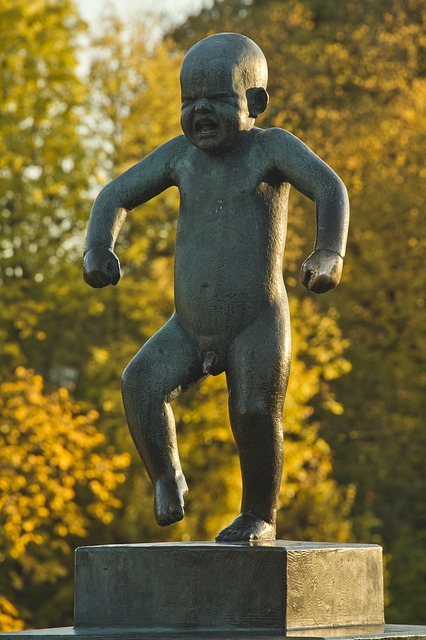
Like a child demanding attention, depression is a temper tantrum of the soul. It’s a test of your balls. It’s a doubter, the take-away closer who says, “Maybe this isn’t for you.” It’s a push at your boundaries of tolerance, demanding a greater integration of your parts. It’s nature calling you, provocatively wondering if you have what it takes to stand up for yourself and declare, “THE PAIN STOPS HERE.”

Like confidence, depression can be lifted from one big change or a series of small things which add up to a retooling of your model of the world. Sometimes changing jobs, moving to a new city, or leaving or gaining a relationship allows the light of change to shine in. But that’s rarely enough.

At other times, these are temporary because the internal operating model is what really needed attention. In my case I realized I was compromising my life and whatever gifts I have to satisfy responsibilities to others. Realizing, I do this as a tendency, having done it most of my life. And of course, I could source this to an abandonment fear as a child, to a deep toxic shame inculcated in my early years as broken and not good enough.

This gift meant my method was to become more, so as to convince myself and others around me I was worthwhile. This nice guy strategy works… until it no longer does. I needed to change jobs and set limits, imposing boundaries to keep my sanity, so I did.

Knowing all this, feeling the pain as a signal for change, what’s one tiny step you could take? Just one thing in what you think or what you do. Rome wasn’t built in a day. Our expectations drive all of our disappointments. Change one thing, then another. Soon you will have a direction. You will know if it’s right for you because your body will tell you. Our eyes see out but somehow you will see the fog within begin to lift.

When the way in which we see ourselves measured up against how we believe others see us is lived consistently, we go confidently into the night. We are ready to meet challenges, putting order to chaos, best expressing the gifts given to us by life. Self-concept is destiny.

So ask yourself: what shall I do with my metamorphosis?

What kind of butterfly will emerge when you are done?

This is your act of creation.

Stay powerful,

Christopher K Wallace
©2018 all rights reserved
advisortomen@gmail.com


TOUGH LOVE

Tough Love

I was drying out in the Civic Hospital. It was back in the early 1980s during the AIDS scare, but long before the discovery of Hepatitis C in 1989. I was in an isolation room as a precaution. So much was unknown then.

My liver markers were all off: leucocytes, reticular counts, liver function tests and bilirubin. I was also quite jaundiced and tired. Things were catching up with me.

Lying alone in my single room in the middle of the day, I was surprised when Ma popped in unannounced. I hadn’t seen her for a while so it was a mystery as to how she knew I was there.

She was her usual kind and accepting self, offering encouraging words and faithful support. But I noticed she was rushed, her answers short, a tension just under the surface of her demeanour that I couldn’t quite grasp and put a reason to.

After a few minutes, she told me to take care and that she was leaving, mentioning my father was outside waiting to see me. Of course, she didn’t give me enough time to ask why he hadn’t come in. She said goodbye and hurried out of the room.

As my gaze followed her out, she swung open the heavy door with its tiny porthole window common to the isolation ward. There I could see my father in rumpled suit jacket and tie, purposefully pacing back and forth in the hallway. Before I could say anything, she was gone and in he came.

I tried to say hello but he cut me off. Coming closer, he spoke with just a hint of some ill-defined emotion, the kind you might see when you can’t tell if the person is hurt or angry. He said something like this to me: “Christopher, if you keep living the way you are, surely, you are going to die…and soon. When you do, we will gather together as a family and mourn your passing. It will be our last goodbye. Afterwards, we will bury you and then… we’ll forget you.”

With that, he turned and walked out.

Admittedly, he’d caught me off guard. I was stunned. I was in a hospital after all. What a jerk, I thought. As the door closed behind him, the pressure in me rose. I railed internally with questions, invectives; the cussing in my mind going off like fireworks.

He had left right away, so it wasn’t like I could argue with him, making it even more frustrating. How absolutely unfair of him, I decried to myself.

Outraged, in my mind’s eye I saw myself in my hospital nightgown, following him down the hallway, demanding, what exactly did he mean by that whole “forget you” bit? And who was HE to be speaking for all of MY brothers and sisters? There are eight of them; had he done a poll? Was this all based on their consensus? I wanted to call them and check for myself.

The scene revolved continuously through my mind as I lay there on my bed, him long gone. I must have stayed steaming for quite a while, fuming to myself over the images. Mumbling at times out loud that it was none of his business, damn it, how I chose to live my life. This was my problem, not anyone else’s.

But in time, I calmed down. I couldn’t stay agitated forever. Eventually, my anger subsided enough to return to a kind of normal. My breathing slowed, my thinking became more introspective. The scene was still fresh in my mind. I kept going over its details: the way he’d left me there by myself; the harshness of his judgment and the finality of its imagery. Suddenly, I felt alone, very alone… and saddened by it all.

I thought about my sisters and brothers. Childhood images flashed by, with them as freckle-faced kids on adventures we’d shared. I was so hurt; I felt a clear and justified self-pity. It was cruel to come into someone’s hospital room—a real medical patient with real medical issues—and say stupid stuff. Anyone would sympathize with how wrong it was.

I felt sad, lonely, and sorry for myself, resigned even. It was all so depressing. As if I didn’t have enough problems.

The more I thought about it, I remembered the way my mother acted during her short visit. She was clearly preoccupied. She had gone through the motions of visiting, but betrayed a hidden agenda. It was then I realized my mother had been in on it from the start. It was a damn set up!

The nerve of her to come in here with her “sweet as a lamb” approach and then help him pull off this kind of bullshit. She was a wolf in sheep’s clothing, that’s what she was!

Now I was mad again.

I could just imagine the two of them concocting their approach for maximum effect before arriving. “He’s in isolation?” he would have asked. She would have replied, “Yes, that’s what the others are telling me. Here’s the room number.”

Dad would have given marching orders: “You go in first; I’ll wait in the hallway. Don’t stay too long. I don’t want you making him feel any better.” She would have assented — like the devoted wife she was.

What a supreme jerk, I thought, envisioning how the whole scene played out in the car on the way over. The gig was up; I was on to them. That’s it, no more Mr. Nice Guy from me. They’re cut off!

After a while, having made that decision, I calmed down. My mind slowed its racing thoughts. My indignity had peaked and ebbed, like a tide of tension leaving shore for sea.

I felt alone again. Now, I was down. I felt it in my body, tired, sorry and sympathetic. It was sad, you see.

I imagined myself at a funeral, my own, watching all of my siblings mourn as they got ready to bury me. I could see my sisters crying in pain like they had when I’d been punished as a child — or like the time my father tossed me out of the house at age 15. I regretted I wouldn’t see them again, that I would have caused them pain. I was hurt, not for myself, but valiantly I thought, only for them.

That’s when I realized it was my father who was causing this anguish to befall my siblings. It was he who was making them turn their backs on me and to literally leave me in the dirt. It was he who was demanding once again the ultimate ostracism of one of his family members. Once more… what a jerk!

Now I was mad again.

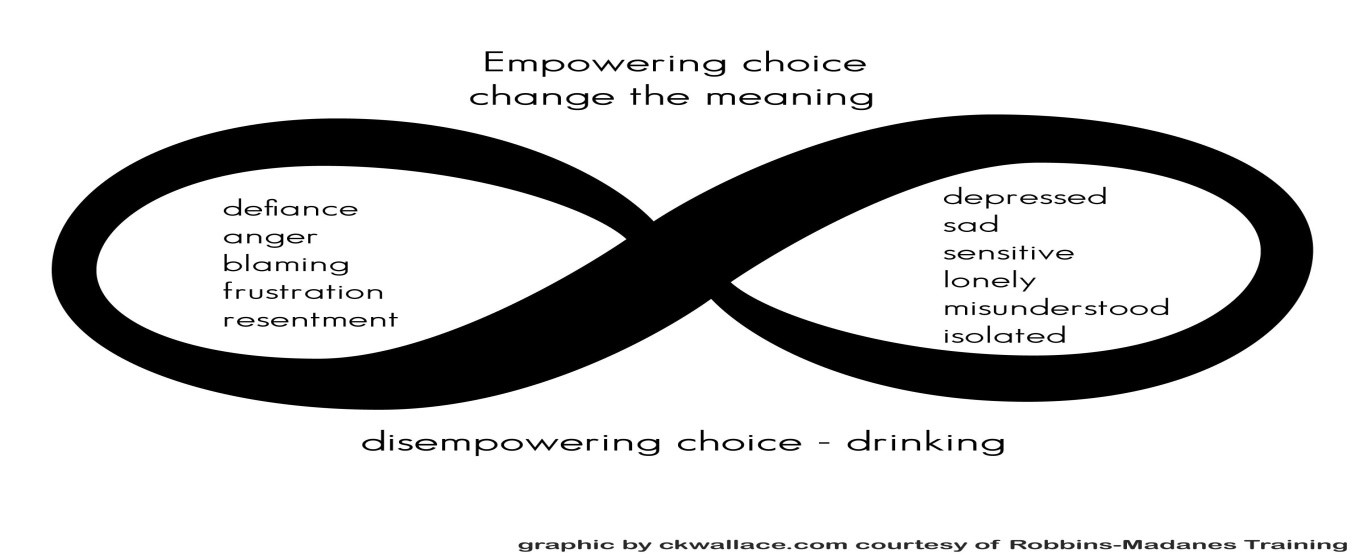
The infinity loop

To be honest, I swung from one side of those emotions to the other for a long time after the incident at the hospital. I had no idea why; I guess I couldn’t see the forest for the trees. I lacked the resources to give me a deeper understanding of my father’s intentions. Neither could I see the basis of how I was reacting to his attempt at tough love; as an effort to shock me into seeing my life as it was.

If I tell you a good joke, you will hopefully laugh. After a minute or two, you will stop laughing as your brain normalizes whatever incongruence made you see the funny.

If you watch a sad movie, you may be so moved by its story and characters that you weep. Once your tears are discharged as pent up tension, your body will adjust, return to some kind of equilibrium and crying will stop.

This is the familiar homeostasis at work on your emotions, returning them to a balanced state. Laughing at a joke or crying over a sad scene in a movie are times where we suspend our own personal disbelief to get the full emotion—laughter or tears—of a situation. In our personal lives, it’s less easily managed simply because we have more at stake: our sense of self.

So picture an infinity sign with two opposites of emotion on each of its ends: frustration, blaming, anger, etc., on one side; sadness, self-pity, depression, etc., on the other.

Something happens to trigger us emotionally. Start anywhere in the loop; it depends on the person.

Let say at first we become frustrated, angry, blaming or even fall into a rage. You can’t remain that way forever so in time we return along the eight towards our feelings centre—our internal balance.

However, since whatever triggered us wasn’t resolved, the pain remains… and staying in the centre is temporary. Instead, we might continue on to the other side of the loop, moving from frustration, blaming and anger to experiencing sadness, self-pity, depression, etc.  In turn, we can’t remain like that forever either. So at some point we return towards emotional neutral.

But again, since we weren’t able to resolve whatever it was that got us so upset, we think about it until we are angry again. This can go on for days, weeks, years even, where the cycle repeats over and over to exhaustion. Tony Robbins calls it the crazy 8.

It creates a tension inside us that craves relief, often an escape by whatever means necessary. Some go and get drunk; a way many choose to deal with emotionally charged events when lacking resources to respond in a more empowering way.

But it’s a never-ending loop, darn it. That’s why the infinity symbol is so appropriate: it goes on forever. The trick is to escape the infinity loop at the top, as opposed to exiting out the bottom. Taking the high road is the perfect metaphor, and it starts first with our own re-adjustment of the meaning we give things.

None of us is immune to the emotional swings of the Infinity Loop: attachment, fear, our expectations, shame and guilt, all of these conspire to put us under their emotional control. Where we differ is in how fast we can extricate ourselves from its cycle. That takes courage, honesty, acceptance, a fair bit of humility and forgiveness even; and often it takes space.

It’s all in the meaning

It took time, a few more years in fact, but eventually I resolved things in a way that gave me a deeper appreciation for what the old naval officer had been trying to do.

I realized it was my lifestyle that was causing others pain; but more importantly, I had no right to do that to people who loved me. Up to then, I might have thought it didn’t matter because I couldn’t acknowledge anyone cared. I had such a low opinion of myself that in my shame, I felt I had rights to self-pity, anger, and the dysfunctional life I lived. Perhaps I could let my guard down and see things by the light of a different day.

That minor shift allowed me to reconstruct the episode with more insight; in a way that to my mind gave us both back our dignity. I assigned new meaning to the hospital episode with my father based on a more profound perception of his intentions.

He wasn’t there to hurt me; he was there to protect himself and the others from the hurt I was causing by living so closely to destruction and death. It wasn’t malicious at all. In his clumsy way, it was an act of caring for his family. By extension, it was a desperate attempt to care for me too.

In the ensuing years after the hospital visit, I kept thinking of the old man and the way his lip quivered as he struggled to get the words out quickly so as to not lose the power of what he had to say. I’d overlooked the impact of that image in the aftermath of my reaction. But it was there; embedded in my subconscious as tiny flashes of recall, unavoidably part of the scene. All I had to do was focus on it.

He was in my hospital room, a deeply faulted man but still a naval commander and patriarch to a family of nine children—five of them grown sons—trying his best to be tough when it was obvious by the look on his face his heart was breaking. That’s the image’s meaning that has stayed with me.

His love wasn’t so tough; it was just plain love.

Stay Powerful,

Christopher K Wallace
©2015 all rights reserved

https://advisortomen.com/board-of-directors/
https://www.facebook.com/groups/advisortomen

MAN OVEREATING


We are coming up on the holidays, when many will get a chance to reconnect with families and friends. Maybe you’ll take a short vacation, either as a break from the cold of winter or to enjoy winter itself. It’s also a time when some of us tend to pack on a few extra pounds.

Today, I want to talk about overeating. I’ll share my food pep-talk, the one I give myself.

I’m inspired by those before and after pictures where people transform their bodies from obese to healthy. I’ve never been big, but I admire those folks, perhaps telling myself, “There but for the grace of God go I.”

Now at about 5 feet 9 inches (and shrinking) and never over two hundred pounds, I bounce between 170 and 180 depending on my exercise regimen and especially, my diet.  My jeans are the measure of how I’m doing. Tight pants on my belly pisses me off just enough to get me to do something about it. The mirror is more feedback, especially looking at my profile. I guess I’m still vain enough for it to have some effect. I don’t want to lose that.


The Deal

I’ve struggled enough with diet over the years to sympathize with those who tend to binge on foods—usually ones not particularly good for them. Fact is, once we learn to overeat, or especially to binge on sweets and high calorie carbs, food is no different than alcohol and drugs.

What else would we call it but an addiction? I say it’s similar in more ways than not. Like smoking, drinking, drug use, porn or gambling, we engage a series of biological, behavioural and cognitive processes to support our actions.

That men drink, and women eat is supported by science. Again, there are plenty of women with booze problems and plenty of us guys with food addictions, so this is only helpful in a very general way.

I’m not suggesting any man who overeats tell himself he’s eating like a woman; nor am I suggesting to the overeating woman she should drink instead. Not at all.

What was confirmed recently is the right side of the vagus nerve, the 10th cranial nerve which connects our stomach to the brain, fires dopamine receptors in the brain stem when we eat foods we like. Umami, or savory, is one of the five basic tastes along with sweetness, sourness, bitterness and saltiness. These form the basis of pleasurable eating.

Normal people stop eating when they feel full. Regular folks can eat one cookie and pass on extras. Dieters, on the other hand, learn to ignore the body’s signals about satisfaction, and continue beyond what the body requires and, more importantly, beyond their own rules about eating.

That’s the same with people who wind up addicted to drugs and alcohol. We adapt to the hangovers, the paranoia, the sickness and mood instability, ignoring basic homeostatic imbalance in favour of continued use.

I had to work hard at becoming a junkie, a booze-hound, a pill-popper, and a dope-smoker. I can assure you none of which are experienced as “all butterflies and rainbows.” And that’s just the physical effects, never mind the mental excuses I used to support my habits.

Dieters, just like alcohol and drug users, use rationalizing powers to continue to eat when we know we shouldn’t. If I’ve been good, following my diet and exercise regimen, and then fall off-plan, I should stop when I realize it.

Mostly likely though, I might eat that extra row or two of cookies instead. The reason I do this is because I write it off. I tell myself: “I’ll get back on the program tomorrow.” Sound familiar?

How is that different from a relapsing drinker? The guy who says, “I’ll get straight, just not today; it’s one day at a time right?”

Learning to Ride
Let me ask you something: when was the last time you rode a bicycle?

Now, let’s imagine you had not ridden a bicycle for many years, maybe five or ten or even twenty years. Could you get on a bike today and ride it? Of course, most likely you could. You never forget it.

It’s in the nature of that kind of learning, at the pons and striatum parts of the brain. There’s both a physical and mental component to riding a bike. In fact, it engages the whole chain of being: physical, emotional state, feelings, thoughts and actions. It uses the special powers of focus and language to effect competence on two wheels.


I watched my daughter learn to ride a bike in my backyard two years ago. I saw her starts and stops, the glimpses of success against the feedback of her failures, her crashes and her frustrations. Her self-talk went from negative to cautiously positive as she kept at it. She can ride no-hands now. It’s automatic for her. My boy is five, in spring, off go the training-wheels and he’ll do the same. Neither will ever forget how once learned.

That’s what happens when we learn to eat and overeat. All behavior is supported by antecedents and consequences. Triggers and rewards. Food is no different.

When we’ve been there before it’s much easier to do it again. It’s why the relapsing drug or alcohol user quickly returns to the same level of use. If I was a ten-beer-a-day drinker, within a week or two of relapse I’m right back at the same level of drinking. If I always smoked a bowl first thing in the morning, a few days into cannabis use and I’m all about the wake-and-bake. If I had a half-gram-a-day heroin habit, with access I’m back there in a couple of weeks (if not dead). Food is no different. Dieters can eat too much like we can all ride a bike. We’re good at it.

In fact, it’s a critical exercise in self-care to realize and take note of what triggers our overeating, just as it’s worth having a heart to heart self-talk about what needs we are really meeting. Antecedents and consequences.

The Crux and The Cost
Here’s the thing: at the crux of all addiction is a search to narrow thinking. It’s a way to take many thoughts and turn them into fewer thoughts. It doesn’t much matter if someone uses porn, food, gambling, or the usual mood-altering drugs of alcohol, cannabis, cocaine or heroin, or even pharmaceuticals. Narrowing of thinking is the goal.

Guy goes to the bar on Friday and has all the week’s worries on his mind: bills, missus, bosses, clients, children sometimes, parents, taxes, rents, car repairs, etc. Has 2-3 beers and all he’s thinking about is pizza and pussy. Or sports.

That’s narrowing of thinking.

The drug and alcohol user will hijack the HPA (hypothalamic-pituitary-adrenal—fight or flight) system to put themselves into a mild (or greater) fear state to narrow thinking, to quell the stress of life and escape the self.

It’s using stress to fight stress. And it works… until it doesn’t.

Food does it too. While food doesn’t trigger the body’s HPA system the way mood altering chemicals do, it has similar cognitive influences. Here’s why:

Ask yourself what goes on in your mind when you’re overeating? If you’re like me, it’s often something like, “I really shouldn’t eat this.” That’s accompanied by a kind of guilty pleasure where I’m torn between the good food or treat and the image I have of myself as a sane and capable adult who can manage diet. The for and against self-talk going on hijacks my thinking to the point of escape.

As you may know, cognitive dissonance occurs when we behave in a way that is inconsistent with self-image. But here’s the screwed-up part: we tend to take the path of least resistance when this happens. Instead of learning and shoring up our approach, we tend to give in.

If I see myself as an honest man and find myself bullshitting people, the right thing to do is to admit my exaggerations and course correct. If I don’t, what I’ve done is accepted a lesser version of myself. I end up altering my self-concept.

Self-concept is how I see myself up against how I believe others see me. It’s also destiny. One of the biggest factors in all addiction is self-concept and how we give into dissonance, thereby accepting a lesser version of ourselves in the process.

Suddenly we see ourselves as a righteous junkie. Rationalizing alcohol use by saying “it’s legal right? Don’t you live longer drinking a glass of wine every day?” as you finish the last glass and toss your empty bottle into the recycling. We might see ourselves as “pleasantly plump” or better, “I need a bit extra to fend off the cold,’ something we can use up here in Canada. It’s all bullshit, and we might call it as it is and look for a deeper answer.

Because when I say to myself, “I really shouldn’t eat this” what I’m doing is not thinking about all the other bullshit in my life, while getting a mild dopamine hit at the same time.

And all that guilt is painful, the to and fro of my thoughts and craving just helps me narrow my thinking even more. I stuff what my body is telling me, my sense of fullness, the cavity activated by sugar in my mouth, the rules I had about diet. In some twisted way, this is the peace I seek from my existence.

Until the only way I can deal with the dissonance over time is to change my self-concept. The problem is accepting  my lesser self, allowing it to rise instead of the person I want and choose to be. That’s a bigger cost later.

First thing about all this is to realize the whole overeating bit as an obvious quelling of overthinking. And if those thoughts are predominantly stress producing, more reason to try and quiet or change them.  In this sense, it’s a quest for control. So, I now ask myself, “what am I escaping from?”

It also means your body (and mind) is working properly–it’s seeking to alleviate your suffering somehow. That’s a good thing but it’s just the tendency—overeating or going off-diet—is the wrong choice being made in response to stress. With awareness, you and I can do better.


The Gift

Think of a time when you were at your happiest doing something. All of us have periods where we engage in an activity which we found interesting enough to be pleasurable yet had enough complexity to be challenging and keep our attention. This made us focus to a high degree. Concentrating while learning to ride the bike may have been like that for you. Or perhaps it was something else.

You may recognize this description as something akin to a “zone” or “flow.” When there is a confluence of passion, talent and focus, with enough complexity to keep us engaged, you can enter a state which literally seems to stop time.

Think of moments in your life when you remarked, “where the heck did the time go?” You have been in this zone. All of us have. It can come from any endeavor which is challenging enough and requires a degree of competence making it pleasurable, forcing us to concentrate at a high level.

I suggest this is the perfect expression of our existence under the sun. It is then we are in harmony with our surroundings, where we feel like we are earning our right to life. We seek to return there in our everyday moments to alleviate our existential angst, because it stops time. In the zone, we don’t feel aging, while still moving ahead. It’s powerful magic. I’m suggesting this is the real drug you seek.

The first time we are aware of having hit a zone we are astonished at its power. Perhaps there’s a part of us which seeks to deny this manifestation of living lest we find ourselves unworthy. And isn’t it always that in part? Isn’t it always that we think somehow we won’t measure up, that we won’t be good enough and because of this, we won’t be loved?

It’s the human need to belong again, clouding judgement and creating just enough fear to keep us humble. The question is not whether I should eat that box of donuts; it’s whether I will celebrate my existence?

Though, what have we got to be humble about? After all, of the 40 to 200 million sperm vying for the egg which began your life, it was you who made it to the finish line. Not some other contender, perhaps of a different chromosome mix. I could have been a girl, and if you’re a girl, you could have been a boy. You were chosen as is.

Who are we to question the wisdom of the universe? It’s easy to remember: the Andromeda Galaxy has a trillion stars. A trillion my friend. Whatever same force created THAT created YOU. This is infinite wisdom.

So, my suggestion is to ask yourself just before you feel like eating blindly or compulsively, before you feed the inner pig (which exists in us all) that you pose the question I ask myself: “How else can I narrow my thinking (in a way that honours the life I’ve been given)?”

For whatever your mix of talents and passions, you are unique, a chosen soul for good reason. It’s not just about satisfying needs and alleviating fears or decreasing stress and being comfortable.  It’s what you owe. Yes, indeed.

It’s what you owe for winning the greatest prize of all: a life.

Stay powerful.

CKWallace
Advisor to Men
©2018 all rights reserved

Join our weekly men’s group:
https://advisortomen.com/board-of-directors/
Join our facebook group:
https://www.facebook.com/groups/advisortomen